


In a groundbreaking study that unravels the complexities of nanoscale materials, researchers from Binghamton University, alongside collaborators from prestigious institutions such as Argonne National Laboratory, Harvard University, Princeton University, and Penn State University, have significantly advanced our understanding of elasticity at the nanoscale. This pioneering work not only validates long-held theoretical models but also lays the groundwork for future applications in microelectronics and nanotechnology, effectively challenging pre-existing notions about materials as we know them.
The essence of the research revolves around the behaviors exhibited by materials when they are crafted at extraordinary thinness, specifically at the nanometer scale, measuring just a fraction of human hair’s diameter. This study highlights how even minimal thermal energy—akin to what is present at room temperature—can induce structural ripples in these fragile materials. Understanding the implications of these ripples is crucial, as they can dramatically influence the mechanical properties and performance of materials in practical applications.
At the core of the findings is the idea that the elasticity of materials is not a fixed trait. Instead, it is scale-dependent, meaning that the mechanical properties of a given material can vary widely depending on its dimensions. This revelation provides a fresh perspective on how scientists and engineers approach material design, particularly when it comes to developing innovative technologies that rely on nanoscale structures.
One of the standout features of the research team’s methodology was their use of semiconductor manufacturing techniques to fabricate alumina structures that were just 28 nanometers thick. These thin materials were strategically designed to harbor thermal-like static ripples, which the researchers meticulously examined using laser testing techniques that allowed them to measure the ripple effects with unprecedented precision. The innovative use of cantilevers to support the substrates during testing minimized potential stresses that could skew the results, contributing to the integrity of the findings.
The results not only confirmed theoretical predictions made by eminent physicists, notably Harvard’s Professor David R. Nelson, but also unveiled new pathways for understanding and manipulating the mechanical behaviors of thin films. The ripples observed in the materials constitute a previously unexplored dimension of structural mechanics, suggesting that there is much more to learn about how materials interact with external forces at such small scales.
These discoveries open significant avenues for the engineered design of microelectronics and micromechanical devices. As the demand for more sophisticated technology in fields ranging from computing to medicine continues to grow, the ability to manipulate materials at the nanoscale will prove vital. The potential applications are vast, encompassing innovative solutions in robotics, where precise geometrical control can lead to the development of responsive and adaptive systems, akin to the transformative concepts presented in popular science fiction.
The research is especially significant considering the rising interest in nanomaterials, which are increasingly integral to various technological advancements, including flexible electronics and advanced sensors. As industries pivot towards more sustainable practices, harnessing the knowledge gained from this study could lead to the creation of devices that are not only high-performing but also resource-efficient.
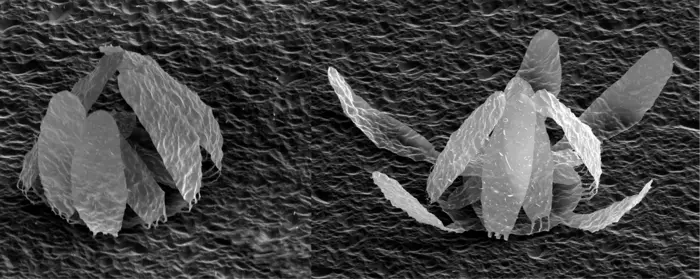
In an insightful twist, the researchers humorously applied their findings in a creative manner, shaping their materials into nanoscopic flowers. This unconventional use of a scientific discovery showcases the potential for artistic expression within the realm of engineering and material science, demonstrating that innovation often occurs at the intersections of various disciplines.
Professor Jian Zhou, who spearheaded this research at Binghamton University, encapsulated the excitement of this work by stating that a deeper understanding of mechanical properties will empower future advancements in micro-robotics. He envisions a future where design processes can incorporate real-time controlled transformations in material shapes, a feature that mimics the fantastical shifting capabilities of a Transformer, thus enriching the landscape of future technology.
The collaborative nature of this study also emphasizes the importance of interdisciplinary research in physics and engineering, as it seeks to merge theoretical foundations with practical applications. This merging of disciplines will be essential in driving forward innovations that can address pressing global challenges, particularly in sustainable technologies and human health.
In conclusion, while the research focused on tiny building blocks of materials, the implications of these findings extend far beyond the nanoscale. As scientists and engineers continue to explore the intricacies of advanced materials, we stand on the cusp of a new wave of innovation that promises to redefine our interactions with technology. The study serves as a timely reminder that at the nanoscale, extraordinary possibilities await when scientific curiosity meets meticulous experimentation.
Keywords
Nanomaterials, Elastic deformation, Thermal energy, Room temperature, Mechanical systems, Semiconductors, Metamaterials
Cite Scienmag News
Denise Maddox. (April 10, 2025). Exploring the Impact of Nanoscopic Ripples on Material Properties: Insights from New Research. Scienmag. https://scienmag.com/exploring-the-impact-of-nanoscopic-ripples-on-material-properties-insights-from-new-research/
Denise Maddox. "Exploring the Impact of Nanoscopic Ripples on Material Properties: Insights from New Research." Scienmag, 10 April 2025, https://scienmag.com/exploring-the-impact-of-nanoscopic-ripples-on-material-properties-insights-from-new-research/. Accessed 10 September 2026.
Denise Maddox. "Exploring the Impact of Nanoscopic Ripples on Material Properties: Insights from New Research." Scienmag. April 10, 2025. https://scienmag.com/exploring-the-impact-of-nanoscopic-ripples-on-material-properties-insights-from-new-research/


