

In a groundbreaking advancement for Roman-period archaeology within the Hesse region, a substantial research initiative has been funded to thoroughly analyze a recently unearthed Roman sanctuary at the ancient site of Nida, located in Frankfurt-Heddernheim. This research project, supported by a combined grant exceeding €1 million from the German Research Foundation (DFG) and the Swiss National Science Foundation (SNF), promises to transform our understanding of religious practice and urban complexity in Roman Germania. Over the course of three years, interdisciplinary teams will delve into one of the most important archaeological discoveries of the past decade, applying advanced methodologies to unlock the secrets hidden within this ancient cult district.
The project, entitled “Exploring the Dynamics of a Roman Sanctuary – Interdisciplinary Studies on Spatial Organisation and Depositions at the Central Sanctuary in Nida-Heddernheim,” reflects an impressive collaboration between major academic institutions and local heritage agencies. Key participants hail from the Archaeological Museum Frankfurt and the Institute for Archaeological Sciences at Goethe University Frankfurt, alongside the Institute for Integrative Prehistoric and Scientific Archaeology at the University of Basel. These institutions unite classical archaeology, archaeobotany, history, and scientific archaeology approaches, ensuring a comprehensive study of the site’s complex stratigraphy, architectural remains, and material culture. The Frankfurt City Monument Office and the Roman-Germanic Commission of the German Archaeological Institute also play pivotal roles, highlighting the project’s extensive institutional network.
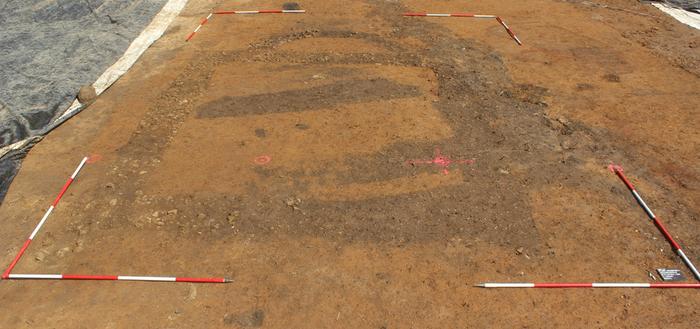
The sanctuary’s discovery arose unexpectedly amid urban development pressures during the construction of the Römerstadtschule school in Frankfurt’s Nordweststadt district. Extensive excavation efforts from 2016 to 2018, followed by renewed investigations in 2022, exposed a vast 4,500-square-meter area at the heart of the Roman urban landscape. Archaeologists uncovered a walled complex containing eleven stone buildings, meticulous documentation revealing these structures were erected in multiple construction phases. The preservation of the architectural features and associated deposits is exceptional, with minimal post-Roman disruption, allowing an unprecedented glimpse into Roman ritual architecture adapted to this provincial setting.
One of the most striking aspects of the site is the presence of nearly 70 shafts and ten pits, which appear to have been systematically utilized for (ritual) depositions. These shafts contain copious quantities of organic remains—including fish and birds—as well as ceramic vessels, which researchers interpret as remnants of votive offerings and ritual feasts. The architectural layouts deviate significantly from known sanctuary plans in other Roman provinces, suggesting regionally distinctive religious developments or local reinterpretations of Roman cult practices. More than 5,000 fragments of painted wall plaster found onsite, along with bronze door and window fittings, indicate that the buildings were not merely functional but elaborately adorned, reflecting the sanctity and importance attributed to the complex.
Among the significant archaeological finds are more than 250 Roman coins and upwards of 70 garment clasps, or fibulae, made of silver and bronze, some remarkably intact. These objects are frequently associated with votive offerings in Roman religious settings and play a central role in reconstructing the nature of sacrifices and ritual customs practiced at Nida. The scarcity yet exceptional nature of possible human sacrifice evidence sets this sanctuary apart, warranting further scientific scrutiny to comprehend its social and religious implications fully. Despite rich artifacts, the precise identification of the deities worshipped remains ambiguous, though inscriptions and iconography reference a pantheon that includes Jupiter, Jupiter Dolichenus, Mercurius Alatheus, Diana, Apollo, and Epona, illustrating the syncretic and locally varied nature of Roman religion.
The sanctuary’s chronological framework places its foundation in the early 2nd century CE, with renewed activity until at least the mid-3rd century, as attested by a dedicatory inscription from 246 CE honoring Mercurius Alatheus. This timeframe situates Nida as a vibrant religious center during a period of economic prosperity and cultural pluralism in the Roman frontier provinces. Founded initially as a military base in the 70s CE, Nida evolved into the political, economic, and cultural hub of the Limes region, maintaining regional prominence until its abandonment circa 275-280 CE amid broader imperial turbulence and frontier reorganization.
The interdisciplinary research initiative leverages cutting-edge techniques ranging from archaeozoological and archaeobotanical analyses to advanced spatial and material culture studies, facilitating a holistic reconstruction of cultic practices at Nida. Hundreds of samples were meticulously taken to examine animal and plant remains, which reveal detailed aspects of ritual meals and offerings. This scientific investigation allows scholars to contextualize the sanctuary within the broad cultural landscapes of the Roman northwest provinces, elucidating the complex religious behaviors and interactions between Roman and indigenous traditions.
Beyond its scholarly merits, this research project underscores the fruitful interface between urban development and archaeological discovery in Frankfurt. The excavation site, uncovered amid modern construction, exemplifies how infrastructural growth can catalyze groundbreaking scientific insight when combined with committed heritage management. City officials have lauded the discovery’s importance, emphasizing Frankfurt’s role as a nexus of international archaeological research and heritage culture. The coordinated efforts between city planners, academics, and conservationists serve as a model for integrating ancient history within contemporary urban life.
This renewed focus on Nida follows closely on the heels of significant discoveries such as the Frankfurt Silver Inscription—the earliest confirmed Christian textual evidence north of the Alps—heightening the Roman city’s prominence as a site of ongoing historical revelations. The comprehensive study of Nida’s religious precincts offers new pathways for understanding Roman religious diversity, ritual practice, and urban identity formation in frontier regions. Scholars are optimistic that uncovering these intricacies will refine established narratives about Roman provincial life and contribute to broader discussions on religious syncretism and cultural interaction in antiquity.
Ultimately, this project envisions involving five young researchers across various academic stages, fostering the next generation of experts in Roman archaeology and interdisciplinary heritage science. Their work will contribute to the vibrant intellectual ecosystem around the Roman Limes, transforming raw archaeological data into narratives that illuminate ancient religious life and social organization. The integration of modern scientific methodologies with traditional archaeological approaches embodies the project’s innovative spirit and commitment to redefining regional archaeological research.
As fieldwork and laboratory analyses continue, the findings emanating from Nida will invariably enrich global understandings of the Roman Empire’s northern provinces. This endeavor exemplifies how local archaeological treasures, when examined with contemporary techniques and interdisciplinary collaboration, can return profound insights into the complexities of ancient urban and religious phenomena. The project’s success sets a benchmark for similar explorations into sanctuaries across the empire and highlights the enduring relevance of Roman heritage within Europe’s historical consciousness.
Subject of Research: Roman sanctuary, archaeological site, ritual practices in ancient Nida (Frankfurt-Heddernheim)
Article Title: Interdisciplinary Exploration of a Roman Sanctuary Unveils Religious Complexity in Ancient Nida
News Publication Date: Not specified
Web References: https://www.eurekalert.org/multimedia/1112218
References: Not provided
Image Credits: Photo: Frankfurt City Monument Office
Keywords: Archaeological sites, Historical archaeology, Archaeological periods, Material culture


