


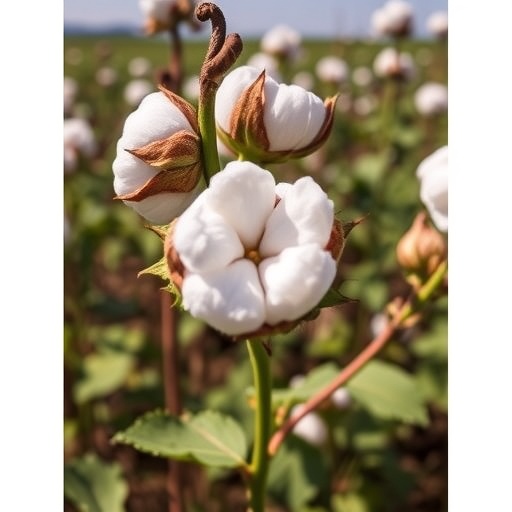
The cotton plant, an essential agricultural crop, has long been under the lens of genetic research due to its economic significance and adaptability. A groundbreaking study led by Wei et al. aims to shed light on the GT92 gene family, a group of genes that, until now, had not been fully characterized. This research marks a significant leap forward in understanding the genetic mechanisms behind cotton’s resilience and productivity, promising to unlock new avenues in crop improvement.
At the heart of this research lies the genome-wide ascertainment of the GT92 gene family. The researchers employed advanced genomic techniques, which involved sequencing the cotton genome and identifying the various members of the GT92 family. This family of genes is believed to play a crucial role in various biological functions within the plant, yet their specific roles had remained largely ambiguous.
The methodology utilized by Wei et al. combined both computational and experimental approaches. The researchers engaged in extensive bioinformatics analyses to discern gene locations within the cotton genome. This involved using state-of-the-art algorithms to predict gene functions based on sequence homology to better-studied plant species. Such strategies are vital for annotating gene functions, especially in crops like cotton, where functional genomic data is still sparse.
The initial functional characterization of the GT92 gene family unveiled intriguing insights into the roles these genes may play in cotton development. Wei et al. conducted a series of expression analyses, observing how these genes are activated under various environmental conditions. Their findings suggest that members of the GT92 family exhibit differential expression patterns during key growth stages, emphasizing their potential importance in cotton physiology and resilience.
Through rigorous experimentation, the research team subjected cotton plants to various stress conditions. The results were enlightening: certain GT92 genes responded significantly to drought and salinity stress, indicating their potential roles as stress-responsive factors. This discovery is particularly crucial, given the increasing challenges that climate change poses to agriculture, including cotton production.
The study further explored the expression pattern dissection of the GT92 gene family. By employing quantitative PCR techniques, the researchers quantified the expression levels of selected GT92 genes across different tissues in the cotton plant. The data revealed tissue-specific expression patterns, with significant expression in the roots, leaves, and flowers. This specificity hints at the multifaceted roles these genes may play in regulating cotton’s growth and development.
In addition to their functional characterization, the research delved into the evolutionary history of the GT92 gene family. By comparing the sequences of GT92 genes across various plant species, the researchers were able to reconstruct a phylogenetic tree. This analysis provided valuable insights into how these genes evolved and diversified, reflecting the adaptability of cotton as a crop throughout its domestication history.
The implications of this research extend beyond basic scientific knowledge. Understanding the GT92 gene family opens doors to potential biotechnological applications, especially in the realm of genetic engineering. With precise genetic manipulation, scientists could introduce or enhance desirable traits in cotton, such as drought tolerance or disease resistance. This could revolutionize cotton farming practices, leading to increased yields and sustainability in production.
The study also emphasizes the importance of interdisciplinary approaches in modern agriculture research. By integrating genomics, bioinformatics, and plant physiology, the authors demonstrate how collaborative efforts can lead to significant breakthroughs. As agriculture faces mounting pressures from environmental changes, such comprehensive research is imperative to develop resilient crop varieties.
Moreover, this investigation contributes to the larger field of plant genomics by providing a model for other crops facing similar challenges. The methodologies and findings related to the GT92 gene family in cotton have the potential to be applied to a broader range of agricultural species, fostering advancements in global food security.
As the study sets a new foundation for future explorations, the researchers highlight the need for continued investigation into the functional roles of identified genes. Further research could involve gene editing technologies, such as CRISPR-Cas9, to dissect gene function more deeply, as well as breeding programs that incorporate genomic data to prioritize desirable traits.
In summary, the work by Wei et al. represents a pivotal moment in cotton genetics, with the GT92 gene family’s elucidation promising to have wide-ranging effects on crop improvement and agricultural resilience. By harnessing the power of genomics, this research pushes the boundaries of our understanding and application of plant genetics for the future of agriculture.
As the findings begin to circulate within the scientific community and agricultural sectors, the anticipation for practical implementations grows. This could lead to transformative changes in how cotton is cultivated worldwide, ensuring that this critical crop meets the demands of a growing population while adapting to the challenges of climate change.
With the release of this research, the future of cotton farming appears more hopeful than ever. The advancements in understanding the GT92 gene family not only enrich scientific discourse but also inspire agricultural innovation towards a sustainable future.
Wei, X., Jiao, Y., Zheng, Z. et al. Genome-wide ascertainment and initial functional characterization and expression pattern dissection of the GT92 gene family in cotton.
BMC Genomics 26, 902 (2025). https://doi.org/10.1186/s12864-025-12034-6
Cite Scienmag News
Juliet Wilcox. (October 11, 2025). Exploring the GT92 Gene Family in Cotton. Scienmag. https://scienmag.com/exploring-the-gt92-gene-family-in-cotton/
Juliet Wilcox. "Exploring the GT92 Gene Family in Cotton." Scienmag, 11 October 2025, https://scienmag.com/exploring-the-gt92-gene-family-in-cotton/. Accessed 6 September 2026.
Juliet Wilcox. "Exploring the GT92 Gene Family in Cotton." Scienmag. October 11, 2025. https://scienmag.com/exploring-the-gt92-gene-family-in-cotton/


