

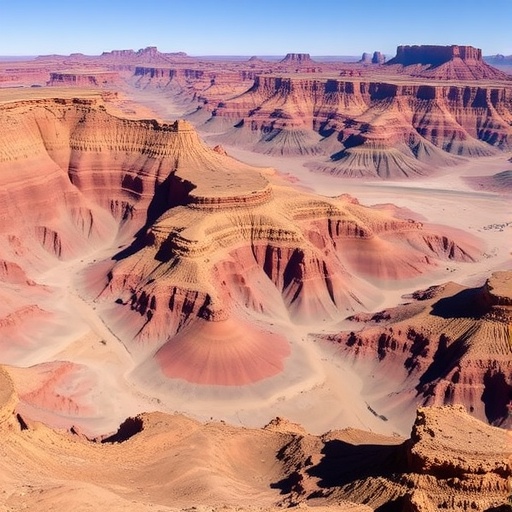
In a groundbreaking study set to reshape our understanding of extraterrestrial geology, a team of researchers led by Jian Sun has uncovered remarkable similarities between the ancient landscapes of Earth’s Qaidam Basin in Northwest China and those found on the surface of Mars. This research not only highlights the unique features of yardang formations but also provides critical insights into the geological processes that shaped these Martian-like structures. The study paints a vivid picture of how the Qaidam Basin has served as a natural laboratory for understanding the intricate interplay between wind erosion and sediment dynamics in arid environments.
Yardangs, streamlined, wind-eroded landforms, are characterized by their distinctive shapes, resembling the contours of elegant, elongated ridges. Found in arid and semi-arid regions on Earth, these formations are created through the relentless action of wind that sculpts the earth over millennia. The Qaidam Basin, an expansive desert, presents an ideal site for such geological formations, where gentle winds and sparse vegetation allow for the detailed study of erosion processes. This research endeavors to illuminate the ancient climatic conditions that facilitated the evolution of these landforms, drawing parallels with similar features on Mars, where wind and atmospheric dynamics play a crucial role in shaping its surface.
The study’s authors emphasize the significance of understanding yardangs not just as Earth’s geological wonders, but also as informants about other planetary bodies. The striking similarities between the yardangs of Qaidam and Martian landforms raise pivotal questions about the potential for historical climatic processes on Mars that mirror those on Earth. By delving into the formation mechanisms, the researchers aim to construct a clearer view of how these processes might have transpired in the Martian context, thereby bridging a critical gap in our understanding of planetary evolution and the comparison of Earth’s and Mars’ environmental histories.
In addition to providing insight into the yardang formations, the research employed sophisticated methods to analyze the sedimentary structures and wind patterns that contributed to the creation of these landforms. Utilizing advanced geological mapping, the team observed how variations in wind speed and direction have historically influenced sediment displacement and sculpting. The results emphasize a correlation between wind dynamics and the morphological characteristics of yardangs, thereby offering a model that could be applied to understand wind patterns on Mars. Such cross-planetary insights illuminate how we might interpret Martian geological features through the lens of terrestrial experiences.
Through rigorous field studies, the researchers effectively cataloged various yardang formations, highlighting both their physical characteristics and the underlying geological processes. Utilizing high-resolution imagery, they conducted detailed comparisons between the Qaidam Basin yardangs and their Martian counterparts. The researchers discovered that similar sedimentary processes, primarily driven by the erosion caused by wind, were pivotal in forming both landscapes. These findings provide compelling evidence supporting the notion that Earth serves as an analogue for understanding Martian geological phenomena.
The implications of this study extend beyond mere geological observations; they also touch upon the broader themes of planetary science and astrobiology. Understanding how arid landscapes evolve under various climatic conditions is essential not only for interpreting Earth’s past but also for predicting the geological futures of other planets. The parallels drawn between the Qaidam Basin and Mars suggest that lessons learned from Earth’s geology can significantly inform our exploration and understanding of extra-terrestrial landscapes.
The research highlights critical questions about the historical climate of Mars; was it ever conducive to processes that mirror those occurring in arid regions on Earth? The findings imply that the formation of yardangs, both on Earth and Mars, likely required similar climatic and aerodynamic conditions. This revelation could significantly influence future missions to Mars, as scientists may prioritize areas where yardang-like features exist, as these could indicate past environmental conditions similar to those that allow for life on Earth.
Moreover, the study contributes to ongoing debates concerning the habitability of planetary bodies. The presence and evolution of similar landforms on Mars hint at the potential for ancient water activity or other climatic conditions that may have favored the development of life. Understanding these geological processes and the environmental conditions required for their formation gives scientists valuable insights into where to search for signs of past life and habitability in the solar system.
The researchers also acknowledge the need for further investigation, suggesting that more sophisticated models may be necessary to fully comprehend the wind patterns and sediment dynamics shaping Martian geological structures. The integration of remote sensing data with ground-based observations could refine our models, enabling an even deeper understanding of the aerodynamic processes at play on both planets. This study establishes a strong foundation for future exploration and comparative planetary geology, urging scientists to consider Earth’s landscapes as vital keys to unlocking the mysteries of other planetary bodies.
As public interest in Mars exploration continues to soar, findings like these can inspire new generations of scientists and enthusiasts alike. The intricate relationship between Earth and Mars, as revealed through this research, emphasizes the importance of interdisciplinary approaches in science. By uniting geology, planetary science, and climatology, researchers are paving the way for more holistic understandings of these complex systems.
In conclusion, this research paves the path for future investigations into the relationship between terrestrial and extraterrestrial geology. The Qaidam Basin stands out as a live gallery that encapsulates processes mirrored in the Martian environment. Harnessing knowledge of Earth’s yardangs equips scientists with a profound method for interpreting landscapes on other planets, potentially bringing us closer to answering one of humanity’s oldest questions: Are we alone in the universe?
This new understanding of yardangs and their formation processes opens up numerous avenues for exploration that could yield significant discoveries in planetary science. Understanding these ancient processes not only enriches our geological knowledge. Still, it also reinforces the ever-present possibility that the traits we study in our own backyard may hold the keys to otherworldly mysteries waiting to be unveiled.
The quest for knowledge about our celestial neighbors continues. This study lays the groundwork for future explorations of Mars, underpinning the necessity of terrestrial analogues in preparing for interplanetary studies. The journey into understanding our planet and beyond is far from over, but as research evolves, so does the prospect of uncovering truths about life and geology on other worlds.
This dynamic and ever-evolving field presents exciting possibilities for integrating technology into foundational research inquiries. Observational technologies and advancements in analytics pave the way for unprecedented exploration. Researchers look forward to combining Earth-based studies with spaceborne observations, providing exciting opportunities to further enhance our knowledge of yardang formations and their role in understanding other planetary landscapes.
As researchers continue to unearth the secrets of the Qaidam Basin, they ultimately inspire a greater curiosity about the universe. The quest for knowledge guides scientific inquiry, revealing connections between what we discover on Earth and the profound mysteries that lie beyond our atmosphere. With each study, we edge closer to unraveling the complexity of life, climate, and geology in our ever-expanding understanding of the cosmos.
Subject of Research: Ancient geological processes and landform evolution in the Qaidam Basin compared to similar Martian features.
Article Title: Origin and evolution of the most Mars-like yardang landforms in the Qaidam Basin of Northwest China.
Article References:
Sun, J., Lü, T., Zhou, K. et al. Origin and evolution of the most Mars-like yardang landforms in the Qaidam Basin of Northwest China.
Commun Earth Environ (2026). https://doi.org/10.1038/s43247-026-03202-x
Image Credits: AI Generated
DOI: 10.1038/s43247-026-03202-x
Keywords: Geological formations, Yardangs, Mars, Qaidam Basin, Wind erosion, Planetary science, Comparative geology.


