


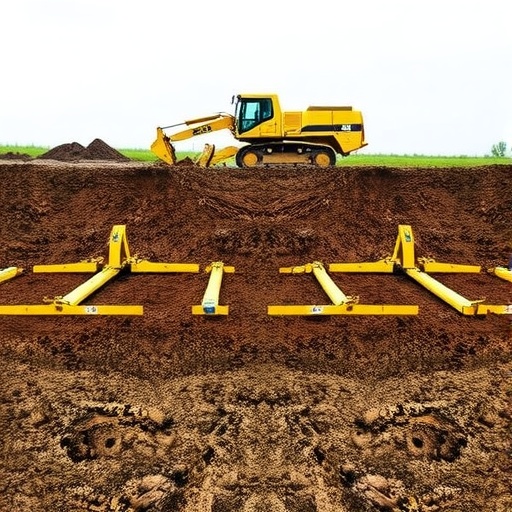
In a groundbreaking advancement at the nexus of geotechnical engineering and computational modeling, researchers have delved deep into the enigmatic mechanisms underlying internal erosion in granular soils. This complex phenomenon, crucial for understanding the stability of earth structures such as dams, levees, and embankments, has been notoriously difficult to quantify and predict due to the microscale interactions involved. The latest study harnesses the power of coupled Discrete Element Method (DEM) and Darcy’s Flow Model (DFM) simulations to unravel the threshold conditions that precipitate internal erosion, shedding light on critical factors that govern soil stability and failure.
Internal erosion, often covert and insidious, refers to the progressive removal and transport of soil particles by seepage flow within the soil matrix. Over time, this process can lead to the formation of preferential flow paths, increased permeability, and ultimately catastrophic failure if unchecked. Traditional experimental approaches to study internal erosion have grappled with scale limitations and difficulties in visualizing the micro-processes at play. This new computational approach offers unprecedented insight into particle-level dynamics coupled with fluid flow, enabling researchers to simulate realistic scenarios and identify conditions that mark the onset of erosive behavior.
Central to this research is the innovative integration of DEM – a numerical technique that simulates individual particles and their interactions through Newtonian mechanics – with DFM, which models the movement of fluid through porous media governed by Darcy’s law. The synergy of these methods allows a dual perspective: the granular soil structure’s mechanical response to seepage forces and the evolution of fluid flow paths resulting from particle rearrangement and removal. This dual simulation framework represents a significant methodological leap, surpassing prior models that considered either fluid flow or particle mechanics in isolation.
The study meticulously explores the threshold effects—critical hydraulic gradients, flow velocities, and stress states—at which particles begin to detach and migrate, marking the inception of internal erosion. By systematically varying these parameters, the simulations reveal that the onset of erosion is highly sensitive to local packing density, particle size distribution, and the connectivity of pore spaces. The research highlights that erosion does not occur linearly with increasing hydraulic gradient; instead, it exhibits a sharp transition once specific conditions are met, consistent with a “tipping point” behavior.
One of the most compelling findings concerns the heterogeneity within the granular soil mass. The coupled DEM-DFM simulations demonstrate that even minor heterogeneities in particle arrangement can generate preferential seepage channels that accelerate erosion locally while leaving surrounding soil relatively intact. This phenomenon underscores the importance of accounting for microstructural variance in predictive models and challenges the conventional assumption of soil homogeneity in geotechnical analyses.
Moreover, the research examines the dynamic feedback mechanisms between fluid flow and particle displacement. As particles are eroded and transported by seepage, the flow paths evolve, altering hydraulic gradients and consequently impacting further erosion. The study’s simulations capture this nonlinear interplay with remarkable fidelity, providing a comprehensive picture of how internal erosion progresses and potentially escalates into full-fledged soil failure.
In addition to advancing theoretical understanding, this numerical investigation has profound implications for engineering practice. By quantifying threshold criteria with greater precision, the findings empower engineers to devise more reliable safety margins for structures vulnerable to internal erosion. The insights could inform the development of improved soil stabilization techniques, filtration layers, and monitoring protocols designed to detect early signs of erosion before critical damage ensues.
The study also opens avenues for the incorporation of more complex soil characteristics and environmental conditions into future models. Incorporating factors such as chemical interactions, variable saturation, and temperature effects could further refine the predictive capabilities of coupled DEM-DFM simulations. Such advancements would be invaluable for addressing erosion challenges under diverse climatic and geological settings.
At the computational level, the research showcases the prowess of high-performance computing in enabling detailed soil-fluid interaction modeling. The granularity of particle-scale simulations, often computationally prohibitive in the past, becomes feasible through algorithm optimizations and parallel processing. This breakthrough points towards an era where virtual testing and design of geotechnical systems can complement and sometimes replace costly physical experiments.
The visualization component accompanying the study offers vivid depictions of particle displacement and fluid flow evolution, making the data accessible not only to specialists but also to a broader engineering community. These visual tools serve as powerful educational and communicative assets, enhancing understanding of complex erosion phenomena and facilitating interdisciplinary collaboration.
Importantly, the study invites reevaluation of existing regulatory frameworks and engineering standards regarding soil erosion control. The identification of precise erosion thresholds could prompt revisions in design codes and maintenance guidelines, promoting more sustainable and resilient infrastructure development globally.
The coupling methodology itself is a testament to interdisciplinary innovation, blending granular physics, fluid mechanics, and computational science seamlessly. This convergence reflects the broader trend towards integrated approaches in tackling complex earth system problems, where a single-discipline lens proves insufficient.
Furthermore, the implications of such research extend beyond civil engineering. Understanding internal erosion mechanisms has relevance in natural hazard assessment, groundwater contamination pathways, and even planetary science where soil-fluid interactions govern landscape evolution on extraterrestrial terrains.
The ramifications of this research are poised to ripple through both academia and industry, inspiring a wave of subsequent studies and practical applications. The detailed insights into threshold effects pave the way for targeted interventions—whether material selection, soil treatment, or structural design modifications—that preempt costly failures and safeguard public safety.
This pioneering work exemplifies how cutting-edge computational tools can unlock longstanding mysteries in earth sciences. By capturing the subtle yet critical transitions that govern internal erosion, the study not only advances fundamental knowledge but also fortifies the foundation upon which safe and sustainable infrastructure is built.
As the research community embraces these findings, ongoing validation through field studies and laboratory experiments remains essential. Such synergistic efforts will ensure that the numerical predictions translate effectively into real-world solutions, ultimately mitigating the risks posed by internal erosion.
The marked progress embodied in this investigation heralds a new chapter in soil mechanics research—one where microscopic perspectives and fluid-solid interactions coalesce to yield macroscopic understanding and practical engineering wisdom.
He, S., Dong, H., Jia, Y. et al. Numerical investigation of threshold effects in internal erosion of granular soils using coupled DEM-DFM.
Environ Earth Sci 84, 460 (2025). https://doi.org/10.1007/s12665-025-12456-1
Cite Scienmag News
Violet Maxwell. (August 3, 2025). Exploring Internal Erosion in Granular Soils Numerically. Scienmag. https://scienmag.com/exploring-internal-erosion-in-granular-soils-numerically/
Violet Maxwell. "Exploring Internal Erosion in Granular Soils Numerically." Scienmag, 3 August 2025, https://scienmag.com/exploring-internal-erosion-in-granular-soils-numerically/. Accessed 3 September 2026.
Violet Maxwell. "Exploring Internal Erosion in Granular Soils Numerically." Scienmag. August 3, 2025. https://scienmag.com/exploring-internal-erosion-in-granular-soils-numerically/


