

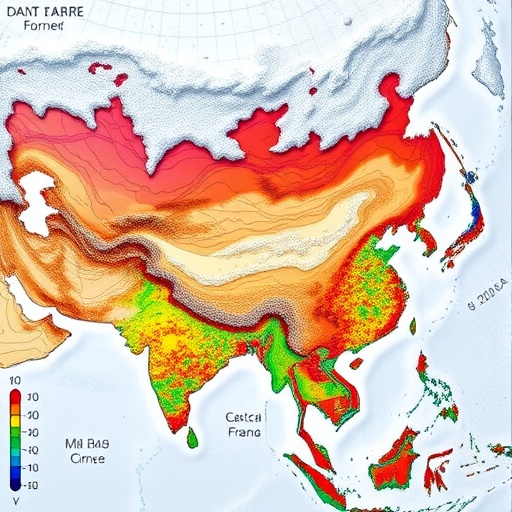
In a groundbreaking study poised to reshape our understanding of climate patterns in mid-latitude Asia, researchers have unveiled the spatial heterogeneity of Holocene winter temperatures. This new research, led by Huang et al., investigates how winter temperatures have fluctuated across this vast and diverse region since the Holocene epoch. Their findings, which are published in the journal “Commun Earth Environ”, not only contribute to our knowledge of historical climate variations but also have significant implications for current climate modeling and future projections.
The Holocene epoch, which began around 11,700 years ago, marks a significant period in Earth’s climatic history where the planet experienced relatively stable climate conditions. However, recent evidence suggests these conditions were not uniformly experienced across all geographic areas. Instead, variations in winter temperatures during the Holocene have been pronounced, suggesting an intricate interplay of local and regional climatic factors at work. This study meticulously documents these variations, presenting a comprehensive analysis that highlights the complexity of climatic phenomena in mid-latitude Asia.
Utilizing a variety of paleoclimate proxies, including ice cores, sediments, and historical climate records, the researchers pieced together a detailed picture of winter temperature fluctuations over millennia. The methodologies employed in this study are particularly striking. By integrating data from diverse sources, the researchers were able to develop a high-resolution temperature reconstruction that offers significant insights into long-term climate trends. This approach showcases the value of interdisciplinary collaboration and highlights the sophistication of modern climate science.
One significant takeaway from Huang et al.’s study is the identification of distinct regional patterns in winter temperature variation. The findings indicate that different areas experienced varying degrees of warming and cooling throughout the Holocene. For instance, while some regions may have experienced more substantial fluctuations in temperature, others remained relatively stable. This aspect of the research underscores the importance of local geographical features, such as mountains and bodies of water, which influence temperature and climatic conditions in nuanced ways.
The implications of these findings extend far beyond the confines of past climatic conditions. As climate change accelerates, understanding these historical variations becomes increasingly vital. The researchers emphasize that by analyzing winter temperature changes during the Holocene, scientists can gain insights into how current climatic trends might evolve. This understanding is crucial for developing accurate climate models, which serve as essential tools for policymakers and environmental planners.
Moreover, the research could have profound implications for understanding the socio-economic impacts of climate variability. Historically, populations in mid-latitude Asia have adapted to climatic changes, often leading to significant cultural and agricultural shifts. By examining the ways past societies responded to temperature fluctuations, the researchers hope to provide valuable lessons for contemporary communities facing similar challenges amid climate change.
Significant attention is drawn to the methodology of this research, as it showcases advancements in paleoclimate research techniques. The integration of multi-proxy data allows for a more nuanced interpretation of past climate conditions compared to singular proxy uses. The researchers have employed statistical methods to ensure the robustness and reliability of their reconstructions, marking a significant advancement in the methodology of climate science.
One of the most thought-provoking aspects of this research is the discussion it prompts regarding climate memory. The term refers to how historical climatic conditions can shape current environmental responses and adaptive strategies. Understanding climate memory is essential, as it informs how ecosystems and human systems might respond to ongoing changes. By investigating how winter temperatures impacted ecosystems during the Holocene, the researchers foster a deeper understanding of today’s climate adaptability.
Despite the study’s comprehensive nature, it inevitably raises new questions. For instance, what other climatic factors might also exhibit similar regional variability? Are there additional feedback mechanisms that could influence these patterns? Such queries highlight the ongoing nature of climate research and the need for further investigation. The complexity of the Earth’s climate system means that there is always more to learn, and this study has opened new avenues for inquiry.
Looking ahead, the researchers are optimistic that their findings will spark further investigations into Holocene climatic conditions worldwide. By creating a clearer understanding of how localized factors contribute to temperature variations, they believe it will enhance global climate models. Future studies could benefit from this research as they work to decode the myriad influences on climate systems, both historical and contemporary.
Collaborations between scientists from various fields will be crucial in advancing the necessary research. As the climate crisis continues to unfold, interdisciplinary efforts must focus on building a more integrated understanding of past climates to better address future conditions. Huang et al. emphasize the importance of shared knowledge, advocating for a holistic approach to climate science that combines data from diverse sources.
In summary, Huang et al.’s study on the spatial heterogeneity of Holocene winter temperatures in mid-latitude Asia not only enriches our knowledge of historical climate patterns but also serves as a critical stepping stone for future climate research. Their insights into how past temperature variations shape current climate dynamics remind us of the intricate connections between history and modernity. The complexities unveiled in this research hold critical relevance for both scientific understanding and practical adaptations to an ever-changing climate.
As the world grapples with looming climate challenges, studies like this carry the weight of urgency. The vital lessons embedded in the climate history of mid-latitude Asia can inform our responses to the complexities of today’s environmental issues. Ultimately, the study by Huang et al. embodies a blend of meticulous research and profound implications, offering both knowledge and a pathway for future exploration.
In conclusion, as researchers continue to uncover the intricacies of our planet’s climatic history, it becomes ever more evident that understanding past conditions is crucial for navigating future prospects. The work established by Huang and colleagues not only marks a significant contribution to the field of paleoclimatology but also serves as a reminder of the interconnectedness of human and environmental systems throughout time. As the climate continues to change, it is this kind of research that will illuminate potential paths forward and foster resilience in the face of uncertainty.
Subject of Research: Spatial heterogeneity of Holocene winter temperature in mid-latitude Asia
Article Title: Spatial heterogeneity of the Holocene winter temperature in mid-latitude Asia
Article References: Huang, C., Huang, X., Min, R. et al. Spatial heterogeneity of the Holocene winter temperature in mid-latitude Asia.
Commun Earth Environ (2025). https://doi.org/10.1038/s43247-025-03117-z
Image Credits: AI Generated
DOI: 10.1038/s43247-025-03117-z
Keywords: Holocene, climate variability, spatial heterogeneity, winter temperatures, mid-latitude Asia, climate change, paleoclimate research, interdisciplinary studies.


