

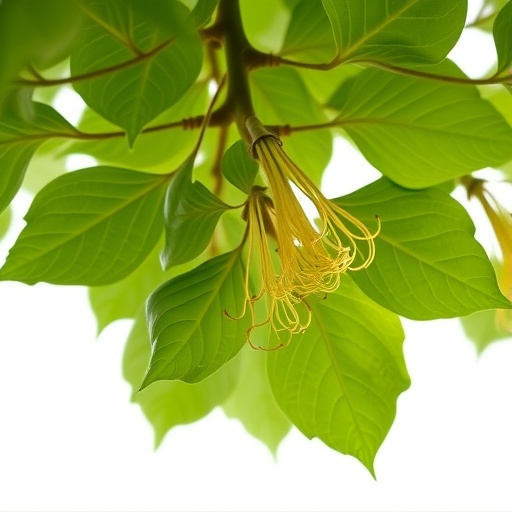
In a pioneering study, the research community turns its focus to the complex world of abiotic stress in plants, particularly how the gene family of calcium-dependent protein kinases (CDPKs) operates under such pressures. The groundbreaking paper by Guan, Liu, and Hwarari provides a comprehensive genomic survey and expression analysis of the CDPK genes in the indigenous species Liriodendron chinense. This species, a member of the magnolia family, not only presents ecological significance but also represents a valuable resource for understanding stress responses in woody plants.
Liriodendron chinense is particularly interesting in plant science because it can thrive in diverse habitats while exhibiting resilience to various environmental pressures. The research team undertook an extensive investigation into the genomic architecture of CDPK genes, which are crucial signalling molecules that respond to calcium fluctuations in plant cells. By analyzing these genes, they aim to elucidate their potential roles in mediating plant responses to environmental stresses including drought, salinity, and extreme temperatures.
Advancements in high-throughput sequencing technologies allowed the researchers to catalogue the CDPK gene family within Liriodendron chinense. This genomic survey revealed critical insights into gene structure, chromosome localization, and evolutionary dynamics. The findings suggest that the CDPK gene family has undergone significant expansion in Liriodendron chinense compared to other closely related species, pointing to an adaptive significance that warrants further investigation.
One of the essential outcomes of the study is the characterization of the expression profiles of the CDPK genes under various abiotic stress conditions. The researchers meticulously subjected plants to stress mimics, including water deprivation and salinity challenges, assessing the resultant gene expression patterns. Remarkably, these analyses indicated that specific CDPK genes exhibited significantly altered expression levels in response to stress, highlighting their potential role as molecular sentinels that monitor and respond to environmental cues.
In a bid to contribute to the understanding of molecular mechanisms controlling stress responses, the study harnessed advanced bioinformatics tools and algorithms. These tools enabled the researchers to predict the functional domains of CDPKs and their interacting partners, making it possible to postulate the pathways these proteins may engage in under stress conditions. Exploring these interactions could unveil novel targets for genetic engineering, aimed at developing stress-resistant crops, which is crucial in the face of global climate change.
Furthermore, upon delving deeper into the data, the research team made an intriguing observation regarding the phosphorylation status of various proteins in response to abiotic stress. CDPKs act as key players in phosphorylation cascades, which modify the function of target proteins, thus shaping the plant’s physiological response. The coordinated action of these kinases could lead to protective responses, such as the synthesis of osmoprotectants or alterations in stomatal behavior to minimize water loss.
The integration of genomic, transcriptomic, and proteomic analyses underpins the multifaceted approach taken by the researchers in this study. This holistic perspective not only enhances the credibility of the findings but also allows for a more robust understanding of how Liriodendron chinense mobilizes its genetic resources to counteract stress. This integrative framework could serve as a model for similar studies across other plant species as researchers strive to unravel the complexities of abiotic stress response mechanisms.
Moreover, the implications of this research transcend academic circles; should the findings lead to tangible agricultural innovations, they could significantly benefit crop resilience in the ever-changing climate landscape. With increasing water scarcity and soil salinity threatening global food security, the need for insights like those provided by this study has never been more urgent. The promise of using CDPK genes as a genetic tool in facilitating stress tolerance could open new avenues for breeding programs aimed at developing resilient crop varieties.
In discussions surrounding agricultural biotechnology, one cannot overlook the ethical considerations linked to gene editing and modification. This research also touches on the conversations about the balance between natural genetic variation and human intervention. It emphasizes the need for responsible application of genetic tools that respect biodiversity while striving for agricultural advancement. Continuous dialogue in the scientific community about the consequences of altering natural gene functions is essential.
As we further explore the ramifications of Guan et al.’s findings, it becomes clear that this research addresses a critical gap in our understanding of plant responses to abiotic stress. With the world grappling with climate challenges, the systematic characterization of stress-responsive genes provides a foundation for innovative strategies in crop management and breeding. The stability and adaptability of species like Liriodendron chinense may offer insights that are relevant not only for conservation efforts but also for the future of sustainable agriculture.
In summary, the research led by Guan, Liu, and Hwarari serves as a vital contribution to plant genomics, specifically in understanding the relevance of CDPK genes under stress. This article not only captures the essence of scientific inquiry into plant resilience but also ignites hope for future agricultural advancements. The ongoing exploration of plant genetics holds the potential to unlock the mystery of stress tolerance, steering the way towards a more sustainable and food-secure future.
The intersection of plant genomics and abiotic stress responses, as illustrated by this research, underscores the importance of investing in fundamental scientific studies. By decoding the genetic hints left by evolution, researchers pave pathways for practical applications that could resonate across global agricultural practices.
The insights and methodologies presented in this groundbreaking publication represent a step forward not just for Liriodendron chinense but for all plants facing the daunting challenges of a rapidly changing world. As we contemplate the complexities of life at the genetic level, findings like these illuminate the road ahead for enhancing plant resilience through scientific advancement.
Subject of Research: CDPK genes in Liriodendron Chinense
Article Title: Genomic survey and expression analysis of the CDPK genes in Liriodendron Chinense to explore their potential functions under multiple abiotic stresses
Article References:
Guan, Y., Liu, S., Hwarari, D. et al. Genomic survey and expression analysis of the CDPK genes in Liriodendron Chinense to explore their potential functions under multiple abiotic stresses.
BMC Genomics (2026). https://doi.org/10.1186/s12864-025-12393-0
Image Credits: AI Generated
DOI: 10.1186/s12864-025-12393-0
Keywords: CDPK, Liriodendron chinense, abiotic stress, plant resilience, genomic survey, expression analysis


