

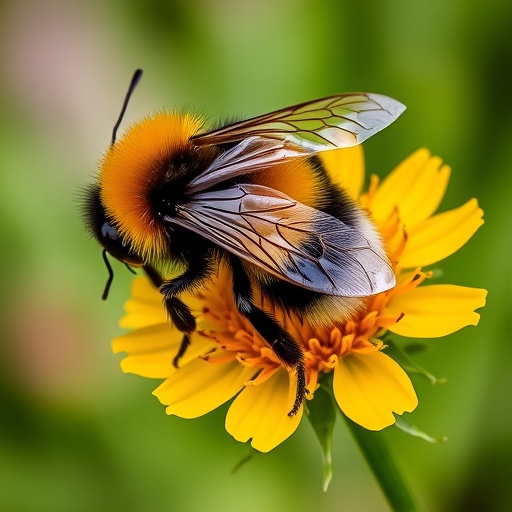
In the realm of animal cognition, researchers have increasingly turned their attention toward the remarkable abilities of bumblebees, specifically their adeptness at recognizing and responding to relational similarities in their environment. A recent study led by Dr. G. Martin-Ordas sheds light on this fascinating aspect of bumblebee behavior, focusing particularly on how spatial alignment complexity plays a role in their cognitive processing. This groundbreaking research, set to be published in Animal Cognition, opens new avenues for understanding not only bumblebees but also broader implications for animal intelligence and ecological interactions.
For quite some time, scientists have been aware that bumblebees possess sophisticated navigational skills and problem-solving abilities, yet the extent of their relational understanding has been less documented. The findings of this new research signal a significant advancement in our comprehension of these creatures. By examining how bumblebees navigate their habitats and recognize spatial relationships between objects, Martin-Ordas and his team have provided compelling evidence that these insects engage in cognitive processes that were traditionally thought to be exclusive to more complex animals, such as primates.
Central to the study is the concept of relational similarity, which refers to an animal’s ability to comprehend the connections between different objects or elements in their environment. This ability is not merely about recognizing a single object but involves understanding the relationships among multiple objects, which can influence decision-making and behavioral responses. The research proposes that bumblebees, upon encountering various spatial alignments, are capable of discerning similarities that allow them to adapt their strategies in foraging and navigation.
The complexity of spatial alignment is a critical factor that the study unpacks. It hypothesizes that bumblebees can assess the geometric configurations of their surroundings, integrating information about distances and angles to make educated decisions. Such cognitive interplay resembles the ways in which more cognitively advanced species might process information, hinting at an evolutionary kinship in the cognitive skills across species. By showcasing this adaptability, the study sets bumblebees in a new light, encouraging further inquiry into the cognitive capabilities of insects more broadly.
Yet, how do scientists measure these abilities in bumblebees? Through a series of carefully designed experiments, Martin-Ordas’ team subjected these bees to various spatial scenarios that tested their understanding of relational similarities. The methodology employed involved manipulating different spatial relationships and observing how the bees approached foraging tasks in environments where they had to recognize patterns and alignments. This rigor in experimental design ensures that the conclusions drawn from the research stand on solid empirical footing, paving the way for more extensive future studies.
Moreover, the findings are positioned not just within the context of bumblebee cognition but are also reflective of ecological concerns. As pollinators, bumblebees play an integral role in ecosystem health. Understanding their cognitive processes sheds light on how they interact with their environments and can inform conservation strategies, particularly in the face of habitat loss and climate change. The implications of this research extend beyond academic circles, as they touch upon agricultural productivity and the sustainability of ecosystems reliant on these industrious insects.
Importantly, this research does not merely conclude on the cognitive prowess of bumblebees; it fundamentally raises questions about the evolution of intelligence. If insects like bumblebees demonstrate relational understanding, what does that mean for other species within the vast insect realm? Additionally, how might these capabilities have evolved independently across different taxa? These queries invite a comparative analysis that is ripe for investigation and promises to enrich our current understanding of cognitive evolution.
Furthermore, the work of Martin-Ordas and his team highlights the intricate relationship between cognitive capabilities and environmental challenges. Just as human beings adapt their strategies in unpredictable surroundings, bumblebees too exhibit a level of cognitive flexibility that aids their survival. This has profound implications for understanding intelligence as not merely a scale but rather a set of competencies shaped by ecological demands.
In an era where the study of animal cognition has garnered significant public interest, such research invites a re-examination of our views on intelligence across the animal kingdom. Bumblebees, often overlooked in discussions about cognition, emerge as key players in this paradigm shift. The meticulous research undertaken by Martin-Ordas serves to remind us that intelligence can manifest in diverse ways, rooted deeply in the specificities of an organism’s life and environment.
As we look to the future of such research, one could speculate on the potential applications of these findings. With ongoing discussions about biodiversity and climate resilience, the understanding of bumblebee cognition may play a vital role in developing strategies for conservation efforts that take into account the cognitive abilities of pollinators. Such interdisciplinary approaches merging cognitive science, ecology, and conservation biology could set the stage for innovative practices that benefit both human endeavors and the natural world.
With the publication set for November 17, 2025, anticipation builds in the scientific community regarding the details that will unfold within the pages of Animal Cognition. The study holds promise not only for a deeper understanding of bumblebee intelligence but also for initiating a broader dialogue about the cognitive capacities of all insects. The burgeoning interest in animal cognition is indicative of a shift in how we perceive the intelligence of non-human species—a shift towards recognizing that intelligence is not uniquely human but rather a spectrum exhibited across the animal kingdom.
In conclusion, the exploration of relational similarity in bumblebees, as delineated in the study by Martin-Ordas, represents a significant contribution to our understanding of cognitive science. By probing into the complexities of spatial alignment and its effect on bumblebee behavior, this research ignites curiosity about the cognitive landscape of insects, fostering a newfound respect for their intelligence. As we endeavor to better understand the myriad forms of intelligence present in non-human species, studies like this serve as crucial stepping stones toward comprehensive ecological and ethical considerations within our shared biosphere.
Subject of Research: Relational similarity in wild bumblebees and the role of spatial alignment complexity.
Article Title: Relational similarity in wild bumblebees: the role of spatial alignment complexity.
Article References:
Martin-Ordas, G. Relational similarity in wild bumblebees: the role of spatial alignment complexity.
Anim Cogn 28, 94 (2025). https://doi.org/10.1007/s10071-025-02012-6
Image Credits: AI Generated
DOI: 10.1007/s10071-025-02012-6
Keywords: Bumblebees, cognitive science, relational similarity, spatial alignment, animal cognition, pollinators, ecological implications, intelligence.


