


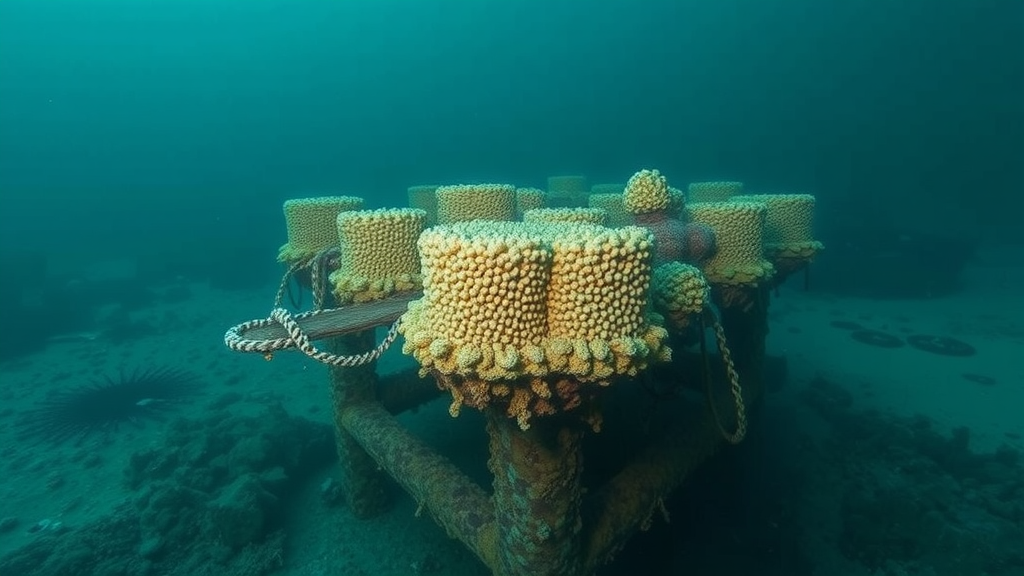
Marine engineers have long known that the greatest threat to a submerged structure is not always a storm or a collision but something far quieter: the slow, relentless accumulation of organisms on every underwater surface. Barnacles, algae, mussels and microbial films—collectively known as biofouling—can degrade hydrodynamic efficiency, corrode hulls and pipelines, and quietly undermine structural integrity while driving up inspection and maintenance costs. A new study published in the Journal of Big Data now describes an artificial intelligence system that can find and outline these biological colonizers pixel by pixel, even in the murky, color-distorted images that underwater cameras typically produce, and explain why it made each decision.
The research, conducted by J. S. Shyam Mohan of Lincoln University College in Malaysia and Ankur Dumka of the Women Institute of Technology in Dehradun, India, addresses a problem that has frustrated automated marine inspection for years. While remotely operated vehicles and fixed cameras can gather enormous quantities of visual data from offshore platforms, ship hulls and submerged infrastructure, turning those images into reliable maps of fouling coverage has remained stubbornly difficult. Underwater imagery suffers from light attenuation, scattering, non-uniform illumination and color cast, all of which degrade the very details a computer vision system needs. On top of that, annotated underwater datasets are scarce, and the fouling classes they contain are often heavily imbalanced—common organisms dominate while rare but structurally significant species barely register.
Existing approaches to automated biofouling analysis have mostly settled for coarse image-level classification, telling an operator whether a scene contains fouling but not where it lies or how extensive it is. Pixel-level segmentation is far more demanding, requiring the model to assign a label to every individual pixel, and previous attempts have struggled with both accuracy and stability when confronted with the high-dimensional, degraded data characteristic of real underwater surveys. The authors of the new study argue that this gap is precisely where their method makes its contribution, offering a model that is accurate, robust and interpretable at the same time rather than trading one quality for another.
The researchers call their approach MRPixelDNet, a unified framework that combines four mutually reinforcing components: underwater image preprocessing, synthetic data augmentation, a deep network architecture built around mutual reinforcement between pixels, and an explainable visual interpretation layer. Rather than treating these stages as separate pipeline steps, the design is intended to let each component strengthen the others—cleaner images feed better segmentation, better segmentation produces more trustworthy interpretations, and those interpretations guide further refinement of the model’s attention across pixels. The novelty, the authors contend, lies precisely in this unified design, which simultaneously improves segmentation performance, resilience to underwater visual distortion and the explainability of predictions.
The preprocessing stage tackles the optical pathology of the underwater environment directly, enhancing texture and color information that would otherwise be lost to the water column. This matters because fouling organisms differ in fine surface texture and hue; if those cues are blurred or shifted, a segmentation network has little to work with. The augmentation stage addresses the data scarcity problem by expanding the training set with synthetic variations, allowing the network to learn from a broader range of degradation conditions, organism appearances and scene compositions than real annotated data alone could ever provide. Together, these measures give the deep network a far cleaner and more diverse foundation than raw underwater footage would allow.
At the heart of the system is the pixel-level deep network itself, which the authors describe as a mutually reinforcing architecture informed by non-local neural network principles. Instead of classifying each pixel in isolation, the network considers relationships across the entire image, allowing distant but contextually related regions to inform one another’s predictions. A patch of algae on one side of a frame can help the model correctly identify a similar-looking patch on the other side, and the boundaries between fouling species and bare substrate become sharper because the network weighs global structure alongside local appearance. The architecture also generates pixel-by-pixel masks, producing detailed maps that show exactly which regions of a submerged surface are colonized and which remain clear.
What sets the work apart from many deep learning pipelines, the authors emphasize, is its commitment to explainability. For infrastructure managers who must act on inspection results—scheduling cleaning operations, prioritizing repairs, certifying structures for continued service—a black-box prediction is of limited use. The explainable component of MRPixelDNet produces visual interpretations of its own predictions, highlighting the evidence the model relied upon when it marked a region as fouled. This transparency makes it easier for human inspectors to verify results, catch errors and build justified confidence in automated reporting, a requirement that becomes especially important when decisions carry safety and financial consequences for expensive offshore assets.
The experimental validation was carried out on underwater biofouling datasets, where the proposed method was benchmarked against state-of-the-art segmentation techniques. The results were consistent and substantial. Intersection over Union, a strict measure of how well the predicted segmentation overlaps the ground truth, improved by approximately six to ten percent, while the Dice coefficient, another standard overlap metric, rose by roughly five to eight percent. Precision, recall and accuracy also improved consistently, suggesting the gains were not confined to a single metric or a favorable subset of images but reflected a genuinely stronger ability to locate and delineate fouling under real imaging conditions.
The implications extend well beyond the metrics themselves. Accurate, interpretable maps of biofouling coverage could transform structural health monitoring in marine environments, turning what is today a labor-intensive and subjective inspection process into a scalable, data-driven workflow. Fouling is not merely a cosmetic nuisance; by altering surface roughness and drag it increases fuel consumption for vessels, and by trapping moisture and corrosive agents against structures it accelerates the degradation of assets worth billions of dollars. A system that can quantify fouling reliably, at the pixel level, in degraded imagery, and justify its own judgments, offers operators a way to detect problems earlier and allocate maintenance resources more rationally across fleets, platforms and coastal installations.
The authors present the work as evidence that segmentation accuracy, robustness and explainability need not compete—under the right architecture, each can reinforce the others in service of a practical monitoring goal. Published open access, with the accepted manuscript already citable ahead of its final version of record, the study offers marine engineers and computer vision researchers alike a detailed blueprint for bringing trustworthy automated inspection beneath the waves, where the most persistent threats to infrastructure grow silently, one settling organism at a time.
Subject of Research: Explainable pixel-level deep learning for marine biofouling segmentation and structural health monitoring
Article Title: A mutually reinforcing pixel-level deep network-driven explainable AI for biofouling segmentation and structural health monitoring in marine environments
Article References: Shyam Mohan, J. S., & Dumka, A. (2026). A mutually reinforcing pixel-level deep network-driven explainable AI for biofouling segmentation and structural health monitoring in marine environments. Journal of Big Data. https://doi.org/10.1186/s40537-026-01568-5
Image Credits: AI Generated
DOI: 10.1186/s40537-026-01568-5
Keywords: biofouling, marine engineering, explainable AI, deep learning, image segmentation, underwater imaging, structural health monitoring, computer vision, non-local neural networks, data augmentation, mutually, reinforcing
Cite Scienmag News
Blake Davidson. (September 22, 2026). Explainable Deep Learning Maps Marine Biofouling Pixel by Pixel for Safer Underwater Structures. Scienmag. https://scienmag.com/explainable-deep-learning-maps-marine-biofouling-pixel-by-pixel-for-safer-underwater-structures/
Blake Davidson. "Explainable Deep Learning Maps Marine Biofouling Pixel by Pixel for Safer Underwater Structures." Scienmag, 22 September 2026, https://scienmag.com/explainable-deep-learning-maps-marine-biofouling-pixel-by-pixel-for-safer-underwater-structures/. Accessed 4 October 2026.
Blake Davidson. "Explainable Deep Learning Maps Marine Biofouling Pixel by Pixel for Safer Underwater Structures." Scienmag. September 22, 2026. https://scienmag.com/explainable-deep-learning-maps-marine-biofouling-pixel-by-pixel-for-safer-underwater-structures/


