

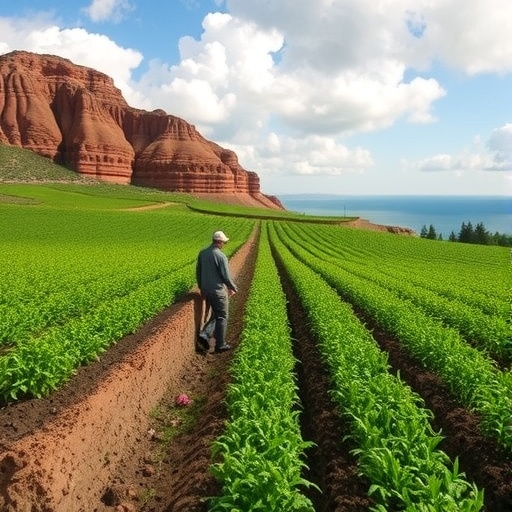
In the ever-intensifying global pursuit of climate change mitigation, scientists are meticulously exploring innovative strategies capable of significantly reducing atmospheric carbon dioxide (CO2) levels. Among these emerging techniques, agricultural enhanced weathering (AEW) has garnered considerable attention due to its potential to leverage natural geochemical processes for large-scale carbon dioxide removal. A recent groundbreaking study, published in Communications Earth & Environment and led by Buma, Dietzen, Gordon, and collaborators, sheds light on both the immense promise and the inherent uncertainties of AEW through a comprehensive expert elicitation framework.
Enhanced weathering refers to the accelerated breakdown of silicate and carbonate minerals when they interact with CO2 and water, forming bicarbonates and releasing essential nutrients into the soil. When applied on agricultural lands, this process can theoretically convert vast quantities of atmospheric CO2 into stable inorganic carbon, effectively locking it away for millennia. The new study dives deep into the agricultural context, where experts in geochemistry, soil science, agronomy, and climate policy convened to systematically assess the carbon dioxide removal potential and the attendant uncertainties surrounding AEW application.
One of the central findings emphasizes the scale of AEW’s potential. Experts collectively estimate that enhanced weathering, if widely implemented on croplands worldwide, could contribute between hundreds of millions to several billion tonnes of CO2 removal annually. This magnitude is highly significant when juxtaposed against global CO2 emissions targets, suggesting AEW could be a critical component of negative emissions portfolios. However, the magnitude varies greatly depending on variables such as mineral type, application rate, crop system, soil properties, and climatic conditions.
The study also highlights critical pathways through which carbon loss could diminish the overall effectiveness of AEW as a carbon sink. These include the re-release of CO2 through soil microbial respiration, incomplete mineral dissolution, and potential loss of soluble bicarbonates through surface runoff or subsurface drainage. The experts caution that these loss mechanisms introduce considerable uncertainty into models predicting net carbon removal, underscoring the importance of long-term field trials and an improved mechanistic understanding of the complex soil-meteorological interactions.
Importantly, the agricultural application of enhanced weathering does not merely impact carbon sequestration. The study elucidates ancillary effects on soil chemistry and fertility. Minerals utilized in weathering, such as basalt, can supply essential nutrients like calcium, magnesium, and potassium, potentially improving soil health and crop yield. This dual benefit might incentivize farmer adoption, linking climate goals with agricultural productivity. Yet, the experts also point to possible negative feedbacks, including soil acidification or the mobilization of heavy metals depending on the mineral source, which must be carefully monitored.
Another compelling dimension explored is the lifecycle implications of AEW. Mining, grinding, transporting, and applying rock powders to farmland involves energy consumption and emissions, which could offset the net carbon benefits if not managed sustainably. Experts emphasized the need for comprehensive lifecycle assessments to identify low-carbon supply chain practices and optimize AEW deployment strategies. The energy intensity is particularly high in mineral comminution, a process essential for creating fine particles that react more rapidly in soils.
Geospatial variability emerged as a critical factor affecting the feasibility and effectiveness of AEW. Soil texture, pH, moisture regimes, and prevailing temperatures all influence mineral dissolution rates and bicarbonate retention. For instance, tropical regions with high precipitation and temperature might enable faster weathering but simultaneously experience greater bicarbonate loss through runoff. Conversely, temperate zones might exhibit slower weathering kinetics but retain more dissolved carbon in groundwater. This geographical complexity necessitates region-specific protocols rather than one-size-fits-all approaches.
The expert elicitation also draws attention to socioeconomic and policy dimensions integral to AEW’s real-world adoption. Farmers require clear economic incentives and regulatory frameworks that recognize AEW’s dual role as a carbon dioxide removal strategy and soil amendment technology. Without policy support, the widespread diffusion of AEW techniques may remain stunted due to high upfront costs and uncertainties over long-term benefits. Regulatory bodies must also address monitoring and verification standards to include AEW in carbon trading markets effectively.
From a technological point of view, there is a pressing demand to innovate in mineral processing and application techniques. Current grinding methods are energy-intensive and costly, leading to calls for advanced comminution technologies or the use of coarser rock powders supplemented by microbial or chemical accelerants to enhance dissolution. Innovations such as electrochemical grinding or bio-weathering via specialized microbes are progressively gaining research attention as potential game-changers.
Crucially, AEW represents just one facet of a holistic climate mitigation strategy. The authors urge integration with other negative emission technologies, renewable energy deployment, and radical emission reductions to hedge against uncertainties inherent in each approach. Enhanced weathering offers a nature-based, potentially scalable solution with ancillary benefits for food security and ecosystem health but is not a silver bullet. The study makes a strong case for multidisciplinary collaboration between earth system scientists, agronomists, engineers, and policymakers to forge a path forward.
The interplay between empirical data and expert judgment constituted the backbone of this analysis. Given the nascent state of large-scale AEW field experiments, expert elicitation provided a rigorous method to collate insights from disparate disciplines, quantifying uncertainties in a transparent manner. This approach identifies knowledge gaps demanding urgent research investment, such as experimental quantification of bicarbonate losses in various soil and climate contexts and long-term monitoring of associated ecological impacts.
Public engagement also emerges as critical for AEW’s deployment. Societal acceptance may hinge on clear communication concerning risks, benefits, and uncertainties. The multifaceted nature of AEW — merging geology, agriculture, and climate science — offers both challenges and opportunities for outreach. Transparent dialogue can foster trust, equipping stakeholders from farmers to policymakers with nuanced understanding that refrains from overselling AEW as a facile solution.
Looking forward, pilot projects and regional demonstrations will be pivotal in advancing AEW from theoretical promise to practical application. By generating context-specific data on effectiveness, costs, and environmental impacts, such initiatives will reduce uncertainty and enable fine-tuned protocols. The study’s authors advocate for international collaboration harnessing funding tools such as climate innovation funds and agricultural development programs to accelerate this transition.
In sum, agricultural enhanced weathering stands as a compelling addition to the climate mitigation toolkit, offering prospects of significant CO2 removal paired with improvements in soil fertility. Nevertheless, it embodies complex biogeochemical, technological, and socio-economic challenges that demand careful, multidisciplinary scrutiny before widespread implementation. This expert elicitation study provides a foundational synthesis, charting both the path forward and warnings necessary to avoid pitfalls. As the climate crisis intensifies, such rigorously evaluated nature-based solutions will prove indispensable in global efforts to stabilize atmospheric carbon levels.
Subject of Research: Agricultural enhanced weathering for carbon dioxide removal and associated uncertainty analysis.
Article Title: Expert elicitation on agricultural enhanced weathering reveals carbon dioxide removal potential and uncertainties in loss pathways.
Article References:
Buma, B., Dietzen, C., Gordon, D.R. et al. Expert elicitation on agricultural enhanced weathering reveals carbon dioxide removal potential and uncertainties in loss pathways. Commun Earth Environ (2026). https://doi.org/10.1038/s43247-026-03375-5
Image Credits: AI Generated


