

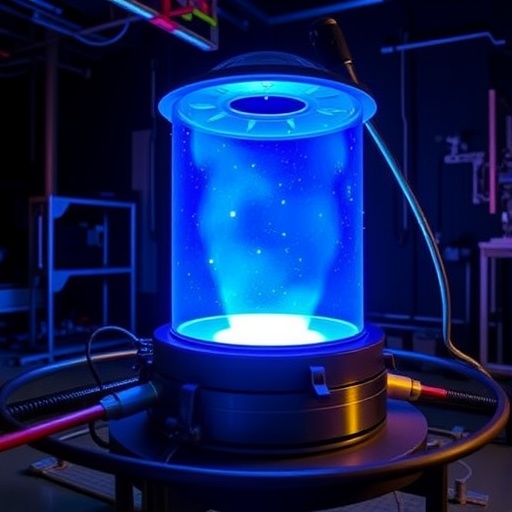
In a landmark achievement poised to deepen our understanding of the cosmos, researchers at the University of Minnesota Twin Cities have successfully cooled the Super Cryogenic Dark Matter Search (SuperCDMS) experiment to its base temperature. This monumental milestone brings the experiment to the operational threshold necessary for its ultra-sensitive superconducting detectors to function effectively. The temperature reached is astonishingly low—just thousandths of a degree above absolute zero—significantly colder than the vacuum of outer space, where atomic and molecular motion virtually ceases.
The attainment of base temperature signifies a pivotal transition for SuperCDMS, marking its progression from the phase of construction and installation to the critical stage of commissioning and scientific operation. The experiment’s core mission is to detect dark matter particles, enigmatic components constituting an estimated 85 percent of all matter in the universe. Despite their pervasive presence, these particles have never been directly observed, making their detection one of modern physics’ most tantalizing challenges.
Dark matter’s elusive nature is intertwined with fundamental questions about the universe’s formation, structure, and ultimate fate. While visible matter accounts for the galaxies, stars, and planets we observe, dark matter exerts gravitational influence without emitting, absorbing, or reflecting light, rendering it invisible to conventional detection methods. The SuperCDMS experiment seeks to intercept the faint interactions occurring as dark matter particles pass through the Earth, interactions so subtle that even trace environmental radioactivity could overwhelm the signals.
To mitigate this challenge, the University of Minnesota team engineered and built a sophisticated low-background shield for the experiment’s detectors. This massive, cylindrical enclosure, standing four meters tall and spanning four meters in diameter, is a layered fortress of ultra-pure lead and high-density polyethylene. The lead layers serve to absorb gamma rays, while the polyethylene moderates neutrons originating from cosmic ray interactions with the surrounding rock. Together, these materials create an ultra-quiet zone, shielding the sensitive detectors from interference that could obscure dark matter events.
Located deep within SNOLAB—a research facility situated some 6,800 feet underground in a working nickel mine near Sudbury, Ontario—the SuperCDMS experiment enjoys natural protection from cosmic rays and other pervasive background particles. This subterranean sanctuary is instrumental in providing the low-background environment essential for such a delicate search. The depth drastically reduces the flux of cosmic particles, which at the surface would generate noise severely hampering the experiment’s ability to discern meaningful data.
As the detectors enter the commissioning phase, scientists will embark on a meticulous process of bringing each sensor online. This involves calibrating and optimizing thousands of individual detector channels, a task that can require months to complete. Achieving precise calibration is crucial to ensuring that detected signals can be confidently attributed to potential dark matter interactions, rather than background noise or instrumental artifacts.
Beyond dark matter detection, SuperCDMS holds the promise of opening new windows into rare nuclear processes and uncharted particle interactions. Its groundbreaking cryogenic solid-state detectors operate at temperatures where quantum properties can be exploited, allowing unprecedented sensitivity to low-energy events. This capability could unveil not only dark matter but also rare isotopic phenomena and potentially undiscovered particles or forces, thus pushing the boundaries of particle physics.
A vital component of the experiment’s scientific arsenal lies in advanced data analysis techniques pioneered by the University of Minnesota group. Led by Assistant Professor Yan Liu, the team has developed sophisticated reconstruction algorithms designed to rapidly extract potential dark matter signals from the complex data that will be generated. These computational innovations are essential for handling the experiment’s high-resolution output while minimizing false positives.
The success of reaching base temperature and initiating detector commissioning is the culmination of years of experimental design, engineering, and collaboration between multiple institutions. The SuperCDMS collaboration includes support from the U.S. Department of Energy Office of Science, the National Science Foundation, and Canadian research agencies. This international effort reflects the global importance of solving the dark matter mystery.
Priscilla Cushman, the Spokesperson for SuperCDMS and a professor at the University of Minnesota School of Physics and Astronomy, emphasizes the significance of this stage: “Our transition to base temperature unlocks a new realm of experimental sensitivity. We are now poised to explore unexplored parameter space where the lightest dark matter particles might reside, potentially answering one of the most fundamental questions about the makeup of our universe.”
The scientific community eagerly anticipates the substantial data set that SuperCDMS will produce once full operation commences. Given the experiment’s unprecedented sensitivity and deep underground location, it is uniquely positioned to explore dark matter candidates across various theoretical models. Its findings will not only inform particle physics but could also have profound implications for cosmology and the understanding of galactic formation.
The University of Minnesota team members actively involved in this groundbreaking work include postdoctoral researchers Shubham Pandey and Himangshu Neog, research scientist Scott Fallows, and graduate students Zachary Williams, Elliott Tanner, and Chi Cap. Their collective expertise across physics, instrumentation, and data science forms the multidisciplinary backbone necessary for the experiment’s success.
With the SuperCDMS collaboration entering this critical phase, the scientific world stands at the threshold of possibly uncovering the constituents of dark matter. The coming months and years of data collection and analysis promise to elevate our comprehension of the Universe’s shadowy majority, transforming once speculative theories into tangible scientific knowledge.
Subject of Research: Detection and characterization of dark matter particles using ultra-sensitive cryogenic detectors.
Article Title: University of Minnesota and SuperCDMS Achieve Record-Breaking Cryogenic Temperatures, Unlocking New Frontiers in Dark Matter Detection.
News Publication Date: March 18, 2026.
Web References:
Image Credits: Greg Stewart/SLAC National Accelerator Laboratory.
Keywords
Dark matter, cryogenic detectors, SuperCDMS, low-background shield, SNOLAB, particle physics, superconducting detectors, underground laboratory, cosmology, gamma radiation shielding, neutron moderation, data analysis, quantum detectors.


