


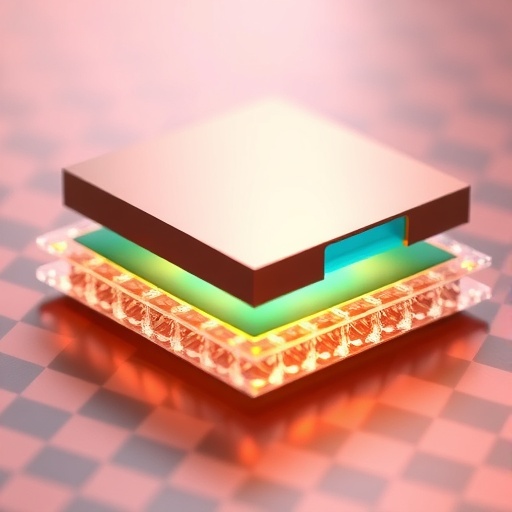
In a groundbreaking advancement set to redefine the landscape of spintronics, researchers at the University of Manchester have unveiled how the integration of magnetic films with atomically thin molybdenum disulfide (MoS₂) significantly alters magnetic energy dissipation mechanisms. This transformative discovery offers a pathway to harness and tailor spin dynamics within two-dimensional (2D) materials, propelling the prospect of practical, scalable spintronic devices closer to realization.
Spintronics, a technology exploiting the electron’s intrinsic spin alongside its charge, promises a new era of high-speed, energy-efficient data storage and processing. However, a critical challenge in this domain has been the inherent energy losses during spin manipulation, primarily manifesting as heat dissipation which throttles device speed and efficiency. The University of Manchester team’s recent findings elucidate how interfacing magnetic films with MoS₂ interfaces can dramatically influence these losses in a nuanced manner.
Central to their study is the use of permalloy, a ubiquitous magnetic alloy known for its soft magnetic properties, deposited on ultra-thin, large-area MoS₂ synthesized via industry-compatible chemical vapor deposition methods. This approach ensures that the observed phenomena transcend academic curiosities, laying a robust foundation for industrial scalability. The permalloy films experience a subtle yet impactful restructuring of their internal crystal lattice upon interaction with the MoS₂ substrate, a revelation that redefines our understanding of magnetic damping at the nanoscale.
Employing the sophisticated technique of ferromagnetic resonance (FMR), the researchers subjected the magnetic films to high-frequency magnetic fields, inducing spin precession akin to a gyroscopic wobble gradually losing momentum due to frictional forces. By methodically altering the thickness of the permalloy layers and meticulously analyzing how the induced spin precession attenuated, the team successfully disentangled energy dissipation contributions arising from the film surface and those emanating from its bulk interior.
Interestingly, the MoS₂ substrate fosters an ultra-clean interface with the permalloy, reducing magnetic damping at the surface and thus suppressing surface-related energy losses that typically plague thin magnetic films. Contrarily, this beneficial surface effect is slightly counterbalanced by increased internal energy losses, attributable to modifications in the film’s crystal structure induced by MoS₂. The precise separation of these competing phenomena resolves longstanding discrepancies in the literature regarding 2D materials’ influence on magnetic properties.
This nuanced understanding extends beyond fundamental physics to practical device engineering. It implies that by judiciously engineering the interfaces where magnetic films meet 2D materials, it is possible to tailor spin losses in a manner that minimizes unwanted heat generation without impairing magnetic performance. Such control is pivotal for the next generation of spintronic memory and logic devices, which demand rapid operation with minimal energy overhead.
The implications of this study ripple through the entire field of 2D material spintronics. While graphene has often stolen the spotlight, this work spotlights transition-metal dichalcogenides (TMDs) like MoS₂ as potent agents capable of modulating magnetic dynamics in technologically relevant ways. This shift opens new routes to exploit the vast family of TMDs to meet specific damping and interface quality criteria tailored for diverse spintronic applications.
Moreover, using large-area chemical vapor deposition to grow MoS₂ ensures that these phenomena can be realized in scalable, reproducible fashions aligned with industrial manufacturing processes. This compatibility marks a vital step toward transferring laboratory successes into commercial technologies, bridging the “valley of death” that often impedes innovation translation.
The lead researcher, Dr. Henry De Libero, emphasized the significance of these findings, noting that they highlight the intricacies and potential hidden within 2D materials to revolutionize magnetic thin-film technologies. “Understanding how ultra-thin material interfaces affect energy dissipation mechanisms allows us to envision spintronic devices that are both more efficient and faster, a critical leap forward for next-generation memory technologies,” he remarked.
Furthermore, this study challenges the prevailing assumption that adding 2D materials inevitably amplifies energy loss in magnetic systems. Instead, it demonstrates that with precise interface engineering, 2D layers like MoS₂ can reduce surface damping, highlighting the importance of clean, well-controlled interfaces in designing future spintronic materials and devices.
Looking ahead, the insights gained from this research pave the way for exploring a broader array of magnetic alloys and 2D material combinations. Such explorations could unlock finely tuned magnetic damping parameters tailored to specific device requirements, including emerging applications in quantum computing and THz-frequency spintronic devices.
In summary, the University of Manchester’s research not only sheds light on the fundamental interactions between magnetic films and 2D materials but also sets a new benchmark for spintronic interface design. By unraveling the complex interplay between bulk and surface damping contributions, it charts a course toward more energy-efficient, faster magnetic memory technologies, fueling both scientific inquiry and technological innovation in the vibrant field of 2D material spintronics.
News Publication Date: 4-Mar-2026
Web References:
https://journals.aps.org/prapplied/abstract/10.1103/wfsl-4mhb
Keywords
Graphene, Materials science, Materials, Material properties, Materials engineering, Two dimensional materials, Spintronics
Cite Scienmag News
Denise Maddox. (March 6, 2026). Expansive MoS₂ Layers Minimize Energy Loss in Magnetic Memory Films. Scienmag. https://scienmag.com/expansive-mos%e2%82%82-layers-minimize-energy-loss-in-magnetic-memory-films/
Denise Maddox. "Expansive MoS₂ Layers Minimize Energy Loss in Magnetic Memory Films." Scienmag, 6 March 2026, https://scienmag.com/expansive-mos%e2%82%82-layers-minimize-energy-loss-in-magnetic-memory-films/. Accessed 4 September 2026.
Denise Maddox. "Expansive MoS₂ Layers Minimize Energy Loss in Magnetic Memory Films." Scienmag. March 6, 2026. https://scienmag.com/expansive-mos%e2%82%82-layers-minimize-energy-loss-in-magnetic-memory-films/


