

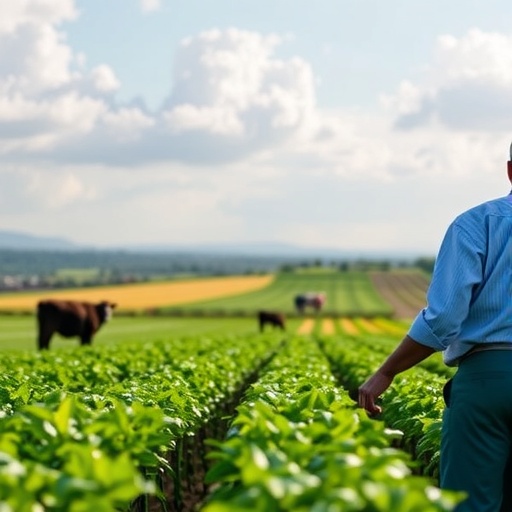
In a groundbreaking advancement for sustainable agriculture, researchers at La Trobe University have unveiled an innovative method to quantify and report the environmental performance of farms. This development signifies a pioneering step towards establishing future sustainability ratings for food and fiber products consumed globally. By integrating diverse scientific techniques and data sources, this method addresses one of the crucial challenges in modern agriculture: obtaining accurate, transparent, and actionable farm-level data encapsulating biodiversity, ecosystem services, and overall environmental stewardship.
The study, published in the prestigious journal Methods in Ecology and Evolution, involved a comprehensive analysis of 50 mixed grazing and cropping farms across southeastern Australia. This region, typifying diverse agricultural systems, served as an ideal testing ground for the new Farm-scale Natural Capital Accounting framework. It bridges the gap between ecological theory and agricultural practice by combining production statistics, remote sensing technology, ecological modeling, and detailed field assessments into a cohesive, verifiable reporting system.
At the forefront of this research is Dr. Jim Radford, director of the Research Centre for Future Landscapes at La Trobe University. He emphasizes the necessity of integrating natural capital into the agricultural accounting ledger, stating that for agricultural sustainability to be genuinely recognized, the socio-ecological assets underpinning productivity—such as soil fertility, water resources, and biodiversity—must be rigorously valued and tracked. This echoes a paradigm shift from purely financial metrics to holistic ecological-economic accounting in farm management.
The Farm-scale Natural Capital Accounting method aligns with the United Nations’ System of Environmental Economic Accounting framework, ensuring international compatibility and relevance. Crucially, it quantifies critical natural assets and assesses their contributions to farming outputs through ecosystem services including pollination, pest regulation, forage provisioning, and providing shade and shelter for livestock. By explicitly including these biophysical contributions, the method offers a nuanced understanding of how natural capital underpins agricultural productivity, resilience, and sustainability.
Beyond natural capital quantification, the system incorporates comprehensive environmental performance indicators like greenhouse gas emissions, water-use efficiency, and pollution metrics. These elements provide a multidimensional view of farm sustainability, enabling farmers and supply chain stakeholders to identify both strengths and vulnerabilities within their operations. Such granularity encourages targeted management actions that enhance environmental outcomes while maintaining or improving productivity.
With 58 percent of Australian land managed by farmers, the invisibility of natural capital in conventional financial accounting systems represents a significant obstacle to sustainable practice adoption. Dr. Radford underscores that farmers face increasing demands from global markets and policymakers to measure and transparently report their environmental stewardship, but lack standardized, scientifically robust tools. The introduction of this new accounting framework directly addresses this gap, offering compelling incentives for farmers to engage in nature-positive management.
Offering practical and repeatable insights, this framework enables farmers to detect degraded zones, prioritize land rehabilitation, and monitor ecological changes over time. Furthermore, through its rigorous verification protocols, the system establishes a trustworthy basis for supply chains and retailers to validate sustainability claims, mitigating the risks of greenwashing and enhancing consumer confidence. Such transparency is critical in an era where eco-labeling and environmental certifications are often scrutinized.
Looking forward, the adaptability of Farm-scale Natural Capital Accounting opens avenues for integrating environmentally friendly product ratings on packaging, paralleling the widely recognized Health Star Ratings in the food industry. Dr. Radford envisions that these ratings will empower consumers to make informed choices, stimulating market-driven demand for sustainable products and incentivizing producers to enhance their environmental credentials systematically.
Collaboration forms a cornerstone of advancing this initiative. The La Trobe University team is currently partnering with Woolmark Plus to embed the method within the Nature Positive farming framework. This cooperation seeks to provide Australian wool growers a verifiable certification of their environmental performance, further promoting accountability and recognition in global textile supply chains. Such alliances demonstrate the method’s scalability and applicability across diverse commodity sectors.
Expanding the application of this novel accounting approach beyond southeastern Australia is a priority for the research group. They aim to adapt and tailor the system to a wider range of farming systems and geographical contexts, facilitating a transformative shift towards nature-positive agriculture nationally and internationally. Ultimately, their vision is to accelerate the integration of natural capital metrics into mainstream agricultural practices, catalyzing a resilient and sustainable food future.
Complementing this initiative, related research findings have revealed that livestock farms enriched with higher natural capital reserves exhibit superior productivity, profitability, and drought resilience. These outcomes challenge conventional perceptions that environmental stewardship compromises economic viability and instead reinforce the synergistic benefits of harmonizing ecological health with agricultural success.
In summary, by delivering robust, transparent, and replicable measures of natural capital and environmental performance, the Farm-scale Natural Capital Accounting framework represents a vital tool for farmers, supply chains, and policymakers alike. It not only bridges scientific rigor with practical utility but also facilitates a credible pathway toward achieving sustainable, profitable, and resilient farming systems in the face of global environmental challenges.
Subject of Research: Not applicable
Article Title: Farm-scale Natural Capital Accounting: Unlocking the potential of natural capital to support sustainable agriculture
News Publication Date: 18-Feb-2026
Web References:
- Methods in Ecology and Evolution
- UN’s System of Environmental Economic Accounting framework
- Woolmark Plus Nature Positive farming framework
References:
- DOI: 10.1111/2041-210x.70245
Keywords: Farming, Sustainability


