


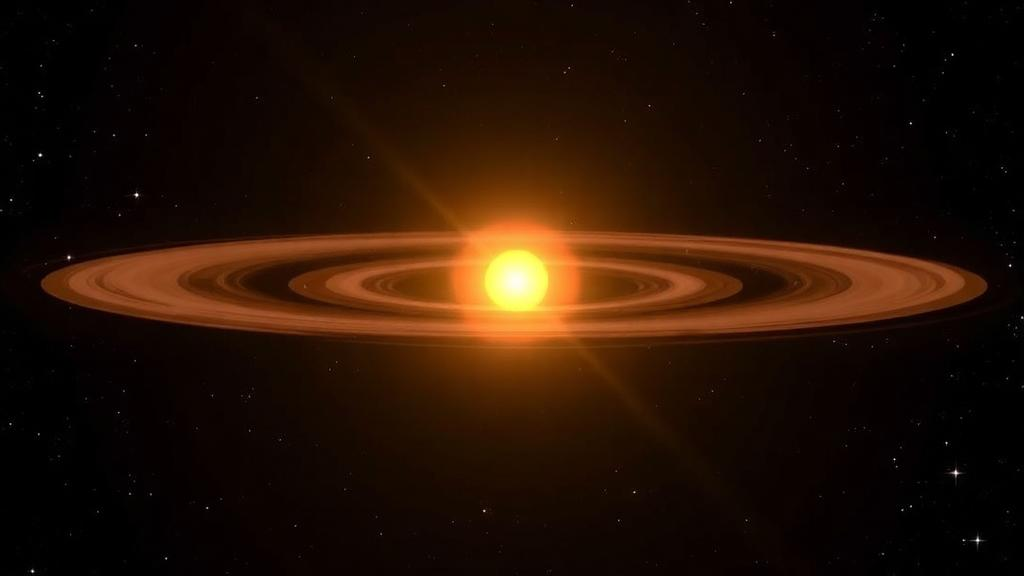
Astronomers at Lund University in Sweden have uncovered what they describe as compelling evidence that comets are orbiting a young star in a distant planetary system, and that these icy visitors may be acting as water carriers in a way that mirrors how our own Solar System may have been supplied billions of years ago. The target of the study is PDS 70, a planetary system just over five million years old located roughly 370 light-years from Earth. It is a system that planetary scientists watch with particular fascination, because it hosts at least two gas giants that are still in the process of forming, embedded in a disc of gas and dust from which new worlds are being assembled in real time. The new findings, published in Nature Communications, suggest that the machinery for delivering water to the inner, planet-forming regions of a young system may already be at work there.
The central clue comes from an unexpected place: sodium gas. Water vapour had already been detected in the inner regions of PDS 70 as early as 2023, a puzzling observation in its own right, because the inner parts of a young planetary system are hot and irradiated, conditions in which water should not easily survive unless it is being replenished. The Lund researchers have now shown that variations in sodium gas observed in front of the star may be the signature of comets sweeping through the inner parts of the system. As a comet approaches its host star, the rising temperature causes the ice on its surface to transform directly into gas, a process known as sublimation. The escaping gas leaves a measurable imprint in the starlight, and it is precisely such an imprint that the team believes it has detected.
The observations analysed by the researchers date from 2018, and they reveal sodium gas moving at several kilometres per second relative to the star. More telling than the speed alone is the behaviour of the gas over time: it appears and then disappears over the course of several nights. That transient pattern is exactly what one would expect if comets were passing in front of the star, briefly releasing gas as they are heated and then moving on. A permanent reservoir of gas would not behave this way. The episodic appearance and vanishing of the absorption signal is the kind of fingerprint that astronomers have learned to associate with cometary activity, and it is the first time such a signal has been linked to a star of this type.
“This is the first time we have seen evidence of exocomets orbiting a star that is relatively cool, much like our Sun. Furthermore, this system is the youngest in which exocomet activity has been proposed,” says Aline Novais, an astronomy researcher at Lund University who led the analysis. The comparison with the Sun matters because most previous detections of exocomets have come from hotter stars, where the observational signatures are easier to isolate. Finding evidence of cometary activity around a cool, Sun-like star that is barely five million years old opens a window onto the earliest chapter of planetary development, the very phase during which the Earth and its neighbours were being assembled from dust, gas, and the volatile compounds delivered from farther out.
The implications reach well beyond a single system. Comets form in the cold outer regions of a planetary system, where water and other volatile substances exist as stable ices. In their distant homes, they are effectively frozen reservoirs of the raw materials of habitability. If nothing disturbs them, they remain there indefinitely. But young planetary systems are dynamically restless places, and the Lund team has used computer simulations to model how the comets around PDS 70 might be set in motion. The results show that objects far out in the system can be affected by the gravitational pull of the system’s gas giants and flung inward toward the star. The two massive planets still forming in PDS 70 are therefore not merely spectators; they may be the engines that redirect icy bodies into the inner system.
“Our study suggests that comets may be responsible for transporting water to the inner parts of the planetary system, where planets can form, in the same way as in the early Solar System,” says Novais. The mechanism is elegant in its simplicity. A comet that forms in the frigid outskirts carries ice from the moment of its birth. If a gravitational encounter with a giant planet alters its orbit and sends it plunging toward the star, sublimation releases that water, along with carbon-bearing molecules and other volatiles, into the inner regions where rocky planets are taking shape. In effect, the comets function as delivery vehicles, ferrying material across the vast temperature gradient that separates the outer system from the warm inner zone where terrestrial planets can hold liquid water on their surfaces.
That picture resonates strongly with one of the oldest questions in planetary science: where did Earth’s water come from? The young Earth formed in a region of the early Solar System that was almost certainly too hot for water ice to condense, which means the water in our oceans must have arrived from somewhere else. Water-rich asteroids and comets are the two leading candidate sources, and researchers have debated for decades which of the two played the dominant role. Isotopic measurements, particularly the ratio of deuterium to hydrogen in Earth’s water, have provided partial constraints, but the question remains open. What the PDS 70 observations offer is the chance to watch a comparable delivery process unfold in a system that is still in its infancy, rather than inferring it from the ancient, heavily altered record preserved in our own Solar System.
“It is reminiscent of a possible process in the early Solar System, in which comets may have helped to deliver water to the young Earth,” says Alexandra Stockwell Murphy, an astronomer at Lund University and a co-author of the study. The parallel is not exact, of course. PDS 70 is a specific system with its own architecture, its own giant planets, and its own history of dynamical evolution. But the physical processes at play, gravitational scattering by giant planets followed by sublimation of icy bodies in the inner system, are universal. If those processes are operating in PDS 70 today, they likely operated in the young Solar System as well, during the era when the giant planets were migrating and the population of small icy bodies was being reshuffled across the system.
The technical achievement behind the detection should not be understated. Sodium is a trace element in cometary material, but it is a valuable diagnostic because it produces strong, narrow absorption lines that stand out clearly against the spectrum of a star. Detecting the gas requires not only high-resolution spectroscopy but also careful discrimination between the signal from the passing comet and the much larger signal from the star itself and from the surrounding disc. The transient nature of the absorption, appearing and disappearing over several nights, combined with the measured velocity offset of several kilometres per second relative to the star, together provide a consistent picture of small, fast-moving bodies releasing gas as they pass through the inner system. The orbital simulations then close the loop, demonstrating that the gravitational influence of the system’s gas giants is sufficient to populate such orbits from the outer reservoir.
The next chapter of the story may arrive soon. “And when the Extremely Large Telescope, which is currently being built in Chile, becomes operational in the coming years, we will be able to find out whether there are any further planets in the system and thus gain an even clearer picture of how water and other building blocks of planets are transported,” concludes Jens Hoeijmakers, an astronomy researcher at Lund University. The Extremely Large Telescope, with its enormous collecting area and advanced instrumentation, will be capable of imaging and characterising planets around nearby young stars with unprecedented sensitivity, and PDS 70 is certain to be among its prime targets. If additional planets are found, their gravitational influence could be incorporated into more refined models of how icy bodies are scattered inward. For now, the sodium signal flickering in front of a five-million-year-old star offers a rare and tantalising glimpse of a process that may have made Earth habitable, playing out again, 370 light-years away, in a system still writing its opening pages.
Subject of Research: Evidence of water-delivering exocomets orbiting the young star PDS 70
Article Title: Comets may have transported water to a young planetary system
Article References: Comets may have transported water to a young planetary system. (n.d.). Original publication
Image Credits: AI Generated
DOI: Not provided
Keywords: exocomets, PDS 70, water delivery, planetary formation, protoplanetary disk, sodium gas, sublimation, Lund University, Nature Communications, Extremely Large Telescope, young star, gas giants
Cite Scienmag News
Grant Pearson. (October 10, 2026). Exocomets Around a Young Star May Be Delivering Water to Forming Planets. Scienmag. https://scienmag.com/exocomets-around-a-young-star-may-be-delivering-water-to-forming-planets/
Grant Pearson. "Exocomets Around a Young Star May Be Delivering Water to Forming Planets." Scienmag, 10 October 2026, https://scienmag.com/exocomets-around-a-young-star-may-be-delivering-water-to-forming-planets/. Accessed 10 October 2026.
Grant Pearson. "Exocomets Around a Young Star May Be Delivering Water to Forming Planets." Scienmag. October 10, 2026. https://scienmag.com/exocomets-around-a-young-star-may-be-delivering-water-to-forming-planets/


