

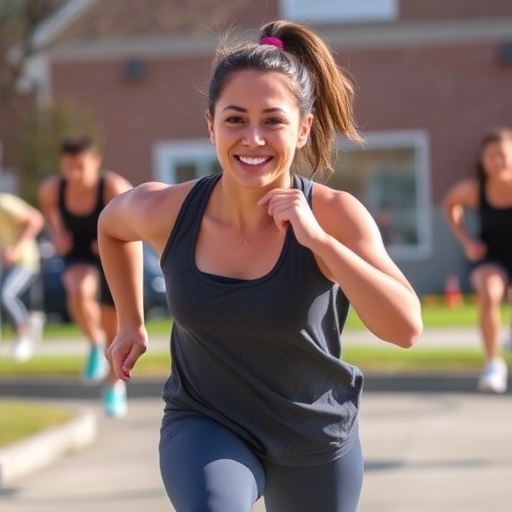
In recent years, the intricate relationship between physical exercise and quality of life has garnered increasing attention among psychologists and public health researchers worldwide. A groundbreaking study conducted by Zhang, An, Li, and their colleagues delves deeply into this fascinating nexus, particularly focusing on Chinese college students—a demographic often navigating the tumultuous pathways of young adulthood. Their paper, titled “Relationship between physical exercise and quality of life in Chinese college students: the chain mediating effect of psychological flourishing and optimistic intelligence,” published in BMC Psychology in 2025, expands our understanding by revealing the complex psychological processes that mediate this relationship.
The study posits that physical exercise, widely recognized for its physiological benefits, exerts profound effects on mental and emotional well-being among college students. By employing sophisticated statistical analyses, including chain mediating models, the research explores how two pivotal psychological constructs—psychological flourishing and optimistic intelligence—intervene in this dynamic. Psychological flourishing refers to a state of optimal mental health characterized by feelings of engagement, purpose, and positive relationships, while optimistic intelligence encompasses an individual’s innate capacity to maintain hope and positive expectations even amid adversity.
The research team utilized a large sample of Chinese college students, a population that faces unique stressors such as academic pressure, social adaptation, and cultural expectations, all of which can significantly influence mental health outcomes. In this context, the authors argue that physical exercise functions not merely as a physical activity but as a catalyst facilitating a boost in psychological flourishing, which in turn fosters optimistic intelligence. This chain mediating mechanism then culminates in enhanced self-reported quality of life measures.
One of the key technical strengths of this paper lies in its rigorous methodological design. The authors deployed validated psychometric instruments to measure psychological flourishing and optimistic intelligence, ensuring high reliability and validity of their constructs. Furthermore, their model accounted for possible confounding factors like socioeconomic status and baseline health conditions, thereby enhancing the robustness of their findings. By employing structural equation modeling, the study disentangled direct and indirect effects, highlighting the mediatory pathways through which exercise benefits mental health.
Importantly, this study transcends simplistic cause-effect assertions typical in earlier research by integrating multidisciplinary perspectives from psychological science and exercise physiology. The nuances captured by analyzing the chain mediating effects underscore the multifactorial nature of well-being among youth. Such insights pave the way for targeted interventions that leverage physical activity not just to improve physical fitness but to foster psychological resilience and optimistic outlooks.
The implications of this research are vast, particularly within the context of public health initiatives and university wellness programs in China and beyond. Given the escalating rates of depression, anxiety, and stress-related disorders among young adults globally, the elucidation of mechanisms that underline the benefits of physical exercise warrants urgent attention. Institutions can tailor evidence-based strategies that incorporate physical activities designed to amplify psychological flourishing, thereby intrinsically nurturing optimistic intelligence.
Critically, the paper also situates its findings within broader sociocultural frameworks, acknowledging that Chinese cultural norms surrounding academic achievement and social harmony might modulate the observed effects. This cultural sensitivity adds a valuable dimension, suggesting that psychological flourishing and optimism may manifest differently across populations, hence necessitating culturally adapted approaches to health promotion.
Moreover, the study contributes to the accumulating body of literature advocating for holistic health models that integrate mind-body connections. It challenges the reductionist viewpoint that isolates physical health from psychological constructs, thereby reinforcing a more comprehensive paradigm where mental and physical health influence and reinforce each other dynamically.
Technologically, this paper opens new avenues for digital health applications that can track not only physical activity but also psychological markers of flourishing and optimism through wearable devices and mental health apps. Such tools could personalize exercise regimens and mental health interventions based on real-time data analytics, enhancing engagement and efficacy.
Future research inspired by Zhang et al.’s findings may explore longitudinal designs to ascertain causality more definitively, as the current cross-sectional nature limits temporal inferences. Additionally, experimental interventions crafted to manipulate psychological flourishing and optimistic intelligence could validate their mediating roles and inform the development of integrated mind-body therapies.
In sum, this study illuminates the transformative potential of physical exercise as a conduit for psychological enhancement among university students. By elucidating the chain mediating effect of psychological flourishing and optimistic intelligence, it provides robust empirical evidence underscoring the necessity to approach health promotion through multifaceted psychological lenses. The research heralds a promising frontier where physical activity intersects with mental vitality, offering a scientific blueprint for fostering resilient and thriving future generations.
On a societal level, the findings encourage policymakers to prioritize and fund physical education and mental health resources within academic institutions. This integrative approach promises not only to elevate individual quality of life but also to cultivate more vibrant, hopeful communities resilient in the face of contemporary stressors.
The research by Zhang and colleagues ultimately reframes physical exercise beyond a mere lifestyle choice—it emerges as a psychological investment with ripple effects that extend across emotional, cognitive, and social domains. In an era marked by mounting mental health challenges, such insights are more than timely; they are imperative for reconfiguring how societies conceive of health and well-being.
Subject of Research: Relationship between physical exercise and quality of life in Chinese college students, with a focus on the mediating psychological variables of psychological flourishing and optimistic intelligence.
Article Title: Relationship between physical exercise and quality of life in Chinese college students: the chain mediating effect of psychological flourishing and optimistic intelligence.
Article References:
Zhang, J., An, H., Li, Y. et al. Relationship between physical exercise and quality of life in Chinese college students: the chain mediating effect of psychological flourishing and optimistic intelligence. BMC Psychol (2025). https://doi.org/10.1186/s40359-025-03777-8
Image Credits: AI Generated


