


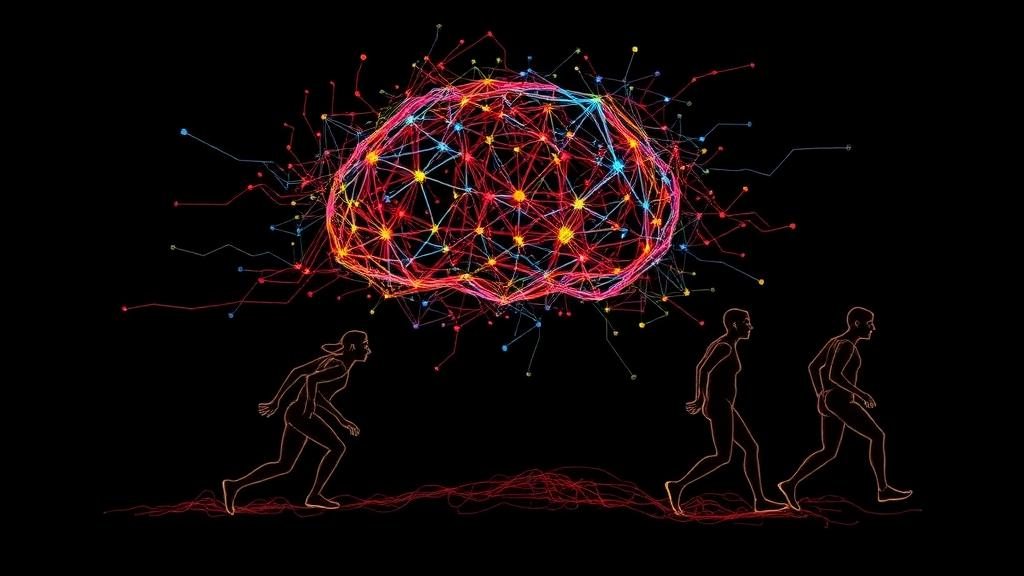
Does evolution have a direction? The question has divided biologists since Darwin, and a new review in Frontiers in Complex Systems argues that the answer is a qualified yes: evolution contains mechanisms that tend to increase complexity, and the same time-asymmetrical dynamics may extend to basic consciousness. The paper, by Shimon Edelman of Cornell University, synthesizes decades of work on complexity, entropy, and selection, then proposes that the emergence and learning of phenomenal awareness follow the same entropic logic as the evolution of life itself.
Darwin himself wrestled with the question. In an 1838 notebook entry, he wrote that as forms became complicated they opened fresh means of adding to their complexity, but that there was no necessary tendency in simple animals to become complicated. Edelman takes this nuance as his starting point: complexity increase is a tendency, not a universal law, and it need not apply across the board. Bacteria and archaea have coexisted with metazoans for hundreds of millions of years, and complexity has risen and fallen in individual lineages.
Edelman identifies at least three families of mechanisms that can drive complexity upward. The first is entirely passive: in any evolutionary system with variation and heredity, complexity tends to increase simply because it is bounded from below. A random walk in complexity space, starting near the minimum, can only drift upward in the long run. This insight underlies the Zero-Force Evolutionary Law proposed by McShea and Brandon, which holds that rising diversity and complexity are the null expectation in the total absence of selection.
The second mechanism is entropic. Complexity growth can proceed concomitantly with increasing entropy, the probable direction of a system’s progression through its configuration space. Edelman focuses on Boltzmann entropy, where the entropy of a macrostate is proportional to the logarithm of the number of microstates it contains. Transitions from macrostates with fewer microstates to those with more are more probable, so the succession of macrostates over time tends toward higher entropy. Crucially, this probabilistic dynamics does not require the system to be closed or to approach equilibrium.
The apparent paradox of ordered biological structures arising under a disordering principle dissolves once the word order is confined to its proper realm. As Wicken argued in 1979, biological structures are not ordered in the information-theoretic sense; they are organized. The Second Law acts to dissipate order, not organization, and organization tends to accumulate at the expense of the former. Brooks and Wiley formalized this idea, noting that when the phase space of possibilities expands faster than the system can fill it, increasing entropy can be accompanied by the emergence of organized structure.
The third family of mechanisms involves selection. Saunders and Ho showed in 1976 that at a local fitness peak, random removal of a component must make the system less fit, while random addition allows the possibility of an increase. This asymmetry acts as a ratchet, amplifying passive complexity increases. Adami and colleagues demonstrated in simulated evolution that selection forces genomes to behave as a natural Maxwell Demon, within a fixed environment, genomic complexity is forced to increase. Selection can also open new possibilities for adaptation, expanding the effective genetic phase space and echoing Darwin’s observation that complexity breeds complexity.
Edelman then extends these ideas to consciousness, focusing on basic phenomenal awareness, the simplest variety of consciousness, exemplified by simple perceptions such as the taste of a wine or the smell of a flower. According to his Dynamical Emergence Theory, this level of awareness consists in dynamically emergent diagnosis by a cognitive system of its own representational states, what he calls autodiagnosis. The stream of awareness is identified with the succession of emergent metastable macrostates in the system’s state space, and these macrostates are non-arbitrary because they are equivalence classes of future predictability.
Basic phenomenal awareness can become more complex over evolutionary time or through learning. Edelman illustrates the evolutionary scale with the progression from simple photosensitivity in planarian eyespots to the imaging camera eye of frogs, cortical shape perception in mammals, and color perception. Learning-induced complexification is exemplified by wine tasting expertise, where a taster progresses from distinguishing red from white wine to identifying a specific variety, vineyard, and vintage. On an abstract computational level, both types of complexification increase the topological complexity of the system’s trajectory space, and the acquisition of exemplars and categories makes the process entropic, as the system’s total entropy increases with learning.
As a test case, Edelman proposes reservoir computing, an architecture consisting of a reservoir of coupled neurons with nonlinear dynamics and a linear readout circuit. This architecture naturally maps onto the olfactory circuit of insects such as the locust and fruit fly, where recurrently interconnected projection neurons in the antennal lobe project to Kenyon cells in the mushroom body. Edelman outlines several experiments using this model to test whether the entropy and topological complexity of the system’s dynamics tend to increase over evolutionary time and through learning.
The review concludes that if one seeks a general tendency rather than a universal law, complexity increase emerges as a non-trivial principle of evolution, underwritten by several distinct mechanisms. This principle applies not just to the evolution of species morphologies but also to the evolution and learning of their capacity for phenomenal discernment, which constitutes the most basic level of consciousness. Edelman notes that the growth of complexity is expected to accelerate when greater complexity facilitates evolvability, and that biology co-evolving with culture provides a cumulative, self-reinforcing catalyst. The scope of such an approach could extend even to cosmological selection hypotheses, though that extension awaits future research.
Subject of Research: On the evolutionary dynamics of complexity and consciousness
Article Title: On the evolutionary dynamics of complexity and consciousness
Article References: Edelman, S. (2026). On the evolutionary dynamics of complexity and consciousness. Frontiers in Complex Systems, 3, Article 1672525. https://doi.org/10.3389/fcpxs.2025.1672525
Image Credits: AI Generated
DOI: 10.3389/fcpxs.2025.1672525
Keywords: evolution, complexity, consciousness, entropy, phenomenal awareness, Zero-Force Evolutionary Law, Dynamical Emergence Theory, reservoir computing, natural selection, thermodynamics, Shimon Edelman, Frontiers in Complex Systems
Cite Scienmag News
Gavin Prescott. (October 16, 2026). Evolution May Push Complexity and Consciousness Upward, Review Argues. Scienmag. https://scienmag.com/evolution-may-push-complexity-and-consciousness-upward-review-argues/
Gavin Prescott. "Evolution May Push Complexity and Consciousness Upward, Review Argues." Scienmag, 16 October 2026, https://scienmag.com/evolution-may-push-complexity-and-consciousness-upward-review-argues/. Accessed 16 October 2026.
Gavin Prescott. "Evolution May Push Complexity and Consciousness Upward, Review Argues." Scienmag. October 16, 2026. https://scienmag.com/evolution-may-push-complexity-and-consciousness-upward-review-argues/


