


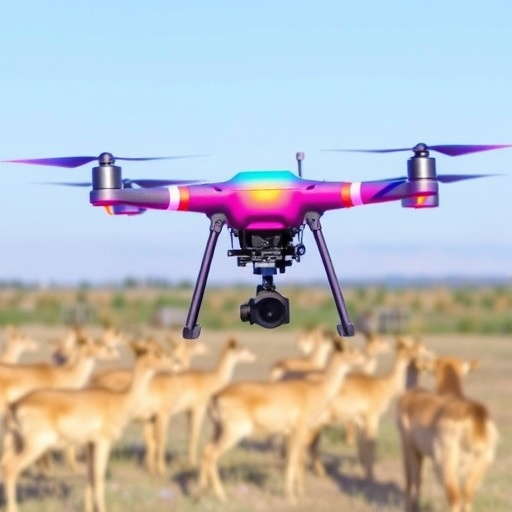
In an era of rapidly advancing technologies, the integration of drones in wildlife monitoring has taken a leap with the advent of thermal infrared imaging systems. Researchers are increasingly recognizing the potential of Unmanned Aerial Vehicles (UAVs) outfitted with thermal sensors to revolutionize the way we observe and study wildlife. This innovative approach not only enhances the efficiency of data collection but also offers unprecedented insights into animal behavior, distribution patterns, and habitats that were previously difficult to obtain through traditional methods.
Recent findings highlighted in a study by Bohnett, Lamichanne, and Chaudhary present a comprehensive evaluation of the efficacy and efficiency of thermal infrared UAV technology specifically tailored for wildlife observations. The study meticulously delineates the parameters that contribute to the effectiveness of this method, arguing for its potential to transform ecological monitoring practices. UAVs have become a critical asset in the field, allowing researchers to cover expansive areas with minimal human disturbance, which is vital for obtaining reliable data on elusive species.
The significance of using thermal infrared UAVs lies in their ability to detect heat emitted from animals, thereby allowing researchers to locate and study them discreetly. Unlike conventional monitoring techniques, which often rely on visual sightings or baiting methods, thermal imaging can penetrate foliage and perform well in various light conditions, making it an invaluable tool for studying nocturnal and cryptic species. This advancement not only facilitates more efficient wildlife counts but enhances the understanding of animal behavior and habitat usage throughout different seasons.
In their research, the team undertook field tests to assess the performance of thermal UAV technology compared to traditional wildlife observation methods. These tests involved a range of scenarios, from surveying large populations in open terrains to tracking individual animals in densely vegetated areas. The results showcased that UAVs equipped with thermal cameras not only reduced the time spent on the ground but also increased the accuracy of wildlife assessments, providing a compelling argument for their widespread adoption in ecological studies.
Moreover, the implementation of thermal infrared technology is noted for its cost-effectiveness. As drones become increasingly affordable and accessible, their application in wildlife monitoring is set to expand, democratizing research capabilities across various geographic regions and research environments. This is particularly advantageous for developing countries that may lack resources for extensive ground surveys, allowing them to engage in wildlife conservation efforts through the use of modern technology.
The research team also emphasized the environmental benefits of using UAVs. By minimizing human interference in sensitive habitats, drones can collect vital data without impacting wildlife behavior. This non-invasive methodology ensures that the natural processes occurring within ecosystems remain undisturbed, providing a more accurate reflection of animal life and environmental health.
A significant aspect of this approach is its adaptability to various ecological contexts. The study demonstrated that thermal infrared UAVs can be effectively employed in diverse terrains—such as forests, wetlands, and grasslands—making them versatile tools for a wide array of wildlife research applications. This adaptability is essential for understanding how different species interact with their environments, especially as climate change alters habitats and migratory patterns.
In addition to wildlife monitoring, the technology holds promise for broader conservation strategies. Identifying hotspots of animal activity can aid in establishing protected areas and managing human-animal conflicts, thus playing a critical role in biodiversity preservation. The integration of thermal UAVs into conservation planning can also enhance the effectiveness of rescue operations for endangered species, ensuring timely interventions in the face of imminent threats.
The implications of this study extend beyond mere data collection; they challenge conventional knowledge about wildlife research methodologies. By signifying a shift towards technological integration in ecological studies, the findings advocate for a future where ongoing surveillance and monitoring can be performed more sustainably and efficiently. As conservationists strive to address the pressing challenges posed by habitat loss, poaching, and climate change, embracing innovative tools like thermal infrared UAVs could be vital in safeguarding our planet’s remaining wildlife.
Overall, the research underscores the transformative potential of UAV technology in improving ecological monitoring and environmental stewardship. By providing new insights and fostering a deeper understanding of wildlife dynamics, thermal imaging drones are not merely tools—they represent a paradigm shift in how we engage with and protect the natural world. The future of wildlife monitoring could very well be defined by this intersection of technology and ecology, marking a significant advancement towards informed conservation efforts that are both efficient and ethically responsible.
In conclusion, Bohnett, Lamichanne, and Chaudhary’s study is a pivotal contribution to wildlife research, advocating for the use of thermal infrared UAV technology in monitoring and studying wildlife populations. As researchers and conservationists, harnessing this technology can lead to more informed decisions and innovative solutions to pressing ecological problems. The call to action is clear: integrating these advanced tools can ensure that our approaches to wildlife conservation are not just reactive, but proactive, ensuring the survival of countless species for generations to come.
Cite Scienmag News
Margaret Porter. (January 11, 2026). Evaluating Thermal UAVs for Wildlife Monitoring Efficiency. Scienmag. https://scienmag.com/evaluating-thermal-uavs-for-wildlife-monitoring-efficiency/
Margaret Porter. "Evaluating Thermal UAVs for Wildlife Monitoring Efficiency." Scienmag, 11 January 2026, https://scienmag.com/evaluating-thermal-uavs-for-wildlife-monitoring-efficiency/. Accessed 3 September 2026.
Margaret Porter. "Evaluating Thermal UAVs for Wildlife Monitoring Efficiency." Scienmag. January 11, 2026. https://scienmag.com/evaluating-thermal-uavs-for-wildlife-monitoring-efficiency/


