


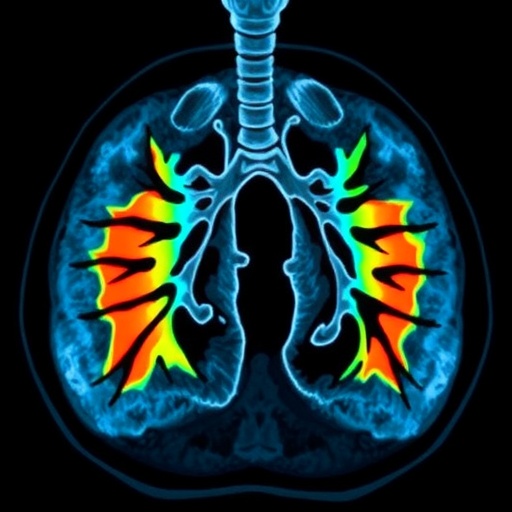
A groundbreaking study has recently emerged in the realm of pediatric medicine, significantly enhancing our understanding of lung health in children afflicted with cystic fibrosis. This innovative research, conducted by a team of scientists led by Munidasa, utilizes advanced imaging techniques to monitor lung function over time. The pivotal focus is on comparing two sophisticated MRI technologies: phase-resolved functional lung imaging (PREFUL) and hyperpolarized xenon-129 (hyperpolarized ^129Xe) MRI. Such comparative studies are essential as they provide clinicians with precise tools for assessing treatment efficacy in a demographic where monitoring lung function presents distinct challenges.
Cystic fibrosis is a severe genetic disorder that primarily impacts the lungs, leading to chronic respiratory infections and declining pulmonary function. Children with this affliction require comprehensive and regular monitoring to manage their condition effectively. Unfortunately, traditional methods of tracking lung health often fall short, making the adoption of advanced imaging techniques not just beneficial, but necessary. With the recent approval of elexacaftor/tezacaftor/ivacaftor—a triple-combination therapy designed to improve lung function—there is a pressing need for reliable longitudinal assessment strategies to gauge treatment impact on pediatric patients.
One of the standout features of this research is its emphasis on longitudinal monitoring. This approach enables researchers to observe how changes in lung function evolve over time, providing invaluable insights into the effectiveness of new therapies. The study thoughtfully contrasts PREFUL, which assesses lung perfusion and ventilation, against hyperpolarized ^129Xe MRI, a method that allows for detailed imaging of alveolar gas exchange. By employing these advanced imaging techniques, the research team seeks to reveal nuanced details about pulmonary health, which are often obscured by conventional methods.
In the study, patients undergo various imaging sessions at specific intervals, creating a comprehensive timeline of lung function dynamics. The imaging data collected are not merely snapshots; they include detailed information about regional lung function, ventilation distribution, and blood flow, allowing for a rich, multifaceted understanding of individual lung health. Such detailed mapping is crucial for determining how well therapies like elexacaftor/tezacaftor/ivacaftor are working in improving airway function and overall respiratory health.
Interestingly, the researchers highlighted some limitations of existing methodologies. Traditional methods for lung function testing, such as spirometry, often fail to fully capture the complexities of lung physiology in children with cystic fibrosis. By juxtaposing these traditional measures with the advanced imaging approaches of PREFUL and hyperpolarized ^129Xe MRI, the researchers hope to emphasize the inadequacies of older technologies and make a compelling case for their adoption in clinical practice.
The study also tackles the critical issue of biomarkers for lung function in pediatric cystic fibrosis patients. While improvements in lung function are the direct goal of therapies, the need for reliable biomarkers to track these improvements remains vital. The imaging techniques evaluated in this research offer the potential for new biomarkers that could not only indicate how well a treatment works but could also lead to personalized therapeutic approaches tailored to individual patient needs.
Moreover, the researchers emphasize the potential for these imaging modalities to play a significant role in clinical trials. As new therapies continue to emerge, the ability to rapidly and accurately assess drug efficacy could drastically change how pharmaceutical companies design and execute trials. Instead of waiting for months or years to gather enough data from traditional measurements, physicians could utilize these advanced imaging techniques to gain quicker insights, allowing for more agile and responsive therapeutic development processes.
As the study progresses, the researchers remain hopeful that their findings will not only aid clinicians in managing cystic fibrosis in pediatric populations but will also catalyze wider discussions among healthcare professionals about the future of lung monitoring techniques. They stress the importance of further research into these imaging modalities, as well as the need for training medical staff in their application for clinical use. Knowledge dissemination will be key to ensuring that the benefits of these advanced technologies are realized in everyday practice.
Potential limitations of the study must also be acknowledged. For instance, the cohort size, while significant, may still limit the generalizability of the findings across diverse populations. Additionally, variations in how devices are used and how images are interpreted might introduce variability into the results. Nonetheless, the research team remains optimistic that the advantages presented by PREFUL and hyperpolarized ^129Xe MRI will outweigh the potential shortcomings, especially in the pursuit of better health outcomes for children struggling with this debilitating disease.
The implications of this study extend beyond the immediate needs of pediatric cystic fibrosis management. The methodologies explored could pave the way for advancements in lung health monitoring for various respiratory illnesses. As research expands, it becomes increasingly clear that innovative imaging studies are central to understanding and treating lung conditions across all age groups and demographics.
Ultimately, the study spearheaded by Munidasa and colleagues represents a significant leap forward in pediatric respiratory care. By demonstrating the efficacy of phase-resolved functional lung imaging and hyperpolarized ^129Xe MRI, the research promises to refine and enhance routine monitoring protocols, leading to improved patient outcomes. As the field of health science continues to evolve, it is innovations like these that will redefine how we understand, monitor, and treat chronic diseases like cystic fibrosis.
In conclusion, as we await further findings from ongoing research, it is evident that the future of lung function monitoring in children with cystic fibrosis has never looked more promising. With new technologies at our disposal and a commitment to expanding our understanding of lung health, the medical community stands on the brink of a revolution in pediatric care.
Munidasa, S., Alam, F., Zanette, B. et al. Comparison of phase-resolved functional lung (PREFUL) and hyperpolarized 129Xe MRI for longitudinal monitoring of lung function in pediatric cystic fibrosis following elexacaftor/tezacaftor/ivacaftor. Pediatr Radiol (2025). https://doi.org/10.1007/s00247-025-06390-4
Cite Scienmag News
Nathaniel Bowman. (September 12, 2025). Evaluating Lung Function in Cystic Fibrosis: MRI Methods. Scienmag. https://scienmag.com/evaluating-lung-function-in-cystic-fibrosis-mri-methods/
Nathaniel Bowman. "Evaluating Lung Function in Cystic Fibrosis: MRI Methods." Scienmag, 12 September 2025, https://scienmag.com/evaluating-lung-function-in-cystic-fibrosis-mri-methods/. Accessed 4 September 2026.
Nathaniel Bowman. "Evaluating Lung Function in Cystic Fibrosis: MRI Methods." Scienmag. September 12, 2025. https://scienmag.com/evaluating-lung-function-in-cystic-fibrosis-mri-methods/


