

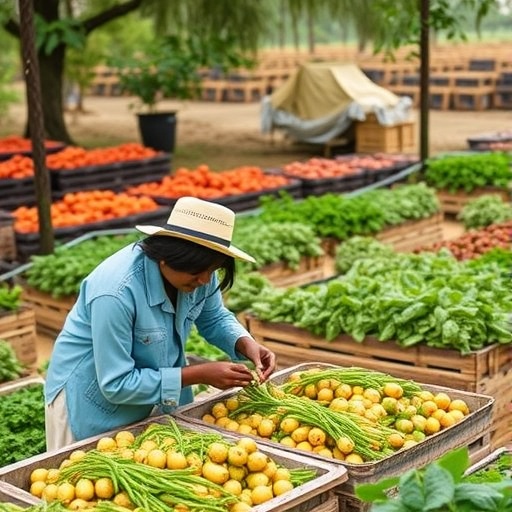
In a rapidly changing world where climate change and population density significantly threaten food security, recent research conducted by Khatoon, Rajput, and Khan presents a critical analysis of agricultural performance in India. Their groundbreaking study, published in the journal “Discov Sustain,” assesses the intricate relationship between infrastructure development, sustainability indicators, and food security in one of the world’s most populous nations. The research highlights the urgent need for integrated strategies that can ensure both sustainable agricultural practices and food security, particularly in a country that is heavily reliant on agriculture for its economic stability.
The study puts a spotlight on India’s agricultural infrastructure, which plays a crucial role in the overall productivity and efficiency of the sector. With the country’s vast geographical diversity and varying climatic conditions, establishing an efficient network of roads, storage facilities, and irrigation systems has become essential. By evaluating the existing infrastructure, the researchers outline how it directly influences agricultural outputs and food distribution, determining access to markets and the availability of fresh produce to consumers.
Another significant aspect of their research involves sustainability indicators that are vital for assessing the long-term viability of food production systems. The authors explore parameters such as water usage efficiency, soil health, and biodiversity preservation, both of which are increasingly becoming critical factors when considering the sustainability of agricultural practices. The authors argue that without proper attention to these indicators, food security remains a precarious goal, especially in the context of dwindling natural resources and growing environmental concerns.
The findings indicate that there is an undeniable link between robust infrastructure and food security outcomes in India. For instance, efficient transportation networks reduce post-harvest losses, thus allowing producers to reach markets more effectively, while also ensuring that consumers have better access to a variety of food products. The study brings to the forefront the positive correlation between infrastructure renovation and the agricultural productivity of smallholder farmers, who often represent the backbone of India’s farming sector.
In addition, the research highlights the importance of policy interventions aimed at enhancing agricultural sustainability. The authors advocate for multifaceted approaches that incorporate technological advancements, capacity building for farmers, and financial support mechanisms. Such policies can lead to better resource management and boost crop yields, ultimately ensuring food security while supporting rural livelihoods. The authors also emphasize the necessity for collaboration between the government, private sectors, and civil society to facilitate this transformation.
The paper meticulously evaluates the socio-economic impacts of food security on rural populations in India, underscoring how malnutrition and hunger can compromise a community’s overall well-being. By conducting detailed field studies across various states, the authors provide empirical evidence regarding the multi-dimensional aspects of food insecurity and its socio-economic implications. Their findings reveal that areas with enhanced agricultural practices and infrastructural investments tend to report lower rates of malnutrition and a higher standard of living among local communities.
Moreover, the study considers the implications of climate variability and its impacts on agricultural productivity. Climate change poses a serious threat to agricultural systems worldwide, and India is no exception. By examining statistical data and predictive models, the authors discuss how changing weather patterns and extreme climate events can severely disrupt agricultural output, leading to heightened food insecurity. Addressing these challenges will require innovative farming techniques, conservation strategies, and investment in climate-resilient infrastructure.
To truly understand the significance of their findings, the authors delve into case studies that exemplify successful application of integrated strategies in different regions of India. These case studies serve as templates illustrating the potential for replicating successful initiatives in other parts of the country. They also highlight research partnerships that are vital for generating localized data, which can be instrumental in crafting policies tailored to specific agricultural and climatic contexts.
Their research also explores the role of technology in enhancing infrastructure and agricultural practices. The authors argue that embracing modern technologies can revolutionize farming in India. From precision agriculture that optimizes resource use to digital platforms aiding farmers with market information, technology can bridge critical gaps in the agricultural supply chain. The burgeoning use of farm management software and mobile applications can empower farmers to make informed decisions, ultimately improving yields and market access.
On a broader scale, the research findings stress the importance of a holistic approach to addressing food security and agricultural performance. Instead of treating food security as a stand-alone issue, integrating it with sustainable infrastructure development ensures a comprehensive solution that benefits both the environment and the economy. Such an approach aligns with the global Sustainable Development Goals (SDGs) that emphasize the interrelated nature of economic, social, and environmental dimensions of sustainability.
The potential ramifications of the authors’ findings extend beyond India’s borders. The research provides valuable insights that can be influential in other developing nations facing similar challenges related to food security and agricultural sustainability. By focusing on specific indicators applicable to various contexts, policymakers worldwide can draw lessons from India’s experiences, tailoring strategies that resonate with their unique challenges.
Ultimately, Khatoon, Rajput, and Khan’s research serves as a clarion call for action, urging stakeholders at all levels to prioritize infrastructure development and sustainability as pillars for achieving food security. Their work underscores the undeniable truth that without a robust framework combining these elements, the goal of eradicating hunger and achieving sustainable agricultural practices remains an uphill battle.
As the world grapples with the looming threats of climate change and population growth, the insights from this comprehensive study hold immense promise for policymakers, stakeholders, and the agricultural community. By investing in infrastructure and embracing sustainability, not only can India enhance its agricultural performance, but it can also pave the way for a more food-secure future for generations to come.
Subject of Research: Food Security and Agricultural Performance in India
Article Title: Assessing food security and agricultural performance through infrastructure and sustainability indicators in India.
Article References:
Khatoon, N., Rajput, S. & Khan, M.R. Assessing food security and agricultural performance through infrastructure and sustainability indicators in India.
Discov Sustain (2026). https://doi.org/10.1007/s43621-025-02156-y
Image Credits: AI Generated
DOI: 10.1007/s43621-025-02156-y
Keywords: Food security, agricultural performance, sustainability indicators, infrastructure, India.


