

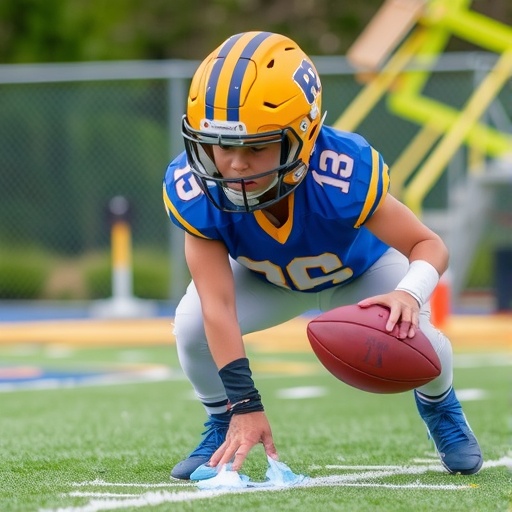
In an era where youth sports continue to grow in popularity, the safety of young athletes remains a crucial concern among parents, coaches, and medical professionals alike. The alarming increase in head injuries, particularly in contact sports like tackle football, raises an urgent requirement for accurate assessment methods. A recent study, spearheaded by researchers S. DeAngelo, A. Culiver, E. Le Flao, and their team, delves into this pressing issue by examining various data cleaning methods to evaluate repetitive head impact exposure in youth tackle football players.
Football stands tall as one of America’s most beloved sports, captivating millions of spectators each season. Yet, the thrill of the game masks a shadowy danger—concussions and repeated head impacts have been linked to long-term neurological issues, such as chronic traumatic encephalopathy (CTE). Recognizing this, the research team aimed to compare different data cleaning methods to enhance the precision of head impact exposure assessments. Determining which techniques yield the most reliable data could revolutionize how youth football programs assess and address the risks linked to head injuries.
In youth tackle football, player safety is often overlooked in the pursuit of skill development and game-winning tactics. The study scrutinized six distinct data cleaning methods, each designed to isolate and refine datasets regarding head impacts. As the researchers meticulously worked through numerical data, they attempted to identify discrepancies that could skew the results, as even minor errors in data handling can have far-reaching consequences for young athletes’ health.
Among the six methods scrutinized in the study, the researchers explored threshold-based approaches, which filter data according to specific impact levels. Such techniques present both advantages and challenges—as they can help eliminate outliers and create cleaner datasets, they also run the risk of excluding meaningful data that falls below certain thresholds. The complexity of head impacts means that impacts of seemingly low intensity could still play a significant role in long-term health outcomes.
Another approach investigated was the use of machine learning algorithms to analyze head impact data. As technology evolves, machine learning models have become invaluable tools in uncovering patterns and trends that traditional methods may overlook. By allowing the algorithm to learn from historical impact data, researchers could develop predictive models that inform coaches and medical teams about the risk levels associated with various types of impacts. This method holds promise, but it requires rigorous validation to ensure the accuracy of its predictions in real-world scenarios.
In examining the efficacy of these data cleaning methods, the researchers conducted a series of experiments with youth football teams. The players donned helmets equipped with accelerometers capable of recording impacts during practice and games. The collected data was then subjected to each of the six cleaning methods to gauge their effectiveness in accurately reflecting head impact exposure. This hands-on approach ensures that the findings from the study are grounded in practical observations rather than purely theoretical models.
The researchers’ results yielded intriguing insights. Each data cleaning method performed differently in terms of reliability and validity, but not all methods were suited to the varied landscape of head impact monitoring in youth football. For instance, while some cleaning techniques greatly improved data reliability, they also removed critical information that could inform player safety protocols. This delicate balance highlighted the need for a tailored approach to data management in the context of youth athletics.
One of the team’s remarkable findings was the impact of data cleaning on concussion prediction models. As illuminated by the results, poor data quality could undermine predictive accuracy, potentially leading to misinformed decisions regarding player safety. The confrontation between data integrity and real-world implications strikes at the heart of modern sports medicine, emphasizing the necessity for meticulous data handling in safeguarding young athletes.
As the study continues to gain traction, it highlights the importance of transparency in data collection and processing. Coaches, parents, and healthcare professionals involved in youth sports must understand the possible ramifications of the data cleaning methods employed in their programs. Educating stakeholders on the nuances of data management can empower them to make informed decisions about interventions that could protect youth athletes from potentially devastating head injuries.
The study’s implications extend beyond the confines of tackle football and into other contact sports, which grapple with similar challenges regarding head impact assessment. As conversations escalate around athlete safety, the knowledge gained from this research can be leveraged in a broader scope, pushing for integrated safety measures across all youth sports disciplines.
Furthermore, the conversation surrounding head injuries in youth sports unveils larger societal implications, prompting deeper reflection on how communities can foster sports environments that prioritize player safety. Stakeholders, including sports organizations, educational institutions, and parents, must collaboratively advocate for enhanced safety protocols. Leveraging research findings like these can spark meaningful discussions around best practices and policies that protect the youngest athletes from the growing epidemic of sports-related concussions.
In conclusion, the battle against head injuries in youth tackle football is not merely a matter of statistics, but a deeply human issue that demands urgent attention. The outcomes from the study conducted by DeAngelo, Culiver, and Le Flao serve as a foundation for a movement towards more responsible engagement with youth athletics. By placing a premium on data integrity and championing transparent communication, coaches and organizations can collectively take strides toward safeguarding the physical and mental health of the next generation of athletes. The challenge ahead lies not only in refining research methodologies but also in fostering a cultural shift within youth sports that prioritizes safety alongside the love of the game.
The road ahead may be fraught with obstacles, but as research continues to reveal the complexities of head impacts and their implications, a safer future for young athletes appears increasingly within reach.
Subject of Research: Methodologies for Data Cleaning in Youth Tackle Football Head Impact Assessment
Article Title: Comparison of Six Data Cleaning Methods for Determining Repetitive Head Impact Exposure in Youth Tackle Football
Article References:
DeAngelo, S., Culiver, A., Le Flao, E. et al. Comparison of Six Data Cleaning Methods for Determining Repetitive Head Impact Exposure in Youth Tackle Football. Ann Biomed Eng (2026). https://doi.org/10.1007/s10439-026-03991-4
Image Credits: AI Generated
DOI: https://doi.org/10.1007/s10439-026-03991-4
Keywords: Youth Tackle Football, Head Impact Exposure, Data Cleaning Methods, Concussion Prediction, Youth Sports Safety, Sports Medicine, Machine Learning, Data Integrity, Neurological Risks.


