


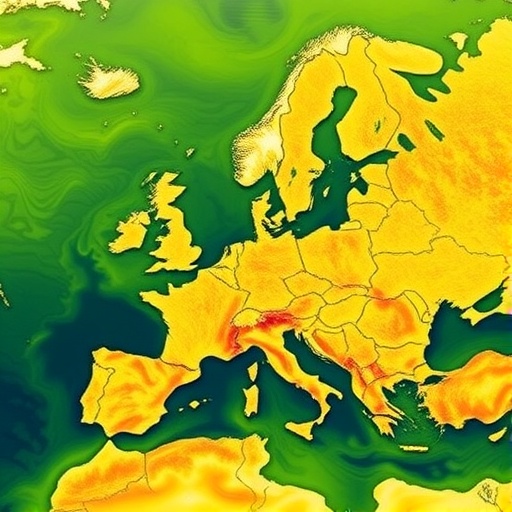
In a significant advancement in our understanding of hydrological phenomena, a recent study led by Fang et al. sheds light on the diverging trends in large floods across Europe amid the backdrop of a warming climate. The research, published in Commun Earth Environ, delves into the complex interplay between climate change and flood occurrences, revealing critical insights that could reshape flood management policies across the continent. As temperatures continue to rise, the implications for both local ecosystems and human populations become increasingly dire, mandating immediate attention and action.
The study emphasizes that not all regions in Europe are experiencing floods in a uniform manner. In some areas, devastating flood events are becoming more frequent, while others are witnessing a noticeable decline in large flood instances. This divergence raises pressing questions about the localized impacts of climate change and the necessity for tailored responses to flooding risks. Previous models have often oversimplified these distinctions, but Fang and colleagues employed advanced statistical methods to track flood trends more accurately, underscoring the heterogeneous nature of climate impacts across different European territories.
Year-on-year assessment of historical flood records coupled with climate data reveals compelling evidence of how climate warming has begun to influence hydrological extremes, specifically in the context of flooding. Regional variations are often attributed to the interplay of various factors including atmospheric circulation changes, land usage, and even urban development patterns. These factors significantly complicate the prediction models regarding where and how floods may manifest in the future. Researchers have employed machine learning techniques to predict these anomalies, which adds a robust layer to flood forecasting methodologies.
Central to the report is the analysis of how increased rainfall intensity and frequency—hallmarks of climate change—can lead to sudden flooding in certain locales. Case studies from countries like Germany and Austria present stark examples where recent heavy rainfall events resulted in unprecedented flooding, causing extensive damage to infrastructure and displacing communities. Such instances serve as grim reminders of the immediate threats posed by climate change and compel policymakers to reconsider existing flood defense mechanisms.
Conversely, the study identifies areas in Southern Europe, such as parts of Spain and Italy, where significant drought conditions have become more commonplace. Here, changes in rainfall patterns have contributed to a decline in large-scale flooding, provoking discussions about water resource management as these regions adapt to increasingly arid conditions. The findings prompt a reevaluation of historical data and an adaptation of water policies to prepare for shifts in hydrological phenomena that differ from traditional expectations.
Fang’s team emphasizes that understanding these divergent flooding trends is not merely an academic exercise but is of paramount importance for climate adaptation strategies. By recognizing the nuanced variations in flood risks, local governments can devise specific mitigation techniques that are not one-size-fits-all. Furthermore, the study serves as a clarion call for the incorporation of more awareness and preparedness initiatives that account for both increased flooding and potential drought conditions.
The implications of these findings extend to various sectors, including agriculture, urban planning, and disaster management. Agricultural practices, for instance, are significantly influenced by flood patterns and water availability. With divergent trends, farmers will need to adapt their crop selections and planting timelines based on anticipated water accessibility. Likewise, urban planners will be increasingly tasked with designing infrastructure that can withstand varying water challenges, necessitating a shift toward smarter, more resilient city designs.
Fang et al. also address the socioeconomic dimensions of flooding. Communities already vulnerable to economic shocks face heightened risks as flood patterns change and intensify. This reinforces the need for proactive measures such as investment in flood defenses and community resilience programs, particularly in regions that are susceptible to explosive flooding events. Recognizing who bears the brunt of these natural disasters is critical, as it provides insights for governments and organizations aiming to implement equitable responses.
The research further discusses the role of climate adaptation and how necessary it is for regions to enroll in collaborative frameworks that facilitate shared knowledge and resources across borders. With transboundary water resources, countries can mitigate flood risks together, fostering a collective approach to climate adaptation. The European Union, through its various environmental initiatives, must prioritize supporting these cooperative strategies as the continent increasingly grapples with the fallout of climate-driven changes.
Fang’s study is a timely reminder that the urgency surrounding climate change and its consequences cannot be overstated. Policymakers, scientists, and communities must remain vigilant and prioritize research that focuses not only on enhancing predictive models but also on fostering social equity in climate action. The path forward requires ongoing dialogue about the realities of a warming climate and how they diverge based on geographical contexts.
In conclusion, the findings presented by Fang and his colleagues not only provide a gateway to deeper understanding of future flood risks but also underscore the necessity for collaborative efforts in climate adaptation strategies. With Europe facing a myriad of ecological challenges brought on by climate change, it is essential that we anticipate changes in hydrological patterns, prepare adequately, and ensure that our strategies reflect the complexity of the situation at hand.
While the challenges posed by climate change may be daunting, they also present opportunities for innovation and progress in water management practices, public policy, and community engagement. As researchers continue to document the impacts of climate warming, it is essential to ensure that this knowledge translates into tangible actions that enhance resilience and protect vulnerable populations across Europe.
Understanding and addressing the diverse impacts of climate change on flooding will be crucial for future sustainability. This research serves as a vibrant call to action, urging a concerted response to emerging flood dynamics that are becoming a defining characteristic of our climatic future.
Fang, B., Rakovec, O., Bevacqua, E. et al. Diverging trends in large floods across Europe in a warming climate. Commun Earth Environ 6, 717 (2025). https://doi.org/10.1038/s43247-025-02734-y
Cite Scienmag News
Violet Maxwell. (August 29, 2025). Europe’s Flood Patterns Shift in Warming Climate. Scienmag. https://scienmag.com/europes-flood-patterns-shift-in-warming-climate/
Violet Maxwell. "Europe’s Flood Patterns Shift in Warming Climate." Scienmag, 29 August 2025, https://scienmag.com/europes-flood-patterns-shift-in-warming-climate/. Accessed 4 September 2026.
Violet Maxwell. "Europe’s Flood Patterns Shift in Warming Climate." Scienmag. August 29, 2025. https://scienmag.com/europes-flood-patterns-shift-in-warming-climate/


