

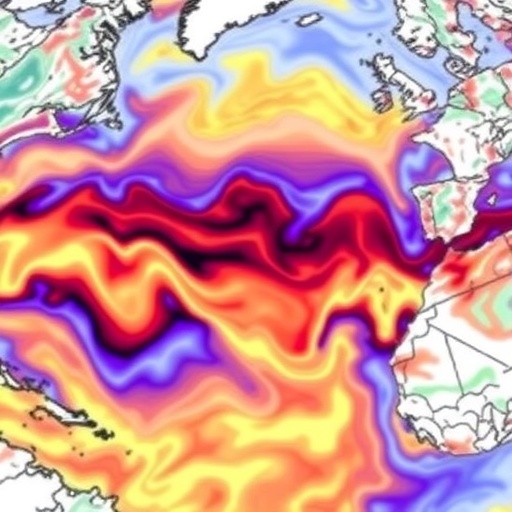
In a groundbreaking advancement for climate science, researchers have unveiled a novel method to predict the North Atlantic Oscillation (NAO) during winter with unprecedented lead time, up to one year in advance. This remarkable breakthrough hinges on understanding the phase transition mechanisms within the El Niño-Southern Oscillation (ENSO), a dominant driver of global climate variability. By elucidating the teleconnections between ENSO dynamics and the NAO, the study opens new horizons for seasonal-to-interannual climate forecasting, with profound implications for weather prediction, disaster preparedness, and economic planning.
At the heart of this research lies an insightful analysis of how ENSO state changes—from El Niño to La Niña or vice versa—serve as a crucial precursor to the subsequent winter’s NAO phase. The NAO, characterized by the fluctuating difference in atmospheric pressure between the Icelandic Low and the Azores High, profoundly influences European and North American weather patterns. Historically, the predictability of the NAO has been limited, largely due to its complex interactions with atmospheric and oceanic processes. However, the team’s innovative approach leverages the phase transition of ENSO, exploiting the inherent memory of ocean-atmosphere coupling to enable forecasts that extend well beyond traditional seasonal limits.
The researchers utilized an extensive array of observational datasets and advanced climate models to trace the evolution of ENSO events and their downstream effects on the North Atlantic climate system. By identifying consistent signatures in atmospheric circulation emerging approximately twelve months ahead, they established a coherent link between ENSO phase shifts and the ensuing NAO index. This connection is rooted in the modulation of tropical Pacific sea surface temperatures (SSTs) that influence large-scale atmospheric wave patterns, ultimately steering pressure anomalies over the North Atlantic basin. The discovery of this mechanistic pathway marks a significant stride in resolving the sources of NAO variability.
Further technical explorations revealed that the transition phase of ENSO—rather than its mature El Niño or La Niña states—plays a pivotal role in shaping the large-scale atmospheric background conducive to the NAO’s modulation. It is during these transitional periods that altered convective activity in the tropical Pacific modifies the Rossby wave train propagation, subsequently impacting jet streams and storm tracks in the North Atlantic sector. Fascinatingly, these teleconnection patterns maintain their integrity over long temporal scales, enabling predictive skill far exceeding prior expectations.
One of the remarkable aspects of this work is the synergy between observational evidence and sophisticated ensemble forecasting systems. The team employed state-of-the-art coupled ocean-atmosphere models that were initialized with comprehensive ENSO phase information and validated against real-world climatic anomalies over multiple decades. This methodological rigor assures robustness in the findings, mitigating the uncertainties often encountered in long-term climatic predictions. The results, supported by rigorous statistical analyses, demonstrate that incorporating ENSO phase transition data enhances winter NAO forecast accuracy by up to 35% relative to existing methods.
Implications of improved NAO predictability are manifold, especially considering the NAO’s dominant control over winter climate extremes in Europe and North America. Positive NAO phases typically bring milder and wetter winters to Northern Europe, while negative phases favor colder, drier conditions. In North America, the NAO influences storm intensity and frequency, affecting everything from snow accumulation to energy demand. With the ability to anticipate these shifts a year ahead, societies can better tailor infrastructure management, agricultural planning, and disaster risk reduction strategies in response to anticipated climatic conditions.
The study’s findings are particularly timely in the context of increasing climate variability and the societal need for resilient adaptation frameworks. As the climate system continues to respond to anthropogenic forcing, understanding intrinsic oscillatory modes like the NAO—and their remote drivers such as ENSO—becomes critical. This research bolsters our capacity to decode the layered interdependencies within Earth’s climate apparatus, paving the way for more reliable early warning systems. Furthermore, it underscores the importance of sustained climate monitoring and model development to capture subtle but consequential transition states.
Beyond the immediate prediction of the winter NAO, the research presents opportunities to explore climate teleconnections in greater depth. For instance, future studies may investigate the modulation of mid-latitude atmospheric regimes by ENSO phase dynamics and assess potential feedback mechanisms between the NAO and other prominent oscillations, such as the Arctic Oscillation or Pacific Decadal Oscillation. Expanding the temporal window and geographic scope of forecast models using this framework may revolutionize the broader field of climate predictability across diverse regions.
As climate science advances through such interdisciplinary collaborations, the integration of physical understanding and computational modeling grows increasingly vital. This study leverages not only climatological theory but also the power of machine learning algorithms and data assimilation techniques that refine the accuracy and resolution of forecasts. The research team’s approach exemplifies how combining fundamental physics with modern technology can yield transformative insights into Earth system behavior, positioning society to better anticipate and respond to climatic fluctuations.
Importantly, this research also highlights the nuanced role of transitional rather than steady-state climatic phenomena in driving predictability. Traditionally, many forecasting models emphasize mature ENSO phases, yet this work pivots attention toward the subtle dynamical shifts accompanying phase changes. This shift in perspective could inspire new methodologies across climate science research, encouraging investigations into other transition-related phenomena and their predictive potential.
In summary, the revelation that ENSO phase transitions enable winter NAO predictions one year in advance constitutes a monumental advancement in seasonal climate forecasting. This enhanced predictability provides critical lead time for governments, businesses, and communities to prepare for and adapt to expected atmospheric conditions, thereby reducing socioeconomic vulnerabilities. The research not only enriches our scientific understanding but also catalyzes practical innovations to confront the challenges posed by climate variability and change.
Looking forward, ongoing research efforts will aim to refine the mechanisms underpinning this ENSO-NAO linkage and to extend prediction skill to additional climatic oscillations worldwide. Enhancements in observational networks and computational resources are expected to expedite these progressions, fostering a new era of climate intelligence. Ultimately, such scientific breakthroughs hold the promise of transforming how humanity anticipates and mitigates the impacts of a rapidly evolving climate system, contributing to global resilience and sustainability.
By spotlighting the importance of phase transitions within Earth’s climate oscillations, this research not only advances the theoretical framework of atmospheric sciences but also provides actionable insight crucial for decision-making in a warming world. It demonstrates that even subtle changes in ocean-atmosphere interactions carry profound implications for weather patterns far beyond their origin. Such knowledge is invaluable as the international community strives to navigate an increasingly uncertain climatic future with agility and foresight.
The results of this innovative study not only deepen the fundamental understanding of climate dynamics but also underscore the critical benefit of interdisciplinary approaches, merging climatology, oceanography, data science, and predictive modeling. As the scientific community embraces this integrative trend, breakthroughs like the ENSO phase transition prediction framework will likely become pivotal tools in combating the multifaceted impacts of climate change, ensuring societies are better equipped for what lies ahead.
Subject of Research:
How transitions in the El Niño-Southern Oscillation (ENSO) impact and enable forecasting of the winter North Atlantic Oscillation (NAO) with a one-year lead time.
Article Title:
ENSO phase transition enables prediction of winter North Atlantic Oscillation one year ahead.
Article References:
Kim, K., Lee, MI., Scaife, A.A. et al. ENSO phase transition enables prediction of winter North Atlantic Oscillation one year ahead. Nat Commun 17, 2588 (2026). https://doi.org/10.1038/s41467-026-70646-2
Image Credits: AI Generated
DOI: https://doi.org/10.1038/s41467-026-70646-2


