

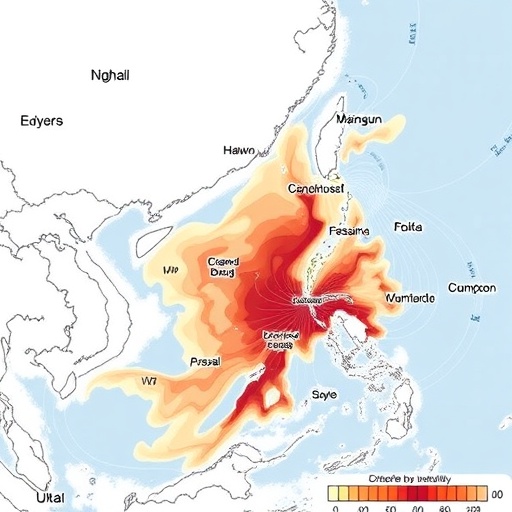
In the intricate dance of the world’s oceans, salinity plays a lead role by influencing both circulation patterns and marine ecosystems. Yet, despite its critical importance, the long-term variability and ecological impacts of salinity, especially in marginal seas like the China Seas, have remained elusive. A groundbreaking study by Wang et al., published in Nature Climate Change in 2026, shines new light on this issue by harnessing cutting-edge machine learning techniques to reconstruct high-resolution sea surface salinity data spanning two decades. Their findings reveal an unexpected, profound influence of the El Niño/Southern Oscillation (ENSO) on salinity regimes and subsequent fish migration, carrying important implications for climate-sensitive marine management.
The researchers embarked on this ambitious project to decrypt the complex interplay between climate variability and ocean chemistry in the China Seas, a region characterized by the interplay of multiple water sources, including major rivers, ocean currents, and atmospheric forces. To overcome the challenge of sparse direct salinity measurements, they employed a novel machine learning framework that seamlessly integrated disparate data streams: in situ observations from research cruises and buoys, as well as satellite remote sensing products. This hybrid dataset, spanning the years 2000 to 2020, enabled an unprecedented spatial and temporal resolution in mapping sea surface salinity across the entire China Seas.
Once the dataset was constructed, the team applied an eigen microstates approach—an advanced mathematical technique that extracts dominant modes of variability and their underlying physical drivers. This diagnostic tool revealed ENSO as the dominant forcing mechanism shaping salinity patterns. ENSO, which cyclically alters oceanic and atmospheric conditions across the Pacific, significantly modulates freshwater inputs and ocean currents in the China Seas. These changes manifest through alterations in evaporation and precipitation rates, variations in river discharge volumes, and notably, modifications of the Kuroshio Current’s intrusion into the region.
Intriguingly, the study found that during El Niño events—the warm phase of ENSO—there is a stark bifurcation in salinity responses depending on the local environment. In ocean-dominated regions of the China Seas, surface salinity can increase by as much as 25%, driven largely by enhanced evaporation and reduced freshwater inflow. Meanwhile, in areas dominated by riverine influence, salinity experiences declines of up to 21%, attributable to intensified river discharge and altered precipitation patterns. This contrast intensifies the north-south salinity gradient, creating a highly heterogeneous marine environment during ENSO episodes.
These salinity shifts carry substantial ecological ramifications. Leveraging species-distribution models, Wang and colleagues demonstrated that 90% of key fish species exhibit a southward migration in response to these ENSO-induced salinity changes. On average, this habitat shift spans up to 2.5 degrees of latitude, underscoring how finely tuned marine species are to salinity thresholds in their habitats. Such movement not only disrupts local fisheries but also alters predator-prey dynamics and ecosystem resilience, echoing through the broader marine food web.
The study also anticipates future trends under climate change scenarios, where ENSO is projected to intensify in both frequency and magnitude. This intensification is likely to exacerbate salinity inhomogeneities in the China Seas, amplifying the ecological shifts observed in recent decades. Such a scenario would create a feedback loop: stronger ENSO events drive more pronounced salinity variability, prompting further fish migrations that, in turn, impact fisheries and marine biodiversity. This “ENSO forcing–salinity–fishery” feedback framework offers a compelling new lens through which to view climate-ocean-ecosystem interactions in the region.
Wang et al.’s research not only addresses a critical knowledge gap but also sets a precedent for integrating oceanographic, climatic, and ecological datasets through machine learning to achieve high-fidelity environmental reconstruction. This approach paves the way for a new generation of adaptive fisheries management strategies, wherein salinity dynamics are no longer sidelined but considered pivotal. By forecasting the spatiotemporal evolution of salinity and its biological impacts, policymakers can better anticipate fish stock movements and develop responses informed by climate variability.
The implications of this framework extend beyond the China Seas. Many marginal seas worldwide experience complex freshwater-ocean interactions and are subject to teleconnections with ENSO and other climate phenomena. Applying similar machine learning and eigen microstates methodologies can decode salinity patterns in these basins, revealing hidden processes that shape marine biogeography at regional scales. It suggests a future where climate-resilient fisheries management hinges on robust, data-driven insights into fundamental ocean chemistry dynamics.
At the ocean-atmosphere interface, salinity acts as a subtle yet decisive regulator of water density and circulation, influencing vertical and horizontal mixing. Understanding how ENSO modulates salinity thus also enhances predictions of broader ocean circulation changes, which impact heat and carbon transport globally. The new salinity dataset offers a valuable benchmark for validating climate models that simulate coupled ocean-atmosphere phenomena, helping refine projections of ENSO’s evolving role in shaping marine environments under global warming.
While satellite observation has revolutionized our ability to monitor sea surface salinity, the spatial resolution and accuracy have remained limited, especially near coastlines and river mouths where salinity gradients are steepest. By combining remote sensing with in situ data through machine learning, Wang et al. overcame these limitations—providing an indispensable tool for coastal and estuarine research. This fusion approach ensures that critical fine-scale salinity structures are captured, which are vital for understanding stressors impacting fisheries, aquaculture, and marine conservation.
Species distributions are exquisitely sensitive to salinity thresholds because many physiological processes—osmoregulation, reproduction, larval development—depend on stable salinity conditions. Rapid shifts in salinity regimes can thus stress populations and compel migrations. The observed southward shifts documented in this study highlight the ecological vulnerability of fish species to climate variability and suggest that future biogeographic boundaries will be dynamic, reshaping marine biodiversity distribution patterns at unprecedented rates over the coming decades.
This research underscores the urgency of integrating interdisciplinary methodologies—including oceanography, climatology, ecology, and data science—to holistically grasp climate impacts on marine systems. The emergent picture is one of heightened connectivity between remote climatic drivers, like ENSO, and local marine ecosystem responses. Such knowledge is essential for crafting management policies that are flexible, forward-looking, and grounded in scientific understanding amid uncertain futures caused by ongoing climate change.
In conclusion, the 2026 study by Wang and colleagues marks a significant advance in ocean science by elucidating how ENSO orchestrates complex, long-term salinity variability and fish migration patterns in the China Seas. Their innovative use of machine learning fused with physical and biological data yields critical insights into the mechanistic pathways linking global climate oscillations to regional marine ecological processes. As ENSO continues to intensify, this research provides a crucial foundation for anticipating and mitigating the multifaceted impacts on marine fisheries, ecosystem resilience, and coastal communities dependent on the ocean’s health.
The work calls for the integration of salinity dynamics into adaptive, climate-informed fisheries policies as a new frontier in sustainable ocean governance. A deeper understanding of ENSO-induced salinity changes will empower fishery managers to anticipate migration-induced shifts in fish stocks, optimize harvesting strategies, and safeguard marine biodiversity. As global climate variability accelerates, harnessing such predictive frameworks will be key to securing ocean-dependent livelihoods and preserving ecosystem functions in marginal seas and beyond.
Wang et al.’s pioneering contribution sets the stage for transformative progress in marine science, inviting further research on how salinity regimes across different seas respond to climate phenomena and how these changes cascade through marine food webs. Ultimately, this holistic approach will improve humanity’s capacity to live sustainably within the dynamic and increasingly variable marine environment that sustains us.
Subject of Research:
The study investigates the influence of the El Niño/Southern Oscillation (ENSO) on long-term sea surface salinity variability in the China Seas and assesses consequent ecological impacts, particularly fish species migration patterns.
Article Title:
ENSO shapes salinity regimes and fish migration in the China Seas
Article References:
Wang, Z., Huang, H., Wang, G. et al. ENSO shapes salinity regimes and fish migration in the China Seas. Nat. Clim. Chang. (2026). https://doi.org/10.1038/s41558-026-02559-3
Image Credits:
AI Generated


