

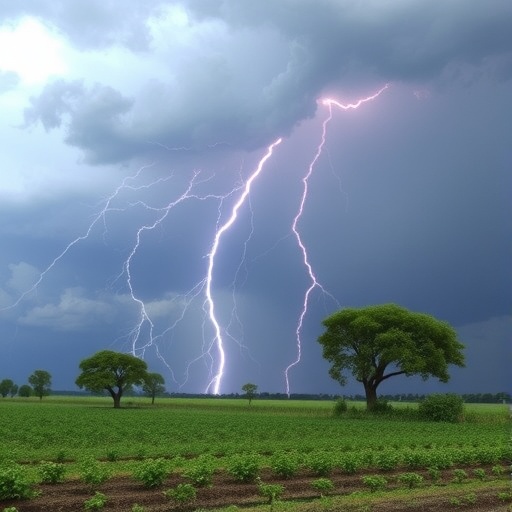
Thunderstorms are among nature’s most spectacular yet perplexing phenomena. Their sudden emergence and unpredictable locations continue to challenge meteorologists worldwide. While it is well known that warm, humid days with unstable air support the formation of thunderstorms, pinpointing the exact locations where these powerful storms will ignite has remained elusive. A pioneering study by a British-Austrian team, including researchers from TU Wien, now offers a groundbreaking physical model that elucidates why thunderstorms develop at particular spots and neglect others, providing new hope for significantly improved forecasting.
At the heart of their discovery is a complex interaction between atmospheric wind conditions and the spatial variability of soil moisture. This intimate relationship between land and sky determines whether a benign cloud will escalate into a potentially hazardous thunderstorm. Utilizing an extensive dataset consisting of 2.2 million thunderstorm events across Africa, the research team spared no effort in uncovering the nuanced mechanics that serve as the thunderstorm genesis trigger.
One of the critical breakthroughs arises from bridging the gap between global meteorological models and localized observations. While large-scale air-mass movements are well understood and can be precisely calculated, thunderstorms develop on a mesoscale—spatial dimensions of a few kilometers or less—that have defied detailed predictive modeling until now. It is at this intermediate scale that soil moisture exerts a decisive influence, impacting surface winds in a manner not captured by existing models.
TU Wien has long been at the forefront of deducing soil moisture from satellite remote sensing. Recent advances in the spatial and temporal resolution of these satellite datasets allowed researchers to correlate thunderstorm occurrences directly with detailed soil moisture distributions. This analysis revealed a striking physical mechanism: thunderstorm cells intensify rapidly in regions where stark contrasts in soil moisture generate near-surface winds flowing in one direction, while winds several kilometers above the ground move in the opposite direction.
In practical terms, wetter regions cool the near-surface air through evaporation. This cooling effect leads to higher surface pressure over moist soil, prompting air near the ground to flow outward toward adjacent, drier areas where the air is warmer and surface pressure lower. Meanwhile, wind patterns at higher altitudes, governed primarily by larger-scale weather systems, generally do not align with these near-surface flows. The resulting wind shear—the difference in wind speed and direction between surface and elevated altitudes—creates ideal conditions for rapid thunderstorm development.
Christopher Taylor, the lead scientist from the UK Centre for Ecology and Hydrology, explains this phenomenon: when the wind vectors at different atmospheric layers oppose each other, it maximizes the relative velocity between the upward-moving cloud at high altitude and the near-surface air fed into it. This dynamic essentially funnels abundant, moist air into the thunderstorm cell from below, fueling intense upward convection. The rising air cools and condenses to form towering cumulonimbus clouds, which can quickly escalate into hazardous thunderstorms. This explanation provides a lucid physical basis for the localized nature of thunderstorm development, long regarded as capricious.
Beyond theoretical modeling, the team employed an array of independent observational datasets to validate their findings. Satellite images captured cloud growth patterns precisely where the model predicted the strongest thunderstorm development. Moreover, lightning strike data corroborated the occurrence of the most severe thunderstorm activity in regions where near-surface and upper-level winds counteractively aligned, illustrating the model’s robustness.
A pivotal enabler of this research was the availability of high-resolution satellite soil moisture data supplied by EUMETSAT—derived from the European ASCAT instrument aboard Metop satellites. These sophisticated, physics-based measurements permit granular estimation of soil moisture conditions worldwide. By integrating these data with atmospheric observations, researchers achieved a nuanced understanding of the microscale interactions influencing thunderstorm formation—a scale previously out of reach for conventional climate models.
The implications of this study extend well beyond academic interest. By incorporating soil moisture heterogeneity and wind shear at mesoscales into predictive frameworks, meteorologists can now hope to forecast thunderstorms with unprecedented specificity. This advancement is especially critical given the increasing frequency and intensity of severe weather events driven by global climate change. Improved thunderstorm predictions will enable better preparedness, reducing fatalities and economic losses from flash floods, lightning, and hailstorms.
Moreover, the study bridges a crucial gap in understanding how land surface conditions feed back into atmospheric processes—a topic essential for holistic climate modeling. It highlights the intricate interplay between terrestrial and atmospheric variables and how subtle variations on the Earth’s surface can propagate upward to influence convective weather phenomena.
Experts anticipate that future weather prediction models will increasingly incorporate detailed soil moisture data, coupled with multi-layer wind observations, to simulate thunderstorm dynamics more accurately. Such integration requires continued advancements in satellite remote sensing technologies and data assimilation techniques but promises revolutionary enhancements in weather forecasting capabilities.
In summary, the new physical model developed by the British-Austrian team reveals that the twin factors of wind shear and soil moisture contrasts critically determine the rapid intensification of thunderstorms. This finding solves a long-standing meteorological mystery, opening pathways to safer, more resilient communities capable of anticipating the caprices of severe weather with greater confidence.
The next steps involve applying this model in diverse climatic regions beyond Africa to explore its universal applicability and refining it further through enhanced observational datasets. As our climate continues to shift, these insights constitute an indispensable tool in the global endeavor to understand, prepare for, and mitigate the impacts of extreme weather events driven by thunderstorms.
Subject of Research: Not applicable
Article Title: Wind shear enhances soil moisture influence on rapid thunderstorm growth
News Publication Date: 4-Mar-2026
Image Credits: TU Wien
Keywords: Thunderstorm formation, soil moisture, wind shear, atmospheric convection, satellite remote sensing, mesoscale meteorology, ASCAT, EUMETSAT, climate change, extreme weather, lightning, weather prediction


