

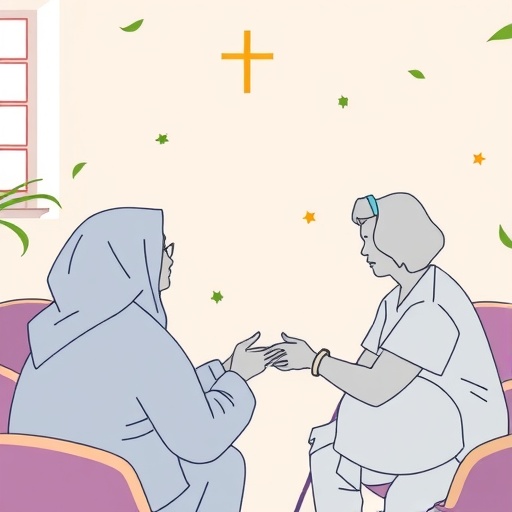
In a rapidly evolving healthcare landscape, the integration of spiritual care within nursing education has emerged as a pivotal area of focus. A recent quasi-experimental study has shed light on the effectiveness of a competency-based spiritual care education program tailored for undergraduate nursing students. This groundbreaking research spearheaded by Sitefane, Afonso, and Ross et al. is poised to change how future nurses are equipped to address the spiritual needs of patients, ultimately influencing healthcare outcomes in profound ways.
The study underscores an increasingly recognized tenet: that healthcare extends beyond mere physical treatment. Spiritual care, while often overlooked, plays a crucial role in holistic patient well-being. By incorporating spiritual care into nursing curricula, educational institutions can cultivate a new generation of healthcare professionals who view patients as whole beings, encompassing physical, emotional, social, and spiritual dimensions. This approach aligns with a growing body of literature suggesting that addressing spiritual health can lead to improved patient satisfaction and engagement in their own care processes.
To evaluate the efficacy of their educational program, the researchers employed a quasi-experimental design, which offered the ability to assess outcomes in a naturalistic setting, reflective of real-world applications. A cohort of undergraduate nursing students participated in this novel program, engaging not only with theoretical constructs but also with practical applications of spiritual care. This immersive approach enabled students to develop essential competencies that are critical in the face of the complex emotional and spiritual challenges patients often confront during illness.
Throughout the duration of the study, participants were subjected to various assessments aimed at gauging their understanding and application of spiritual care concepts. These assessments were designed with meticulous attention to detail, ensuring that they accurately reflected the competencies the curriculum aimed to instill. By methodically analyzing pre- and post-program evaluations, the researchers could substantiate the program’s impact on students’ capabilities and confidence in delivering spiritual care.
Interestingly, the findings revealed a significant increase in the students’ self-reported ability to address spiritual issues in patient care after completing the educational program. This shift in self-perception is not merely an academic achievement; it reflects a transformational experience that could have lasting implications for patient-nurse interactions in clinical settings. It suggests an awakening to the importance of spirituality in healthcare, potentially leading to more meaningful dialogues between nurses and patients.
Moreover, the quasi-experimental study illuminated several broader themes relevant to nursing practice. One such theme was the critical need for curricula that promote emotional intelligence and empathy among nursing students. As the healthcare environment becomes increasingly complex, the ability to engage with patients on a deeper emotional and spiritual level is essential. The integration of spiritual care education is a testament to this evolving necessity, aiming to bridge the gap between technical skills and compassionate care.
The shift towards competency-based education reflects a broader trend in professional training, where the emphasis is placed on equipping students with the skills they will require in their future roles. This paradigm signifies a move away from rote memorization of facts and towards an experiential learning model that prioritizes critical thinking, adaptability, and interpersonal skills. By fostering an environment where spiritual care is prioritized, educators are preparing students to meet the multifaceted needs of their future patients.
The implications of this study extend beyond the confines of the classroom. As nursing students graduate and enter various healthcare settings, they will carry with them the knowledge and skills necessary to provide holistic care. Their ability to attend to spiritual needs can significantly influence patient care dynamics, contributing to improved health outcomes and a more satisfying healthcare experience for patients, families, and healthcare providers alike.
However, implementing such educational programs is not without its challenges. Institutions must navigate logistical constraints, such as curriculum design, faculty training, and resource allocation. Furthermore, garnering support from stakeholders across the healthcare continuum is paramount to ensure the sustainability of these initiatives. By addressing these potential obstacles head-on, educational institutions can champion the integration of spiritual care in nursing programs.
This pioneering study serves as a crucial stepping stone for further research in the domain of spiritual care education. As the body of evidence grows, future studies can explore additional facets, such as long-term outcomes for patients cared for by nurses trained in spiritual care, or comparative analyses of different educational models. The ongoing discourse surrounding this topic is bound to influence policy decisions and curricular frameworks, paving the way for broader adoption of spiritual care training in healthcare education.
Additionally, this research invites a wider conversation about the role of spirituality in overall health. As scientific understanding of health continues to evolve, it opens the door for interdisciplinary collaborations that incorporate insights from psychology, sociology, and theology. Such integrative approaches could yield richer insights into how spiritual care impacts overall patient experiences and health trajectories.
As the dust settles on this transformative educational study, one can envision a future where spiritual care is not an afterthought in healthcare but a foundational component embraced by all healthcare practitioners. The comprehensive understanding of patient care that incorporates spirituality may soon transform the nursing landscape, creating a rippling effect that enhances the quality of care delivered across all levels of the healthcare system.
In conclusion, the work of Sitefane and colleagues provides a timely and necessary push towards rethinking how we prepare nursing students for the realities of patient care. By embracing a competency-based spiritual care education program, institutions are not only enhancing the skill set of future nurses but are also reimagining the healthcare experience from a holistic perspective. This represents a significant step towards fulfilling the true potential of compassionate healthcare, where every dimension of a patient’s needs is considered and attended to with respect and understanding.
Subject of Research: Competency-based spiritual care education program for undergraduate nursing students
Article Title: Competency-based spiritual care education program for undergraduate nursing students: a quasi-experimental study
Article References: Sitefane, S., Afonso, A., Ross, L. et al. Competency-based spiritual care education program for undergraduate nursing students: a quasi-experimental study. BMC Nurs 24, 1495 (2025). https://doi.org/10.1186/s12912-025-03805-3
Image Credits: AI Generated
DOI: https://doi.org/10.1186/s12912-025-03805-3
Keywords: Spiritual Care, Nursing Education, Competency-Based Training, Quasi-Experimental Study, Holistic Health.


