


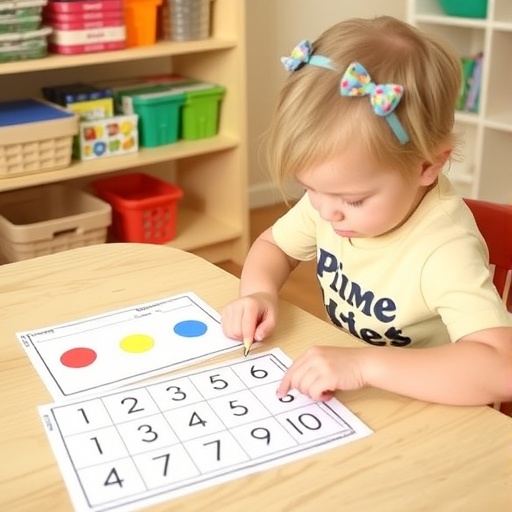
In a groundbreaking study published in the International Journal of Early Childhood, researchers R.C. Torres-Peña, D. Peña-González, and E.A. Ariza-Echeverri explore the pivotal role of mathematical thinking in preschool education. The authors emphasize that fostering early mathematical skills is crucial for children’s cognitive development and academic success. Their research addresses how specific problem-solving strategies can enhance preschoolers’ abilities in seriation and counting, two foundational mathematical concepts that set the stage for more complex arithmetic understanding.
Mathematical thinking does not merely involve memorizing numbers or performing operations; it encompasses a broader cognitive process that includes reasoning, strategy development, and problem-solving. For preschoolers, this cognitive development is especially important as it lays the groundwork for future learning. In their article, the authors argue that preschool environments that prioritize mathematical activities can significantly enhance children’s overall academic trajectory.
Sadly, despite the recognized importance of early math skills, many preschool classrooms continue to neglect structured mathematical instruction. The research highlights this gap and proposes actionable strategies that educators can implement in their classrooms. The study outlines engaging, hands-on activities that encourage children to explore mathematical concepts through play. This method not only makes learning enjoyable but also effective.
One of the key aspects of the research is the exploration of seriation, which refers to the ability to arrange objects in a specific order based on a characteristic such as size, color, or shape. Torres-Peña and colleagues illustrate how simple activities like sorting blocks or arranging colored beads can help preschoolers make connections between their tactile experiences and mathematical thinking. This process of arranging and categorizing not only builds foundational math skills but also enhances critical thinking abilities.
Counting, another essential mathematical skill, is also thoroughly examined in the study. The authors present evidence that when preschoolers engage in counting exercises through storytelling and interactive games, they develop a more profound understanding of numerical concepts. These activities help children not only to memorize numbers but also to grasp the relationship between quantities and their numerical representations.
The authors emphasize the importance of educators being intentional in their teaching methods. By integrating mathematical problem-solving into daily activities, teachers can create rich learning environments that stimulate cognitive engagement. Rather than relying on traditional rote learning, this approach encourages children to inquire, hypothesize, and explore various solutions to mathematical problems.
Further, the research addresses the significance of social interaction in preschool math learning. Collaborative activities, where children work together to solve problems, have shown to enhance their understanding of mathematical concepts. This collaborative environment not only builds social skills but also enables children to articulate their thought processes, contributing to a deeper understanding of mathematics.
Torres-Peña and colleagues also discuss the potential long-term benefits of developing mathematical thinking in early childhood. They cite several studies indicating that children who excel in mathematics during their preschool years are more likely to succeed in academic settings later in life. This correlation underscores the urgency of prioritizing mathematics in early education curricula.
Importantly, the article also tackles the disparities in early mathematical education. The authors point out that children from disadvantaged backgrounds often lack access to quality preschool programs that emphasize mathematical instruction. The research advocates for a more equitable distribution of resources so that all children can benefit from high-quality early math education.
As the study unfolds, it becomes evident that the implications of enhancing mathematical thinking in preschool extend beyond individual achievement; they touch on broader societal issues. Educators, policymakers, and parents are called upon to re-evaluate the role of mathematics in early childhood education and advocate for more comprehensive curricula.
In conclusion, Torres-Peña, Peña-González, and Ariza-Echeverri present compelling evidence that nurturing mathematical thinking in preschool can transform children’s educational outcomes. Their study provides a blueprint for educators to follow, encouraging them to implement engaging, problem-solving methods that focus on seriation and counting. The findings advocate for a paradigm shift in how early childhood education approaches mathematics, highlighting the critical role it plays in shaping future learners.
The exploration of mathematical thinking in preschool settings is more than an academic exercise; it is a societal imperative that requires immediate attention. It is crucial that educators and stakeholders take actionable steps to foster these essential skills in our youngest learners. The future of our educational landscape may very well depend on it.
Torres-Peña, R.C., Peña-González, D. & Ariza-Echeverri, E.A. Mathematical Thinking in Preschool: Strengthening Seriation and Counting Through Problem Solving.
IJEC 57, 379–401 (2025). https://doi.org/10.1007/s13158-024-00402-4
Cite Scienmag News
Courtney Benton. (October 14, 2025). Enhancing Preschool Math: Seriation and Counting Skills. Scienmag. https://scienmag.com/enhancing-preschool-math-seriation-and-counting-skills/
Courtney Benton. "Enhancing Preschool Math: Seriation and Counting Skills." Scienmag, 14 October 2025, https://scienmag.com/enhancing-preschool-math-seriation-and-counting-skills/. Accessed 5 September 2026.
Courtney Benton. "Enhancing Preschool Math: Seriation and Counting Skills." Scienmag. October 14, 2025. https://scienmag.com/enhancing-preschool-math-seriation-and-counting-skills/


