

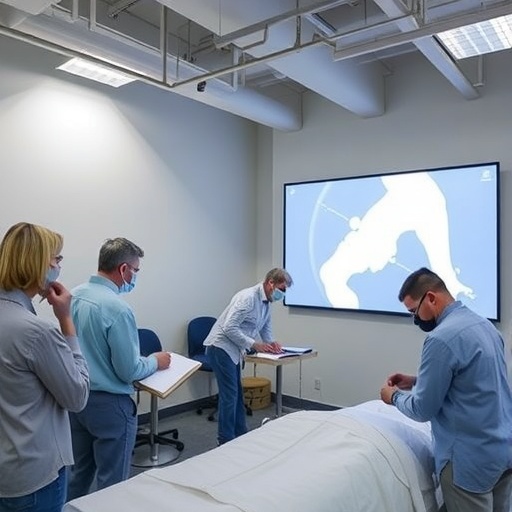
In a groundbreaking study set to be published in 2025 in BMC Medical Education, researchers, including A.J.S. Moore, K. Dhas, and D. Karunaratne, delve into the transformative potential of high-fidelity simulation as a pedagogical tool for pre-foundation assistantship students. The medical field consistently seeks innovative methodologies to enhance student preparedness for practice, and this study serves as a beacon of progress in bridging the gap between academic training and real-world application.
High-fidelity simulation refers to advanced educational strategies that replicate real-life clinical scenarios, allowing students to engage in a hands-on learning experience. With advancements in technology, simulations can now closely mimic intricate clinical environments, replete with physiological responses, which compel students to react as they would in actual clinical settings. The engagement with these simulated scenarios fosters not only a deeper understanding of medical procedures but also cultivates essential soft skills such as communication and teamwork that are critical in any healthcare environment.
The study’s foundation rests upon the premise that traditional learning methods may not adequately prepare students for the complexities of real-world medical practice. Through high-fidelity simulation, students can practice clinical decision-making in a safe environment where mistakes become invaluable learning opportunities rather than career-derailing errors. As they navigate through various scenarios, they build confidence in their skills, which significantly enhances their overall readiness for the demands of their future roles.
Furthermore, the research posits that high-fidelity simulation can significantly improve retention of knowledge and techniques among medical students. By engaging in active learning, students are less likely to forget crucial information compared to traditional passive learning methods, where information may merely be memorized for exams. This retention translates into better clinical performance, ultimately leading to improved patient outcomes.
In the study, Moore, Dhas, and Karunaratne meticulously analyze the experiences of pre-foundation assistantship students who participated in various high-fidelity simulation exercises. Through qualitative and quantitative assessments, they present compelling evidence that this form of education not only enhances skill acquisition but also promotes a positive attitude towards continual learning and self-assessment. Such traits are paramount in the dynamic field of medicine, where practices and technologies continually evolve.
Moreover, the researchers highlight the role of debriefing sessions post-simulation as a critical component of the learning process. During these sessions, students have the opportunity to reflect on their performance, receive constructive feedback, and discuss the emotional and psychological aspects of their experiences. This reflective practice is essential in fostering resilience and the capacity to adapt, qualities that are indispensable in high-stress medical environments.
The implications of this research extend beyond individual student growth; they also touch upon systemic improvements within medical education. By advocating for high-fidelity simulations as integral to training programs, the study calls for a paradigm shift in how future healthcare professionals are educated. It emphasizes a movement away from rote memorization towards a more experiential learning model that better prepares students for unpredictability in clinical practice.
The psychological safety that simulation provides is another pivotal element that the research underscores. In traditional education, the fear of making mistakes often hampers student learning and participation. In contrast, simulation creates an environment where students are encouraged to explore and take risks without the fear of negative repercussions. This atmosphere not only enhances learning but also empowers students to emerge as proactive problem solvers.
Critically, the researchers also address potential barriers to the widespread implementation of high-fidelity simulation in medical education. Factors such as cost, resource allocation, and faculty training must be considered to effectively integrate these innovative methodologies into curricula. Understanding these challenges allows educational institutions to strategize and ultimately enhance the educational experiences of their students.
As the medical community grapples with the ongoing demand for improved educational frameworks, the insights garnered from Moore et al.’s research underline the urgent need for educational reforms in training future medical professionals. By adopting high-fidelity simulation practices, medical schools can potentially revolutionize the preparation of students entering the workforce, ensuring they are not only competent but also confident in their ability to provide high-quality patient care.
In conclusion, the study by Moore, Dhas, and Karunaratne makes a compelling case for the incorporation of high-fidelity simulation in the educational journey of pre-foundation assistantship students. By marrying theory with practice, this innovative approach promises not only to enhance individual student experiences but also to elevate the standards of medical education as a whole. As the publication date approaches, anticipation builds within the medical community, eager to explore the transformative insights offered by this pivotal research.
The findings from this study could very well inform the next generation of medical training, emphasizing that the future of healthcare competency lies in embracing experiential learning avenues. It raises a crucial dialogue about how we prepare our healthcare providers for the intricate challenges they will face in their careers and the potential repercussions on patient care as a result.
As we look forward to the full publication, the importance of this research cannot be overstated. It not only contributes to educational practices but also underscores a critical evolution in how we perceive the cultivation of healthcare professionals in an ever-changing medical landscape.
Subject of Research: The role of high-fidelity simulation in preparing pre-foundation assistantship students for medical practice.
Article Title: Exploring the role of high-fidelity simulation for pre-foundation assistantship students to improve preparedness for practice.
Article References:
Moore, A.J.S., Dhas, K., Karunaratne, D. et al. Exploring the role of high-fidelity simulation for pre-foundation assistantship students to improve preparedness for practice. BMC Med Educ (2025). https://doi.org/10.1186/s12909-025-08477-w
Image Credits: AI Generated
DOI: 10.1186/s12909-025-08477-w
Keywords: high-fidelity simulation, medical education, student preparedness, experiential learning, clinical practice.


