


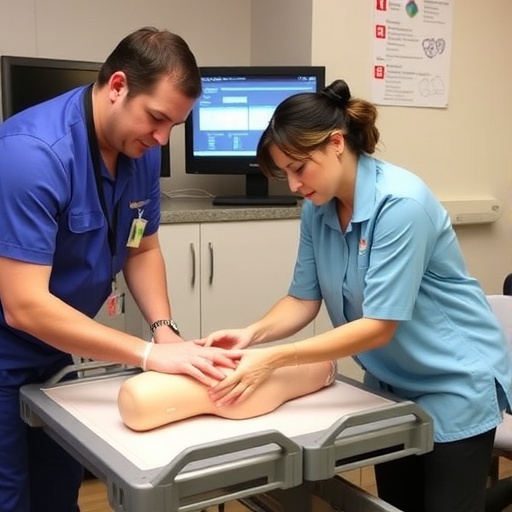
In the landscape of medical education, the emphasis on effective training methodologies is critical, especially in the fields requiring immediate and life-saving interventions, such as paediatric care. In a thought-provoking study by Zhang et al., the integration of simulation-based learning and team-based strategies emerges to enhance cardiopulmonary resuscitation (CPR) training among paediatric postgraduates. The complexity of managing medical emergencies in children, who may present unique physiological challenges, necessitates that the training be rigorous, comprehensive, and engaging. This article delves into the findings and implications of this groundbreaking research, which stands to impact educational practices in medicine significantly.
The study, conducted by a team of researchers known for their expertise in educational strategies within the medical field, explores the pedagogical impact of an innovative training model that merges traditional learning techniques with contemporary simulation exercises. Medical professionals, particularly those in pediatrics, often face high-stakes situations that require split-second decision-making. This dual focus on scholarly study and practical application serves to create a more robust learning environment that prepares students not just academically but also practically.
Central to the research is the use of integrated simulation, a method that mimics real-world situations in a controlled setting, allowing students to practice and hone their skills without the risk of patient harm. Simulated environments can replicate a variety of scenarios and complications that pediatric practitioners might encounter, making the training both comprehensive and targeted. By immersing trainees in these realistic situations, educators can assess both individual performance and group dynamics, offering insights into areas of strength and those needing improvement.
In conjunction with simulation, the study emphasizes team-based learning (TBL), which leverages the collective knowledge and skills of diverse groups to enhance the educational experience. Team-based approaches encourage collaboration, communication, and critical thinking — all essential competencies in medical practice. By engaging in structured teamwork, paediatric postgraduates can learn how to operate effectively within multidisciplinary teams, mirroring the actual environment of hospitals where diverse healthcare providers must work together under pressure.
The findings of Zhang et al. indicate a notable increase in the efficacy of CPR training delivered through this integrated approach compared to traditional methods. Participants reported heightened confidence in their skills and a greater readiness to perform CPR in real-life emergencies. Moreover, the study provides quantitative evidence illustrating improved retention of knowledge and skills performance, which are key metrics in assessing training effectiveness. By directly correlating educational methodologies with improved outcomes, this research offers compelling reasons for medical institutions to reconsider their pedagogical approaches.
An often-underestimated component of rigorous medical training is the necessity of mental resilience and team cohesion. Through this integrated strategy, the research highlights not just the ‘how’ but the ‘why’ of effective CPR training. Students learned to support each other emotionally, developing a psychological safety net that can prove invaluable in high-pressure situations. Such interpersonal skills foster an environment where practitioners can communicate transparently, crucial during emergencies where rapid and accurate information flow can save lives.
Moreover, the study’s conclusion draws attention to several recommendations for implementing this training model across various medical schools. Given the success of the integrated simulation and TBL approach, the authors advocate for broader adoption, encouraging institutions to tailor the program to their specific educational contexts and available resources. Flexibility in implementation allows for diverse adaptations, making the framework accessible regardless of institutional constraints.
As the research unfolds, it sheds light on the long-term implications of enhanced CPR training on patient outcomes. Well-trained healthcare professionals are better equipped to handle life-threatening emergencies efficiently, significantly reducing morbidity and mortality rates among paediatric populations. As such, initiatives that prioritize medical education reforms could have a profound societal impact, reinforcing the critical value of ongoing research in this domain.
In a world grappling with the challenges of providing optimal healthcare, innovative training methods like those proposed by Zhang et al. represent a beacon of progress. Not only do these approaches align with modern educational theories, but they also address the pressing need for effective training in high-stakes clinical environments. Engaging medical students actively through simulation and teamwork not only benefits the trainees but ultimately promotes a culture of safety and excellence in patient care.
Looking ahead, the implications of this research extend beyond the realm of CPR; the effectiveness of integrated simulation and team-based learning could inform training in other critical areas of medicine. By establishing a foundation for collaboration and advanced skills acquisition, this model sets a precedent for future curriculum development. Educators and administrators alike are urged to consider how these principles can be applied across specialties, enhancing overall medical education and fostering a generation of highly competent healthcare professionals.
In the face of evolving medical challenges and the ongoing need for effective training solutions, the work of Zhang and colleagues presents a timely and impactful contribution to the field of medical education. As more institutions acknowledge the need for reform and innovation in educational practices, studies like this one serves as a guiding framework for implementing meaningful change. By prioritizing immersive training that balances knowledge with practical skills, the future of paediatric care appears brighter and more prepared for the challenges that lie ahead.
As this new research starts to permeate the medical education community, there will undoubtedly be ongoing discussions about best practices and the potential for further enhancements. The encouragement of interprofessional education and the development of collaborative environments is not merely an academic exercise; it represents a necessary evolution in how we prepare future healthcare providers for the realities of medical practice. The emphasis on integrated simulation and teamwork could transform the very fabric of medical training, leading to better outcomes for patients and practitioners alike.
In conclusion, the study by Zhang et al. promises to pave the way for vital shifts within medical education strategies. By merging simulation-based training with team-oriented methods, educators are well-placed to cultivate a new standard for developing critical skills in medical trainees. With the stakes as high as they are in paediatric healthcare, embracing these innovative approaches will ultimately result in a more competent, confident, and cohesive workforce ready to tackle the challenges within medical care.
Zhang, Ld., Wang, L., Li, Yt. et al. Effectiveness of integrated simulation and team-based learning in paediatric postgraduates for cardiopulmonary resuscitation training: a multiple methods study.
BMC Med Educ (2026). https://doi.org/10.1186/s12909-026-08694-x
Cite Scienmag News
Harold Sullivan. (February 2, 2026). Enhancing Pediatric CPR Training with Team-Based Simulation. Scienmag. https://scienmag.com/enhancing-pediatric-cpr-training-with-team-based-simulation/
Harold Sullivan. "Enhancing Pediatric CPR Training with Team-Based Simulation." Scienmag, 2 February 2026, https://scienmag.com/enhancing-pediatric-cpr-training-with-team-based-simulation/. Accessed 4 September 2026.
Harold Sullivan. "Enhancing Pediatric CPR Training with Team-Based Simulation." Scienmag. February 2, 2026. https://scienmag.com/enhancing-pediatric-cpr-training-with-team-based-simulation/


