


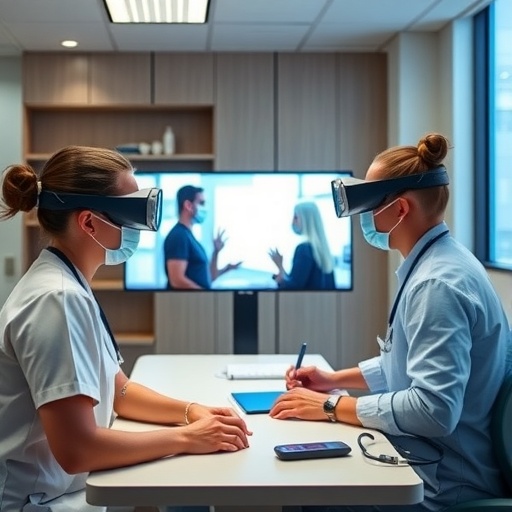
In the rapidly evolving field of education, the integration of technology into traditional teaching methods has sparked a revolution. A recent study by Li, Wu, and Zhang et al. investigates a cutting-edge approach in nursing education that leverages virtual reality (VR) within a flipped learning framework, incorporating collaborative role-playing. This innovative methodology not only enhances the learning experience for nursing students but also equips them with practical skills essential for patient care in real-world scenarios.
The essence of flipped learning lies in its unconventional structure, where traditional lecture content is delivered outside the classroom, often through online resources, while in-class time is devoted to active learning strategies. By using VR technology, the researchers aimed to immerse nursing students in realistic simulations that mimic clinical environments, enabling them to practice their skills in a safe and controlled setting. This approach provides an engaging platform for students to explore complex medical situations, fostering critical thinking and decision-making skills.
In their study, the authors note that VR offers a unique advantage by creating realistic, interactive scenarios that students might not encounter during conventional training. By embodying different roles within teamwork dynamics, nursing students can develop both individual competencies and collaborative skills. This experiential learning approach fosters an environment of peer interaction, where students can learn from each other while assuming responsibilities that reflect real-life healthcare roles.
The implementation of this dual strategy holds significant promise for improving educational outcomes in nursing programs. The researchers found that students who participated in VR-based flipped learning exhibited higher levels of engagement and satisfaction compared to those who received traditional instruction. This shift toward an active learning paradigm aligns with contemporary educational theories that prioritize student-centered learning experiences.
Moreover, based on performance assessments, the study indicated that students not only retained information more effectively but also gained a deeper understanding of complex clinical concepts. By participating in role-playing exercises within VR environments, students were challenged to apply theoretical knowledge to practical situations, which is crucial for developing clinical reasoning skills. This hands-on experience helps prepare them for the pressures and nuances of actual healthcare settings where critical thinking and adaptability are paramount.
The findings from Li and colleagues’ research underline the transformative potential of integrating VR into nursing education. As healthcare continues to evolve, the demand for well-prepared professionals who can adeptly navigate technological advancements and complex patient scenarios is greater than ever. This study highlights that VR-based training can address this gap by providing students with opportunities to engage in realistic, immersive learning experiences.
However, the successful implementation of VR in nursing curricula is not without challenges. Institutions must consider the costs associated with acquiring and maintaining the technology, as well as training faculty to effectively deliver VR-enhanced courses. Additionally, logistical considerations regarding class size, technical support, and student accessibility must be addressed to ensure equitable learning opportunities for all students.
Despite these challenges, the implications of this study suggest a promising future for nursing education. As educational institutions begin to adopt more innovative teaching methodologies, the role of technology will only continue to expand. The positive outcomes associated with VR-based flipped learning add to the growing body of evidence advocating for a reimagined approach to nursing training that prioritizes experiential learning and skills retention.
In conclusion, the efficacy of virtual reality flipped learning with collaborative role-playing signifies a shift towards more immersive and engaging educational practices in nursing. As further research unfolds on this subject, it may pave the way for broader applications of VR technology across various fields of education. Bridging the gap between theory and practice, this approach not only enhances the learning experience but ultimately contributes to the development of competent and confident healthcare professionals ready to meet the challenges of the future.
The integration of advanced educational methodologies such as this one marks a critical evolution in how nursing professionals are trained, ensuring they are equipped with the skills necessary to excel in their careers amidst the ever-changing landscape of healthcare.
In the end, fostering a spirit of innovation in education through the use of technologies like virtual reality will remain essential. As educators and institutions continue to explore the possibilities of VR, the ultimate goal will be to enhance student learning outcomes while preparing the next generation of healthcare providers more effectively than ever before.
Li, Y., Wu, J.G., Zhang, D. et al. The efficacy of virtual reality flipped learning with collaborative role-playing in nursing education.
BMC Nurs 24, 1102 (2025). https://doi.org/10.1186/s12912-025-03709-2
Cite Scienmag News
Courtney Benton. (August 24, 2025). Enhancing Nursing Education with VR Collaborative Learning. Scienmag. https://scienmag.com/enhancing-nursing-education-with-vr-collaborative-learning/
Courtney Benton. "Enhancing Nursing Education with VR Collaborative Learning." Scienmag, 24 August 2025, https://scienmag.com/enhancing-nursing-education-with-vr-collaborative-learning/. Accessed 3 September 2026.
Courtney Benton. "Enhancing Nursing Education with VR Collaborative Learning." Scienmag. August 24, 2025. https://scienmag.com/enhancing-nursing-education-with-vr-collaborative-learning/


