

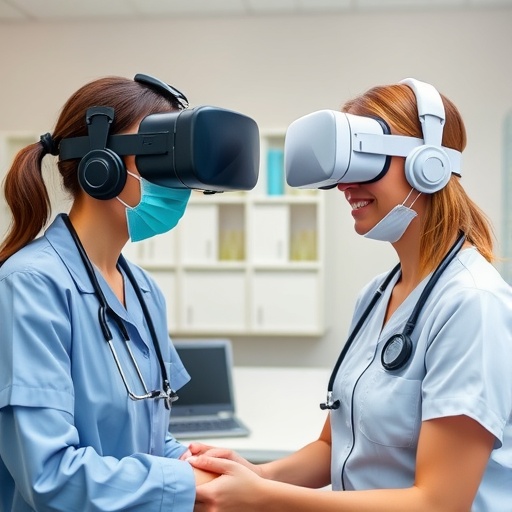
Virtual reality (VR) has captivated the attention of educators and healthcare professionals alike, particularly as an innovative tool in teaching communication skills to undergraduate nursing students. A recent scoping review by Deng, Tan, and Chen emphasizes the significant potential of VR in simulating real-life scenarios, thereby transforming how nursing students learn effective communication. This exploration into VR technology indicates a remarkable shift from traditional methods towards more immersive learning experiences that align with contemporary educational standards and student needs.
One of the primary advantages of utilizing virtual reality in nursing education is its ability to create simulated environments that replicate real-world patient interactions. Within these VR environments, nursing students can engage in diverse scenarios such as patient consultations, emergency response situations, and even complex ethical dilemmas. This multi-faceted approach allows students to not only practice their technical skills but also develop critical soft skills like empathy, active listening, and effective verbal communication.
Moreover, VR simulations offer a safe space for nursing students to make mistakes and learn from them without the risks associated with actual patient care. This hands-on experience is invaluable, particularly when considering the high-stakes nature of healthcare, where communication can lead to life-or-death outcomes. The ability to repeat simulations as needed allows students to build confidence and proficiency at their own pace, reinforcing their learning through practice and reflection.
The scoping review highlights the impressive variety of existing VR applications in nursing education, which include everything from basic communication exercises to complex multi-faceted scenarios involving interdisciplinary teams. Throughout these simulations, students are provided with immediate feedback, which is crucial for reinforcing learning outcomes. The immersive aspect of VR captures students’ attention and engagement, making the learning experience more enjoyable and memorable.
Research indicates that undergraduate nursing students often report feeling anxious or unprepared when engaging in actual patient communication scenarios. This anxiety can stem from a lack of practice or inadequate preparation during their training. By integrating VR into the curriculum, educational programs can help alleviate some of this pressure, providing a structured yet flexible environment where students can hone their skills. As they train in these simulated settings, students gradually develop the emotional intelligence and competence required to interact effectively and compassionately with real patients.
Another key point addressed in the review is the adaptability of VR technology to fit various educational contexts and learning styles. Whether it is through individual practice or collaborative group tasks, VR can cater to the diverse needs of students. Institutions can customize scenarios to reflect community-specific health issues or to address unique demographics, ensuring that learners are well-prepared for the populations they will serve upon graduation.
As with any emerging technology, there are potential challenges and barriers to implementing VR in nursing education. One concern revolves around the financial implications and accessibility of VR equipment. Not all educational institutions may have the necessary resources to invest in VR technology, which could lead to disparities in training quality among nursing programs. Nevertheless, there is hope that as the technology advances and becomes more cost-effective, broader access will be possible.
In addition to financial considerations, faculty training and development are crucial components necessary for successful VR integration. Educators must become proficient in utilizing VR tools and understanding the pedagogical strategies that maximize their effectiveness. This requires ongoing professional development and support from institutions to ensure that nursing educators can effectively guide students in their VR experiences.
The transition to VR-based education also poses questions about the assessment of learning outcomes. Traditional assessment methods may not adequately measure the competencies that students develop through immersive simulations. Innovative assessment strategies that consider both technical skills and soft skills are needed to accurately gauge student progress and effectiveness in communication.
Despite these hurdles, the potential benefits of VR in nursing education are immense, according to the findings in the scoping review. Evidence suggests that students who engage in VR simulations demonstrate enhanced confidence levels and a greater ability to communicate with patients. These skills not only improve student preparedness for clinical environments but also ultimately enhance patient care outcomes.
Looking ahead, the integration of VR technologies into nursing curricula signals an exciting new frontier in healthcare education. As future nurses become adept at navigating complex patient interactions through simulations, they will likely emerge as more competent and compassionate practitioners. The implications for the healthcare system as a whole are significant, potentially leading to improved patient satisfaction and better health outcomes.
Ultimately, the findings of Deng, Tan, and Chen’s scoping review underscore the transformative nature of VR in nursing education. By equipping students not just with medical knowledge but also with essential communication skills via immersive simulations, educators can prepare the next generation of nurses to thrive in dynamic healthcare environments. The move towards VR in nursing education is not merely a trend; it’s a substantial evolution that promises to enhance educational practices and health care delivery.
This scoping review presents a compelling case for the adoption of digital innovations like virtual reality in nursing education, advocating for a future where technology and compassionate care go hand-in-hand. As the landscape of healthcare continues to evolve, embracing such advancements will be vital for cultivating a proficient, empathetic nursing workforce ready to face the challenges of tomorrow’s medical realities.
Subject of Research: Virtual reality simulation in nursing education
Article Title: Virtual reality simulation to teach communication for undergraduate nursing students: a scoping review.
Article References:
Deng, J., Tan, Y., Chen, J. et al. Virtual reality simulation to teach communication for undergraduate nursing students: a scoping review.
BMC Med Educ (2025). https://doi.org/10.1186/s12909-025-08450-7
Image Credits: AI Generated
DOI: 10.1186/s12909-025-08450-7
Keywords: Virtual reality, nursing education, communication skills, simulation, undergraduate training, medical education, immersive technology.


