

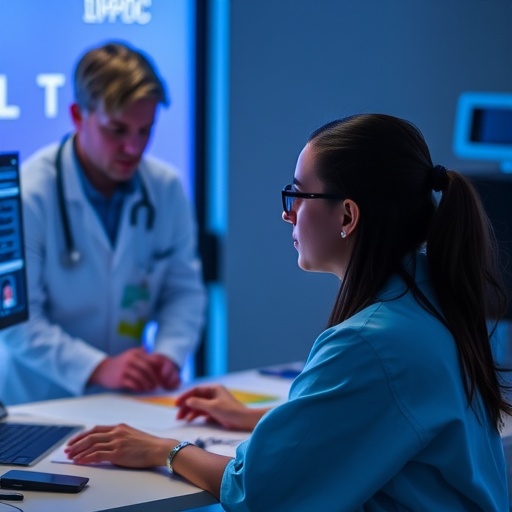
The evolution of medical education is increasingly marked by innovative teaching methodologies aiming to equip future healthcare professionals with the requisite skills and knowledge to thrive in complex clinical environments. A recent study conducted by Kldiashvili and colleagues has critically examined the application of project-based and simulation-based approaches in medical curricula, generating intriguing insights that could influence educational practices across medical schools worldwide. The mixture of these pedagogical strategies not only enhances learning outcomes but also replicates real-world challenges that students may encounter in their medical careers.
Project-based learning (PBL) represents a paradigm shift in how knowledge is imparted in medical education. Instead of the traditional lecture-based format, PBL encourages students to engage in hands-on activities, solving real-life problems collaboratively. By undertaking projects that require critical thinking, creativity, and teamwork, medical students become active participants in their education rather than passive recipients of information. This approach not only aids retention of information but also promotes a deeper understanding of complex medical concepts, ultimately contributing to improved clinical practice.
Complementing PBL, simulation-based learning offers a controlled environment where students can practice clinical skills without the fear of causing harm. Utilizing high-fidelity manikins and virtual reality, simulation allows learners to engage in realistic clinical scenarios, developing mastery in techniques ranging from basic physical examinations to high-stakes procedures like surgical interventions. This method addresses the educational necessity for practical experience before students face real patients, mitigating the anxiety that can accompany first-time clinical encounters.
In Kldiashvili’s research, the integration of these two methodologies demonstrates significant improvements in several core competencies. Students who participated in PBL and simulation-based activities reported increased confidence in their clinical skills and decision-making abilities. The intertwined nature of project and simulation-based learning fosters an engaging classroom environment where students are motivated to apply theoretical concepts to practice. This is particularly critical in medicine, where application of knowledge can have life-or-death implications.
Furthermore, this research finds substantial evidence supporting the enhancement of soft skills through project-based and simulation-based learning. Skills such as communication, teamwork, and leadership become natural byproducts when students engage in collaborative projects and simulated scenarios. The ability to communicate effectively with peers and patients is invaluable for any healthcare professional, and embedding these opportunities into the curriculum prepares students for the interpersonal demands of clinical practice.
The results of this study highlight another significant advantage: the adaptability of these learning approaches across diverse medical disciplines. Whether students are training to become surgeons, general practitioners, or public health specialists, the principles of project-based and simulation-based learning can be tailored to meet the specific goals of various educational tracks. This flexibility makes them highly appealing to medical curricula, as they can be customized to enhance different areas of specialization.
Moreover, the authors suggest that incorporating feedback sessions into these learning frameworks enhances their efficacy. Constructive feedback during project work or post-simulation debriefings allows students to reflect on their performance, identify areas for improvement, and foster a growth mindset. This cyclical process of learning through feedback is essential, especially in an educational context as rigorous as medicine, where the stakes are invariably high.
Despite the apparent benefits of these approaches, the transition from traditional education to more innovative methodologies is not without challenges. Faculty from medical schools may require training and resources to effectively implement and facilitate project-based and simulation-based learning. Additionally, there must be an institutional commitment to adjust curricula and assessment methods to align with these approaches. Recognizing the value of educators as facilitators rather than lecturers is crucial in shifting the educational landscape.
Furthermore, the study underscores the importance of collaborative learning not only among students but also among faculty. Interdisciplinary cooperation can enhance the effectiveness of project-based learning. For instance, involving instructors from various fields of expertise encourages broader perspectives in medical education, linking various realms of knowledge that enriches students’ learning experiences.
The findings from this research resonate with contemporary calls for reform in medical education worldwide. Stakeholders—including educators, administrators, and health organizations—are increasingly advocating for teaching methods that prioritize experiential learning and prepare students for the demands of modern healthcare. The need for medical professionals who are not only knowledgeable but also skilled in navigating complexities is paramount, and integrating project-based and simulation-based approaches could be fundamental to achieving this goal.
Additionally, as healthcare systems face unprecedented challenges, such as those posed by pandemics and emerging technologies, the role of medical education must evolve correspondingly. Approaches that encourage adaptability, critical thinking, and teamwork prepare students to respond to the unexpected, fostering a generation of healthcare professionals ready to tackle the evolving landscapes of medicine.
As we look forward to the future of medical education, the implications of Kldiashvili and colleagues’ research cannot be understated. The integration of innovative teaching methodologies represents a clear direction towards improving the educational experience for aspiring medical professionals. By embracing project-based and simulation-based approaches, medical schools can significantly enhance the quality of education and ultimately, patient care.
Ultimately, this research marks an important step in the ongoing discourse around medical education reform, calling for stakeholders to recognize the necessity of innovative pedagogical strategies. By prioritizing experiential learning environments, medical education has a unique opportunity to produce graduates who are skilled, confident, and illuminated by the passion for continuous learning—a fundamental characteristic of exceptional healthcare providers.
As the academic and healthcare communities continue to navigate complexities within medical education, studies like this one pave the way for a paradigm shift that promotes not only technical proficiency but also empathetic, patient-centered care. The journey toward excellence in healthcare education is gradual, yet it is propelled by the dedication of educators and researchers who strive for transformative change. The narrative is clear; effective medical education must evolve, and the time for change is now.
Subject of Research: Application of project-based and simulation-based approaches in medical curriculum
Article Title: Application of project-based and simulation-based approaches in medical curriculum
Article References:
Kldiashvili, E., Al-Rustum, S., Zarnadze, M. et al. Application of project-based and simulation-based approaches in medical curriculum.
BMC Med Educ 25, 1707 (2025). https://doi.org/10.1186/s12909-025-08196-2
Image Credits: AI Generated
DOI: https://doi.org/10.1186/s12909-025-08196-2
Keywords: project-based learning, simulation-based learning, medical education, healthcare professionals, experiential learning


