

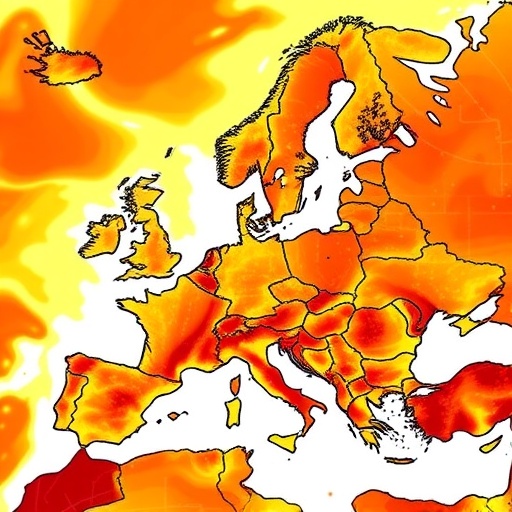
In a groundbreaking research endeavor, scientists led by Krüger, Kjellsson, and Lohmann have made significant strides in enhancing the predictive accuracy of heat events across Europe through advanced eddy-resolving climate models. Heat events, which have become increasingly intense and frequent due to climate change, pose substantial risks to ecological stability, public health, and global economies. Accurate modeling of these phenomena is vital for effective climate mitigation and adaptation strategies. As climate experts grapple with the complexities of localized weather systems, this innovative approach introduces new techniques that could redefine how meteorologists forecast extreme temperatures in Europe.
Eddy-resolving climate models, unlike traditional climate models, provide higher resolution data that captures smaller-scale meteorological phenomena. This capability is crucial for simulating heat events that often develop over limited geographical areas. By focusing on finer atmospheric processes, these models can discern the interactions between various climate parameters, which is essential for predicting how heat waves form and persist. The ability to resolve such eddies could mean the difference between a vague forecast and an accurate prediction that informs citizens and policymakers alike.
The authors of the study utilized extensive historical temperature data and advanced computational techniques to calibrate their models. By integrating high-resolution satellite observations alongside sophisticated atmospheric physics, they enhanced the models’ capacity to simulate realistic urban heat island effects, which are significantly influenced by local topography and human activities. The urban heat island effect—a phenomenon where urban regions become significantly warmer than their rural surroundings—illustrates the importance of localized temperature modeling and its implications for public health, energy consumption, and urban planning.
One of the study’s key developments is the refinement of parameterization schemes within the models. Conventional climate models often rely on broad generalizations that do not account for micro-scale climate interactions. However, the researchers implemented new parameterization techniques that allow for more nuanced representations of land-atmosphere interactions, effectively bridging the gap between macro-scale climate patterns and micro-scale weather events. This methodological shift holds promise not only for European heat event predictions but for global climate forecasting models overall.
Through rigorous validation against past heat events, the research findings suggest that the new eddy-resolving models exhibit a significantly improved predictive skill when compared to their conventional counterparts. This success underscores the pressing need for the scientific community to adopt advanced modeling techniques that closely reflect the changing dynamics of our planet. As regions worldwide brace themselves for increasingly severe climatic events, these breakthroughs in model resolution offer a vital tool for understanding and responding to heat-related challenges.
The implications of these findings extend beyond mere academic interest; they have tangible consequences for disaster preparedness and public health initiatives. As governments and organizations work to mitigate the impacts of extreme weather, the ability to accurately forecast the timing, intensity, and duration of heat waves becomes paramount. Thus, enhanced climate models can empower stakeholders with the knowledge needed to implement effective heat action plans and safeguard vulnerable populations.
Moreover, understanding the geographical trends of heat events across Europe could significantly impact agricultural planning. Farmers and agribusinesses dependent on climate cues for crop management must adapt quickly to changing weather patterns. The enhanced modeling capabilities can provide timely insights that inform irrigation strategies, crop choices, and harvest timelines, ultimately contributing to food security in an era of climatic unpredictability.
The study’s authors also highlight the importance of international collaboration in refining climate models. Given that climate change knows no borders, pooling resources, data, and expertise across nations can yield more comprehensive models and robust responses to heat events. International cooperation can foster the development of common standards in climate modeling and data sharing that enhances global resilience to climatic challenges.
While this research presents groundbreaking advancements, the scientific community acknowledges the persisting challenges faced in climate modeling. The complexity of the Earth’s climate system, with its myriad interactions and feedback loops, demands continuous refinement of models. As computing power grows, so does the potential to simulate climate phenomena at even more granular levels. The pursuit of improved resolution is an ongoing commitment that requires a multidisciplinary approach, integrating insights from meteorology, physics, environmental science, and data analytics.
As the world grapples with the realities of climate change, significant advancements in climate modeling tools will be crucial for devising effective responses. The ability to predict and understand heat events not only informs policy but also shapes public perception and action. Effective communication of such research findings is essential to engage the broader public and promote awareness of climate issues and their implications.
In summary, Krüger, Kjellsson, and Lohmann’s study represents a significant leap forward in climate modeling. By improving the simulation of heat events in Europe, the researchers not only enhance the predictive capabilities of climate models but also lay the groundwork for broader implications in climate science, public health, and economic planning. This research marks a pivotal step toward a more nuanced understanding of our planet’s changing climate and underscores the importance of continually evolving our scientific methodologies to meet the challenges that lie ahead.
Ultimately, the findings of this study could serve as a catalyst for further research initiatives aimed at integrating eddy-resolving models into existing frameworks and exploring other climate phenomena that necessitate higher resolution. As climate scientists work toward better forecasting tools, ongoing innovation in methods and collaboration across disciplines will remain key in understanding and combating the impacts of climate change.
Subject of Research: Improved simulation of European heat events in climate models using eddy-resolving techniques.
Article Title: Improved European heat event simulation in eddy-resolving climate models.
Article References:
Krüger, J., Kjellsson, J., Lohmann, K. et al. Improved European heat event simulation in eddy-resolving climate models.
Commun Earth Environ (2026). https://doi.org/10.1038/s43247-025-03145-9
Image Credits: AI Generated
DOI: 10.1038/s43247-025-03145-9
Keywords: Climate models, heat events, eddy-resolving models, climate change, urban heat islands, predictive accuracy, public health, international cooperation.


