

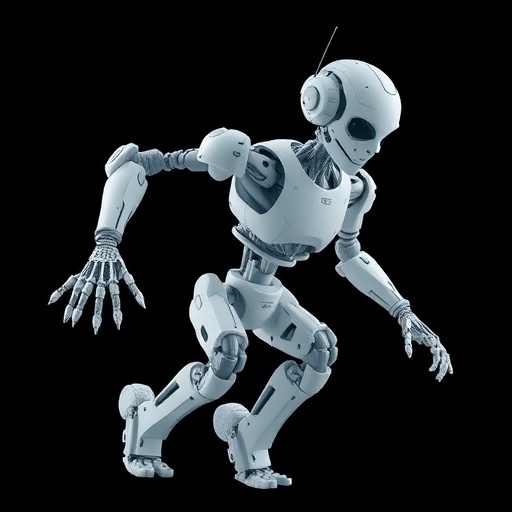
The human knee is a marvel of biomechanical engineering, boasting a complex system of bones, ligaments, and cartilage that work in unison to provide smooth, controlled movement. Unlike simplistic hinge joints seen in many mechanical systems, the knee is capable not only of flexion and extension but also of rolling and gliding motions that preserve alignment and reduce stress on the joint tissues. Inspired by this intricate natural mechanism, researchers at the Harvard John A. Paulson School of Engineering and Applied Sciences (SEAS) have introduced a transformative mathematical framework to optimize the design of robotic joints that emulate this sophisticated behavior.
Traditional robotic joints often rely heavily on bearings and four-bar linkages, which, while effective for many applications, lack the nuanced motion and flexibility inherent in biological joints. The new approach pioneered by the Harvard team focuses on rolling contact joints—mechanical connections characterized by curved surfaces rolling over one another, bound together by flexible connectors that maintain structural integrity while allowing complex movements. These rolling contact joints mimic the multipoint contact and sliding behaviors observed in human cartilage, offering reduced friction and enhanced wear resistance.
Central to this breakthrough is a computational design methodology that allows for the simultaneous optimization of the joint’s geometric components to meet specific performance goals. This novel framework enables the tailoring of joint surfaces to produce prescribed trajectories and force transmission characteristics, a capability previously unattainable with standard circular joint designs. By formulating the problem mathematically, the researchers can derive noncircular and irregular surface profiles that guide the rolling elements along desired paths, ensuring precise motion control embedded directly in the mechanical structure.
One of the landmark proofs of concept involves the construction of a knee-like robotic joint that significantly diminishes misalignment errors commonly found in existing assistive devices such as exoskeletons and knee braces. Unlike conventional designs that hinge at a fixed axis, often causing discomfort and inefficiencies by failing to replicate the natural shifting and rolling of the human knee, this optimized rolling contact joint aligns dynamically with the typical knee trajectory. Experimental results demonstrate a remarkable 99% reduction in joint misalignment compared with standard mechanical joints, suggesting potential for personalized, biomechanically harmonious orthopedic supports and prosthetics in the future.
Expanding beyond assistive technologies, the team also developed an innovative two-finger robotic gripper that applies the principles of rolling contact joint design to enhance gripping strength and dexterity. By optimizing the joint geometries to produce maximum force transmission correlated to object size and shape, the robotic gripper achieves a gripping capacity exceeding that of traditional designs by a factor of three, under the same actuator input. This represents a substantial advancement in robotic manipulation, where force efficiency and delicate handling often conflict.
The mathematical underpinning of this design process incorporates trajectory and force transmission specifications, enabling the generation of joint surfaces and pulleys customized for particular motions and tasks. This approach facilitates the encoding of complex kinematic and dynamic behaviors directly into the mechanical architecture, effectively offloading tasks conventionally managed by software control onto the physical structure of the robot. Such integration promises the development of robots with intrinsic efficiency and adaptability, permitting smaller, less power-intensive actuators and streamlined control systems.
Notably, this holistic integration of mechanics, control, and task goals aligns with broader advances in robotic design philosophy. According to senior author Robert J. Wood, the goal is to transfer as much motion control as possible from traditional control algorithms to the innate characteristics of the robot’s materials and geometry. By doing so, control systems can focus on higher-level objectives like environmental interaction or complex sequences of movement while the mechanical joints handle fundamental motion coordination intrinsically.
The flexibility inherent in rolling contact joints also offers practical advantages for robotic systems operating in real-world environments. Their low-friction interfaces and robust wear characteristics contribute to longevity and reliability in applications involving repetitive, high-load, or delicate motions. Moreover, the capacity for such joints to be tailored precisely to desired trajectories opens new possibilities in soft robotics and bio-inspired designs which require a seamless balance between compliance and strength.
From a biomechanics perspective, the ability to design joints that replicate or exceed the nuanced behavior of natural counterparts offers new avenues for studying animal locomotion or disease states. Robotic models equipped with these optimized joints could serve as high-fidelity testbeds to understand joint mechanics under varying conditions, enabling breakthroughs in rehabilitation and biological research.
The development of this computational framework was motivated initially by challenges in combining rigid linkages with soft, flexible connections found in cutting-edge gripper research at Wood’s lab. Studying rolling contact joints allowed the team to bridge these physical domains, achieving mechanical complexity with manageable software control requirements.
While the immediate prototypes showcase applications in robotic grippers and knee-like joints, the underlying methodology is broadly applicable across robotic linkages. Roboticists can now specify arbitrary joint trajectories and associated force requirements to generate customized joint profiles, enabling innovations in walking, jumping, climbing robots, or precision manipulation systems.
Fundamentally, this work blurs the boundary between mechanical design and control theory by embedding targeted functional behaviors within the structural design. The researchers envision a future where the mechanical body of a robot is as thoughtfully programmed as its software brain, creating machines that move with the economy, grace, and adaptability of living organisms.
This research was published in the prestigious Proceedings of the National Academy of Sciences and represents a significant step forward in robotic linkage design. Supported by the National Science Foundation, the project underscores the critical value of interdisciplinary collaboration across engineering, computer science, and applied physics to push the boundaries of synthetic joint and robotic development.
Subject of Research:
Article Title: Noncircular Rolling Contact Joints Enable Programmed Behavior in Robotic Linkages
Image Credits: Wood Lab / Harvard SEAS
Keywords
Robotics, Rolling Contact Joints, Mechanical Engineering, Biomechanics, Robot Kinematics, Control Systems, Assistive Devices, Soft Robotics, Mechanical Components, Applied Physics, Human-Robot Interaction, Robotic Grippers


