

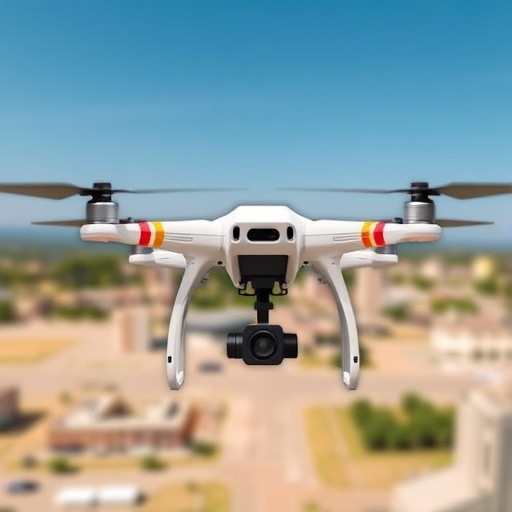
In an era where technology continuously evolves, the integration of drones into various applications has become a focal point for researchers and industries alike. The latest study by Morando et al. ventures into the realm of human-drone collaboration, particularly emphasizing mixed-reality environments to enhance navigation and interaction in constrained areas. This pioneering research not only showcases the advanced capabilities of autonomous drones but also illuminates the potential for synergetic relationships between humans and machines, enhancing operational efficiency and safety.
The study sets the stage by discussing the limitations faced by drones, especially in restricted spaces. Traditional navigation systems often struggle with obstacles and unforgiving environments filled with complicated layouts. Morando and his team propose an innovative solution: utilizing mixed-reality technology to bridge the gap between human operators and autonomous drones. Mixed-reality merges physical and digital worlds, providing real-time insights that empower drone operators to make educated decisions during critical operations. This intersection of digital enhancements and real-world navigation marks a significant leap forward in drone technology.
One of the cornerstone features explored in this research is the interface of human-drones collaboration through interactive mixed-reality applications. The researchers unveil various use-case scenarios, illustrating how drones equipped with augmented reality (AR) can adapt to varying environmental conditions. By visualizing the drone’s perspective within a user’s field of view, operators can effectively command actions and streamline navigation paths. Such display systems ensure that users are no longer confined to their screen’s two-dimensional constraints, enhancing their spatial awareness and control over the drone.
Additionally, the implications of this research stretch far beyond mere navigation enhancements; they extend into areas such as disaster response and search-and-rescue missions. In chaotic scenes, where real-time assessments are crucial, the ability to visualize a drone’s trajectory can drastically improve decision-making. Imagine a rescue operator on-site, utilizing mixed-reality goggles to see through the drone’s eyes as it scans through debris. This fusion of human insight and machine precision can lead to saving lives, offering a glimpse into the practical advantages of this technology.
Moreover, collaboration in mixed-reality environments stimulates a new paradigm of teamwork between humans and drones. The research emphasizes that drones are no longer just aerial tools; they can act as trusted companions in complex scenarios. By sharing sensory data and environmental context in real-time, both parties can optimize their efforts, leading to improved outcomes in various fields such as agriculture, construction, and logistics. The ability to harness shared intelligence contributes to a more holistic understanding of tasks at hand.
The study further delves into the mechanics behind the technology at play, detailing the algorithms that allow drones to process and adjust to environmental stimuli. Advanced machine learning techniques enable drones to learn from their previous experiences, refining their navigation strategies. The research illustrates how these artificial intelligence systems adapt to unique challenges posed by specific environments, ensuring that each mission benefits from the accumulated knowledge of past encounters.
While the practical advantages of human-drone collaboration in mixed-reality environments are promising, the challenges should also be acknowledged. The question of data security and privacy looms large in such technologies. As drones collect vast quantities of environmental information, ethical considerations surrounding the processing and storage of this data become paramount. An important aspect of Morando’s study addresses these concerns by outlining protocols that prioritize user privacy while maximizing the benefits of mixed-reality navigation.
User experience stands at the forefront of this study as well. It’s not just about the technology’s capabilities but also its accessibility for operators with varying skill levels. The researchers conducted a comprehensive user case study involving participants from diverse backgrounds to assess the effectiveness and intuitiveness of the mixed-reality interfaces. Feedback gathered from real-world applications highlights the need for user-friendly designs that can enhance operational efficiency without overwhelming the users mentally.
This approach to user-centric design extends to training programs, as well. As industries adopt drone technology, the necessity for structured training initiatives arises. Morando et al. suggest that incorporating mixed-reality training modules can significantly enhance the learning curve for novice operators. By simulating real-life scenarios through augmented environments, new users can grasp complex navigation skills without the inherent risks associated with actual drone operations.
In light of the findings presented, the future of human-drone collaboration seems bright, particularly as advancements in mixed-reality technology continue. As researchers and industry leaders explore further enhancements, the opportunities for drones in various fields appear boundless. From aiding in emergency situations to revolutionizing how humans interact with their surroundings, this technology lays the foundation for smarter, safer operations.
The implications for future research are profound. The intersection of artificial intelligence, mixed reality, and drone autonomy invites a wealth of potential studies waiting to be explored. Expanding on Morando’s foundational work could lead to refining algorithms, perfecting user interfaces, and addressing security concerns, creating a robust ecosystem designed to harness these technologies holistically.
As we look ahead, the importance of interdisciplinary collaboration cannot be overstated. Integrating insights from robotics, computer science, and human-computer interaction will be essential in further developing these technologies. The collaborative efforts between researchers, technologists, and industry professionals signify a collective ambition to elevate drone utility, ensuring that they align seamlessly with human needs and expectations.
In summary, the research conducted by Morando et al. opens an exciting chapter in the realm of human-drone interactions, emphasizing the transformative potential of mixed-reality applications. This study not only enriches the understanding of drone navigation in constrained spaces but also sets a benchmark for future innovations in this captivating field.
Subject of Research: Human-drone collaboration via mixed-reality for efficient navigation in constrained environments.
Article Title: Human-drone collaboration via mixed-reality for efficient navigation and interaction in constrained environments: a comprehensive user case study.
Article References:
Morando, L., Zhou, X., Atashzar, F. et al. Human-drone collaboration via mixed-reality for efficient navigation and interaction in constrained environments: a comprehensive user case study. Auton Robot 49, 40 (2025). https://doi.org/10.1007/s10514-025-10222-7
Image Credits: AI Generated
DOI: https://doi.org/10.1007/s10514-025-10222-7
Keywords: Mixed-reality, human-drone collaboration, navigation systems, autonomous drones, artificial intelligence


