


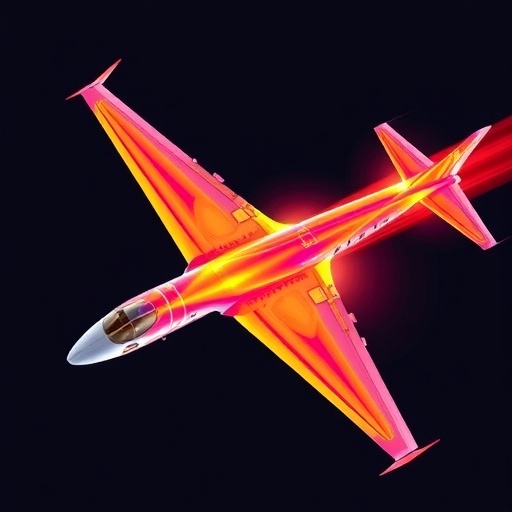
Researchers at the University of Surrey have introduced an innovative computational tool named AeroMap, poised to revolutionize the way aerodynamic drag is assessed in the aircraft design process. This pioneering approach aims to streamline the early stages of aircraft development, enabling engineers to obtain drag data with remarkable efficiency. The significance of AeroMap lies in its potential to influence the safety and fuel efficiency of future aircraft models, thereby playing a crucial role in the evolution of the aviation industry.
Aerodynamic drag, which opposes the motion of an aircraft through the atmosphere, is a critical consideration for engineers during the design phase. The ability to predict drag with accuracy at an early stage not only mitigates the risk of costly redesigns later but also curtails the extensive periods typically required for wind tunnel testing and intricate computer simulations. This new capability provided by AeroMap could lead to dramatic reductions in both time and financial resources allocated to aircraft development.
AeroMap specializes in estimating drag for various wing-body configurations at transonic speeds—those close to the speed of sound. The research team’s publication in the esteemed journal, Aerospace Science and Technology, highlights that AeroMap is capable of delivering datasets that are 10 to 100 times faster than existing, high-fidelity simulations available in the market. Despite this increase in speed, AeroMap maintains a level of accuracy that is vital for making informed design decisions.
The findings suggest that the rapid prediction of drag could unlock new opportunities for innovative aerodynamic configurations. By allowing engineers to explore a broader spectrum of design alternatives within reduced timeframes, AeroMap supports the pursuit of more fuel-efficient aircraft designs. This aspect is especially relevant as the industry shifts towards sustainability and aims to minimize its environmental footprint.
Dr. Rejish Jesudasan, the lead author of the study and Research Fellow at the University of Surrey, articulated the essence of AeroMap’s development. He emphasized the necessity of creating a method capable of providing reliable transonic aerodynamic predictions for various configurations without incurring the substantial computational costs associated with full-scale simulations. By augmenting the speed at which reliable results are generated, AeroMap lessens the dependency on repetitive wind-tunnel testing and costly redesign processes. This innovation contributes to increasing the confidence and efficiency with which engineers can refine their concepts.
The technical underpinnings of AeroMap rest on a viscous-coupled full potential methodology. This approach ingeniously merges a reduced variant of the Navier–Stokes equations, which model airflow dynamics, with a framework describing the thin boundary layer of air interacting with the aircraft’s surface. This method allows AeroMap to effectively encapsulate the primary drag effects while operating within a significantly lower computational demand compared to more exhaustive simulation techniques. The result is a practical, rapid-response tool that meets the pressing needs of aerospace engineers during the formative stages of aircraft design.
It is important to note that many existing aerodynamic models still hinge on empirical methods from decades past, which, while historically reliable, may exhibit inaccuracies when applied to modern high-efficiency wing designs. AeroMap has received validation against established NASA wind tunnel data, revealing a close correlation between its predictions and empirical measurements. This reinforces AeroMap’s viability as a reliable resource for the sustainable development of future aircraft.
In discussing the broader implications of AeroMap, Dr. Simão Marques, a co-author of the study, highlighted the ongoing challenge of accurately predicting transonic performance for aircraft configurations during early concept phases. The shortcomings of prior empirical approaches, which are based on outdated datasets, often fail to capture the complexities of contemporary high-efficiency wings. AeroMap innovatively integrates recognized aerodynamic principles, enhancing the reliability of drag predictions throughout the early development process. This enhancement empowers engineers to make more informed and strategic design decisions.
John Doherty, another co-author of the study and Associate Professor at the University of Surrey, expressed the exploratory avenues AeroMap could open. He noted the potential for combining AeroMap with optimization techniques to analyze a wider array of wing-body configurations and performance scenarios. By facilitating expedited assessments of aerodynamic performance, this dual approach could significantly enhance engineers’ ability to pinpoint efficient designs at an earlier stage in the design process, ultimately resulting in reduced lifecycle costs.
The introduction of AeroMap is not merely a tool for design efficiency; it represents a paradigm shift in how aerodynamics is approached within the context of aerospace engineering. Its potential to streamline the design process while maintaining accuracy positions AeroMap as a critical ally for engineers facing the dual challenges of innovation and sustainability. As the aerospace industry grapples with the imperative need for efficient flight solutions, AeroMap emerges as a beacon of promise for the future of aircraft design.
Furthermore, the implications of AeroMap extend beyond mere speed and efficiency; they encompass strategies for reducing the environmental impact of air travel. With the aviation sector under scrutiny for its carbon footprint, the development of aircraft that are both safer and more fuel-efficient could play a pivotal role in aligning the industry with evolving sustainability goals. AeroMap’s ability to provide quick, reliable drag data could catalyze a new wave of innovation focused on eco-friendly aircraft designs.
It is evident that advances like AeroMap are instrumental in propelling aviation forward. As the industry transitions to greater reliance on computational models and simulation tools, the introduction of AeroMap exemplifies a fusion of tradition and innovation in aircraft design methodology. This tool will likely underpin the next generation of aerospace engineering, ensuring that aircraft are not only smarter but also greener. AeroMap is set to affect not only the efficiency of design processes but also the larger narrative of how the aviation sector aligns with global sustainability objectives.
In conclusion, as researchers continue to refine and develop AeroMap, the potential for significant advancements in aircraft design becomes increasingly apparent. The marriage of speed and accuracy in drag prediction heralds a new era for aerospace engineering. With its promising foundation, AeroMap stands ready to support the next generation of aircraft innovations, ensuring a more effective, efficient, and sustainable future for the industry.
Keywords
Aerodynamics, aircraft design, drag prediction, transonic speeds, computational approach, aerodynamic efficiency, sustainability in aviation, engineering innovation, AeroMap, University of Surrey, aerospace engineering, wind tunnel testing.
Cite Scienmag News
Denise Maddox. (November 4, 2025). Enhancing Aircraft Design with Rapid and Precise Drag Predictions. Scienmag. https://scienmag.com/enhancing-aircraft-design-with-rapid-and-precise-drag-predictions/
Denise Maddox. "Enhancing Aircraft Design with Rapid and Precise Drag Predictions." Scienmag, 4 November 2025, https://scienmag.com/enhancing-aircraft-design-with-rapid-and-precise-drag-predictions/. Accessed 4 September 2026.
Denise Maddox. "Enhancing Aircraft Design with Rapid and Precise Drag Predictions." Scienmag. November 4, 2025. https://scienmag.com/enhancing-aircraft-design-with-rapid-and-precise-drag-predictions/


