


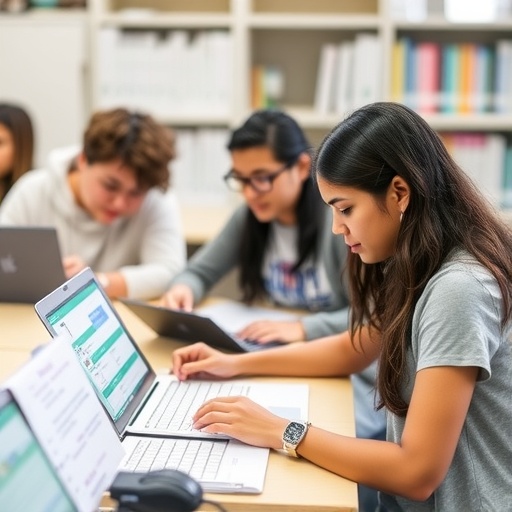
In the ever-evolving world of academia, the importance of undergraduate research has been growing exponentially. While research opportunities are essential for deepening students’ understanding and fostering innovative thinking, not all students have equal access to these valuable experiences. New insights from a recent paper by Amelung and Helmke bring to light an innovative solution aimed at democratizing these opportunities. Their work, titled “Lowering Barriers to Entry in Undergraduate Research Through Student-Led Virtual Workshops,” is a clarion call for a shift in how research is approached at the undergraduate level.
The authors underscore that traditional models of research engagement often pose significant challenges for students, particularly those from diverse or underrepresented backgrounds. Barriers such as limited access to mentorships, financial constraints, and often intimidating academic environments can deter prospective researchers before they even get started. This disheartening trend emphasizes the need for alternative pathways that empower students rather than alienate them.
The framework proposed by Amelung and Helmke centers around the concept of student-led virtual workshops. This format embraces the digital revolution that has permeated our lives, especially in light of the recent global pandemic, which has forced educational institutions to adapt and rethink their approaches. The authors argue that virtual workshops can break down geographical and institutional barriers, allowing students from various backgrounds and locations to engage in rich, collaborative learning experiences.
A crucial aspect of this innovative model is its community-driven nature. By empowering students to lead workshops, the authors suggest that not only do the participants learn about research methodologies, but they also cultivate valuable leadership and communication skills. This dynamic not only strengthens individual capabilities but also fosters a sense of community among aspiring researchers. The interaction within these virtual settings is vast, enabling students to share their ideas and insights freely, thus enriching the collective knowledge pool.
Moreover, the implementation of a student-led framework encourages ownership of the learning process. Traditional pedagogical models often place students in passive roles, where they absorb information without fully engaging with it. However, by switching to an active, student-led format, the authors of the study promote a culture of inquiry and critical thinking. Students are not merely learning how to conduct research; they are actively engaging in shaping the research landscape itself.
Virtual workshops also have the potential to enhance inclusivity and representation in research. In an academic environment often dominated by a select few, it is crucial to harness diverse perspectives. The paper emphasizes that underrepresented groups bring unique viewpoints that can lead to more holistic and innovative research outcomes. By lowering barriers, the authors argue that we can create a more inclusive and equitable scientific community.
Another essential component highlighted by the authors is the accessibility of resources. Virtual workshops mean that students can access materials and guidance without the constraints of travel or campus-specific resources. This democratization of knowledge enables greater participation and allows for a broader range of subjects to be explored. Students who might struggle to find research opportunities at their institutions can now connect with experts and peers globally, breaking previous limitations.
In discussing the methodology behind their framework, Amelung and Helmke detail the processes involved in setting up these workshops. The collaboration between students, faculty, and researchers is paramount to ensure that these workshops are effective and impactful. The authors advocate for an inclusive planning process that invites diverse voices and perspectives during the workshop setups. This collaborative effort amplifies the educational experience, making it more relevant to the current needs of students.
The paper also discusses the technical aspects of executing successful virtual workshops. A solid understanding of digital platforms and tools is critical for ensuring smooth interactions and presentations. This technical know-how is invaluable for students, as they often have to navigate complex software and communication systems in research environments. Thus, the virtual platform promotes not just research skills but also vital technical competencies.
Student-led virtual workshops could also lead to exciting partnerships between institutions. Collaboration across universities allows for the pooling of resources, knowledge, and expertise. The authors envision a future where these partnerships can cultivate a rich interchange of ideas, ultimately propelling scientific inquiry forward. By working together, institutions can create a unique ecosystem of learning that transcends geographical boundaries.
Research in education has often focused on augmenting traditional learning methods without radically changing the framework in which students operate. However, the authors of this paper challenge that status quo. They invite educators, administrators, and policymakers to rethink what undergraduate research can and should look like. This call to action is not merely about adjusting current practices but about reimagining the very structure of how we engage students in research.
Furthermore, the authors provide a compelling argument for assessing the impact of these workshops. Evaluation metrics will be crucial for understanding their effectiveness and ensuring they meet the intended goals of inclusion and accessibility. Continuous feedback from participants will enable iterative improvements, creating a refined model that can adapt with changing student needs.
In conclusion, Amelung and Helmke’s paper presents an inspiring vision for the future of undergraduate research. The switch to student-led virtual workshops shines a light on the importance of agency, inclusivity, and accessibility in academia. By lowering barriers to participation, we can cultivate an environment where every interested student has the opportunity to become a researcher. This approach holds the promise of not only diversifying the research landscape but also enriching the overall scientific discourse. The future of research is bright, as we embrace new pathways that honor the contributions of all voices.
Amelung, C., Helmke, B.P. Correction: Lowering Barriers to Entry in Undergraduate Research Through Student-Led Virtual Workshops.
Biomed Eng Education 5, 101 (2025). https://doi.org/10.1007/s43683-024-00164-4
Cite Scienmag News
Ophelia Keating. (August 30, 2025). Enhancing Access to Undergraduate Research via Student Workshops. Scienmag. https://scienmag.com/enhancing-access-to-undergraduate-research-via-student-workshops/
Ophelia Keating. "Enhancing Access to Undergraduate Research via Student Workshops." Scienmag, 30 August 2025, https://scienmag.com/enhancing-access-to-undergraduate-research-via-student-workshops/. Accessed 5 September 2026.
Ophelia Keating. "Enhancing Access to Undergraduate Research via Student Workshops." Scienmag. August 30, 2025. https://scienmag.com/enhancing-access-to-undergraduate-research-via-student-workshops/


