

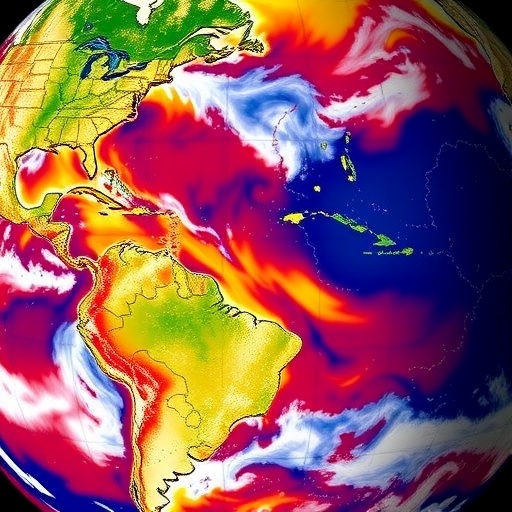
Emergence of the Enhanced Equatorial Atlantic Warming: A Defining Fingerprint of Global Climate Change
In recent decades, global warming has indisputably reshaped the climate dynamics of our planet, triggering alterations in temperature patterns, ocean currents, and atmospheric circulation. Among the vast array of climatic changes observed, one particularly striking phenomenon has emerged in the tropical Atlantic Ocean: an accelerated warming concentrated along the equatorial band. This enhanced equatorial Atlantic warming (EAAW) is garnering intense scientific scrutiny as it has profound implications for regional and global climate systems. The landmark study by Dong, Wang, Wu, and colleagues, published in Nature Communications in 2025, elucidates the mechanisms driving this intensified warming pattern and establishes it as a distinct fingerprint of anthropogenic global warming.
The equatorial Atlantic Ocean, straddling the equator between the western coasts of Africa and South America, has historically exhibited unique thermal structures due to its geography and atmospheric interactions. This region has been characterized by a delicate balance of oceanic currents, surface winds, and solar heating effects. However, emerging observational data coupled with advanced climate models reveal that the SST (sea surface temperature) increase along the equator in the Atlantic basin is not merely a uniform gradient but displays an anomalously enhanced warming signal. The research team leverages high-resolution datasets spanning multiple decades to detect the subtle yet statistically significant acceleration in warming specific to this equatorial zone.
Crucially, the study identifies that the emergence of this enhanced warming is intimately linked to alterations in surface wind patterns—predominantly the weakening of the trade winds that traditionally blow from east to west across the tropical Atlantic. The weakening trade winds reduce evaporative cooling and decrease the upwelling of cooler subsurface waters, which under normal conditions help regulate the sea surface temperature. This process not only amplifies surface warming but also disrupts the vertical thermal stratification within the upper ocean layers. As a result, the intensified heat content near the ocean surface contributes to the pronounced warming anomaly detected in the equatorial Atlantic region.
The research highlights the feedback loops that reinforce this warming. Elevated SSTs alter atmospheric pressure gradients, which in turn further diminish the intensity of the trade winds. This creates a positive feedback mechanism that exacerbates the warming trend, potentially stabilizing the enhanced equatorial Atlantic warming as a persistent climate feature. The study’s simulations also suggest that the warming pattern is not an ephemeral or localized event but a robust emergent property under scenarios of continued greenhouse gas emissions. Consequently, this phenomenon stands as a climate fingerprint, marking the distinctive influence of anthropogenic forcing separate from natural interannual or decadal variability.
Understanding the emergence of enhanced equatorial Atlantic warming is of paramount importance due to the wide-reaching climatic and societal ramifications linked with this oceanic change. The tropical Atlantic influences the genesis and trajectory of Atlantic hurricanes, which derive much of their energy from warm ocean surfaces. Thus, an elevated and spatially intensified warming zone along the equator could modulate hurricane season characteristics, potentially increasing storm intensity or altering their paths, with profound impacts on vulnerable coastal communities and ecosystems.
The study also discusses how the modified SST gradients in the tropical Atlantic may influence atmospheric circulation beyond the oceanic realm. For instance, the shifting thermal contours can perturb the West African Monsoon system, which is critically dependent on Atlantic Ocean temperatures for moisture transport and regional rainfall patterns. Any sustained changes in the timing, intensity, or spatial distribution of monsoon rains could have sweeping consequences on agricultural productivity, water resources, and livelihoods in densely populated regions of West Africa.
Employing coupled ocean-atmosphere climate models validated against observational records, Dong et al. meticulously dissect the complex interplay between oceanic and atmospheric processes driving this warming fingerprint. Their models incorporate ocean dynamics, heat flux exchanges, and atmospheric circulation responses with unprecedented precision, enabling a holistic understanding of how anthropogenic climate forcing manifests uniquely in the equatorial Atlantic. The study’s sophisticated approach also accounts for potential confounding natural climate modes, such as the Atlantic Multidecadal Oscillation (AMO), making the identification of the EAAW’s anthropogenic origin significantly more robust.
Another dimension illuminated by the research pertains to the broader implications for the Atlantic Meridional Overturning Circulation (AMOC), a crucial component of global ocean circulation. Variations in the equatorial Atlantic temperature field affect salinity patterns and stratification, which can modulate the strength and stability of the AMOC. Given the AMOC’s role in redistributing heat globally and influencing European and North American climate, alterations triggered by the enhanced equatorial warming could potentially reverberate through distant regions, amplifying global climate risks.
Interestingly, the paper also emphasizes how the signal of enhanced equatorial Atlantic warming is emerging earlier and more distinctly than previously anticipated by many climate projections. This underscores the urgent need for continuous oceanic monitoring and refined predictive modeling to better anticipate climate-linked hazards. The findings challenge the climate science community to revisit their understanding of regional climate feedbacks and integrate these findings into global climate policy frameworks.
Beyond the physical sciences, the societal relevance of this discovery cannot be overstated. The equatorial Atlantic warming pattern holds significance for climate adaptation and mitigation strategies across multiple continents bordering the Atlantic basin. Governments and international institutions can leverage such targeted scientific insights to devise more precise early warning systems for extreme weather events, optimize water management, and safeguard agricultural productivity in climate-vulnerable zones.
The scientific breakthroughs led by Dong, Wang, Wu, and their team mark a pivotal advancement in decoding the fingerprints of human-induced climate change. Their identification of the enhanced equatorial Atlantic warming as a clear and quantifiable marker of global warming represents a critical step toward unraveling the complex regional manifestations of a warming world. It is a clarion call for deepened scientific inquiry, enhanced observational capabilities, and proactive climate resilience planning geared towards the nuanced realities of Earth’s evolving climate system.
As new research builds on these findings, future studies will likely focus on the multi-faceted interactions between equatorial Atlantic warming and global climate phenomena such as El Niño Southern Oscillation (ENSO), the Intertropical Convergence Zone (ITCZ) shifts, and polar ice melt feedbacks. The integration of these insights will sharpen the predictive abilities of climate models, fostering improved public awareness and actionable knowledge.
In conclusion, the enhanced warming along the equatorial Atlantic Ocean emerges not only as a remarkable climate signal but also as an urgent indicator of the accelerating pace and intricate nature of human-driven climate change. This study serves as an exemplar of how meticulous scientific observation coupled with advanced modeling can provide a window into the changing heartbeat of our planet’s climate, offering critical guidance for the global community seeking to understand and mitigate the challenges of the Anthropocene era.
Subject of Research: Enhanced equatorial Atlantic warming as an indicator and mechanism linked to global anthropogenic warming and its broader climatic impacts.
Article Title: Emergence of the enhanced equatorial Atlantic warming as a fingerprint of global warming.
Article References:
Dong, L., Wang, Z., Wu, L. et al. Emergence of the enhanced equatorial Atlantic warming as a fingerprint of global warming. Nat Commun (2025). https://doi.org/10.1038/s41467-025-68015-6
Image Credits: AI Generated


