


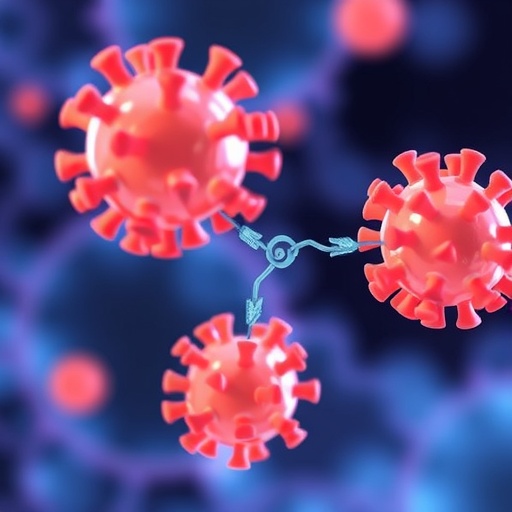
In a groundbreaking advancement poised to redefine cancer therapeutics, researchers have engineered a novel drug delivery system that enhances the targeting and retention of anti-cancer agents within tumors. The innovative approach hinges on molecular “grappling hooks,” specialized peptides designed to anchor therapeutic compounds securely to cancer cell membranes, thereby amplifying drug efficacy and reducing collateral damage to healthy tissues. This breakthrough, detailed in a forthcoming publication in ACS Central Science, signifies a transformative leap toward more precise and enduring cancer treatments.
Central to this paradigm is the concept of drug retention in tumor microenvironments—a critical yet historically underappreciated factor influencing treatment outcomes. While conventional therapies often rely on molecules engineered to home in on tumor-specific markers, the physical dwell time of the drug within malignant tissues is equally pivotal. Insufficient local retention can precipitate rapid drug clearance, diminishing therapeutic impact and expanding systemic toxicity. Addressing this challenge, the newly developed system leverages restricted interaction peptides (RIPs) that undergo conformational shifts upon enzymatic activation, enabling them to insert firmly into cell membranes.
These RIPs are ingeniously programmed to respond selectively to fibroblast activation protein (FAP), a protease overexpressed in the stroma of many solid tumors. Upon enzymatic processing by FAP, the peptides transform structurally, adopting amphiphilic configurations that facilitate membrane insertion and tether the attached therapeutic cargo directly to cancer cell surfaces. This targeted membrane anchoring effectively transforms the drug into a “molecular grappling hook,” securing it precisely where it is most needed and promoting enhanced cellular uptake.
Preclinical evaluations underscore the system’s potential. Fluorescently labeled RIPs exhibited rapid and specific uptake by cultured cancer cells, validating the mechanism of membrane engagement. When conjugated to monomethyl auristatin E, a potent chemotherapeutic, the combined molecule retained cytotoxic efficacy equal to that of the free drug in vitro. Crucially, in vivo studies using murine models implanted with human tumors demonstrated that the RIP-drug conjugate accumulated selectively in tumor tissue. This selective localization translated to superior tumor regression and reduced systemic side effects compared to administering the drug alone.
Expanding the versatility of this platform, researchers substituted the chemotherapeutic payload with radioactive copper isotopes commonly employed in nuclear medicine. This adaptation yielded comparable tumor binding and shrinkage efficacy, effectively establishing a theranostic agent capable of both diagnosing and treating cancers. The dual functionality heralds a new era wherein a single molecular entity can seamlessly traverse the translational gap between imaging and therapy, optimizing personalized cancer management.
The implications of these findings extend beyond the laboratory. Plans are underway to initiate Phase 1 clinical imaging trials using the RIP-copper pairing, aiming to translate this technology into human applications. Collaborations with biotech firms focused on radiopharmaceutical development are facilitating the swift advancement of RIP-based therapeutics toward regulatory approval and clinical integration.
This research not only enriches the chemical biology of drug delivery but also redefines the pharmaceutical landscape by emphasizing the kinetic dimension of drug retention within tumors. By physically anchoring drugs to malignant cells, this approach mitigates premature drug dispersal, enhances therapeutic window, and curtails adverse effects. Michael Evans, a leading investigator in the study, underlines that maximizing tumor-specific drug delivery while sparing healthy tissues holds the promise of safer, more effective therapies.
The multidisciplinary team behind this technology, including experts from the University of California San Francisco, integrates expertise in peptide chemistry, enzymology, and oncology. Their meticulous design and characterization of RIPs exemplify the confluence of chemical innovation and clinical aspiration, establishing a platform adaptable to a range of oncological agents and diagnostic isotopes.
Funding from entities such as the Advanced Research Projects Agency for Health and the National Institutes of Health has been instrumental in propelling this research. The support underscores the growing recognition of targeted drug retention technologies as pivotal elements in the future of precision cancer medicine. Furthermore, some of the authors have spun out a company, TheraPaint, Inc., to accelerate the development of RIP-based radiopharmaceuticals for cancer theranostics.
Overall, this innovative molecular grappling hook strategy illuminates a promising frontier in oncological therapeutics. By harnessing biochemically triggered conformational changes to gain a physical foothold on cancer cell membranes, the approach offers a sophisticated solution to persistent challenges in drug delivery. As the field eagerly anticipates clinical validation, the technology exemplifies how molecular engineering can reconcile efficacy and safety in cancer treatment.
Cite Scienmag News
Nathaniel Bowman. (May 13, 2026). Enhanced Cancer Drug Targeting and Efficacy Through Molecular Grappling Hooks. Scienmag. https://scienmag.com/enhanced-cancer-drug-targeting-and-efficacy-through-molecular-grappling-hooks/
Nathaniel Bowman. "Enhanced Cancer Drug Targeting and Efficacy Through Molecular Grappling Hooks." Scienmag, 13 May 2026, https://scienmag.com/enhanced-cancer-drug-targeting-and-efficacy-through-molecular-grappling-hooks/. Accessed 3 September 2026.
Nathaniel Bowman. "Enhanced Cancer Drug Targeting and Efficacy Through Molecular Grappling Hooks." Scienmag. May 13, 2026. https://scienmag.com/enhanced-cancer-drug-targeting-and-efficacy-through-molecular-grappling-hooks/


