


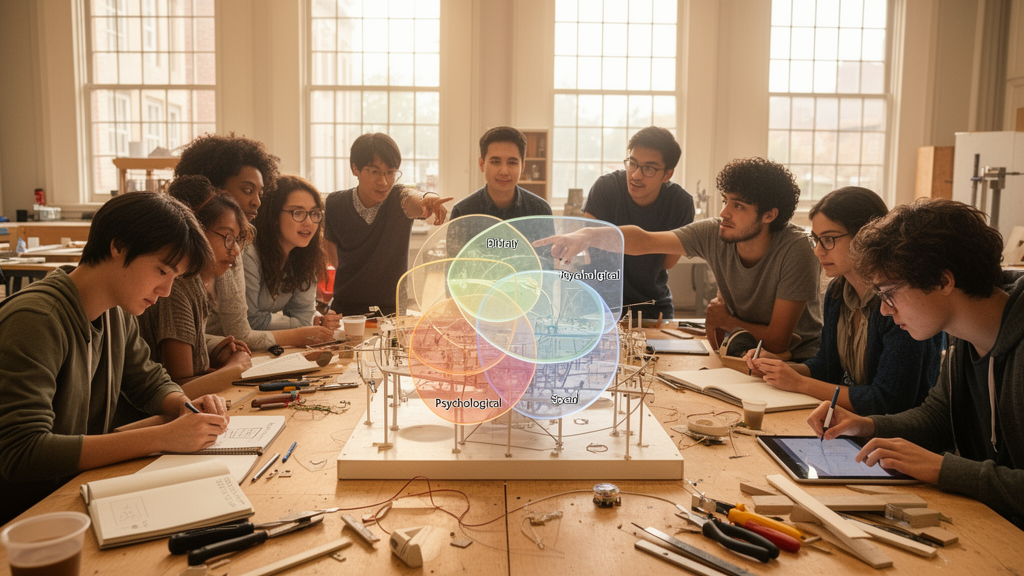
Engineering classrooms have long rewarded students who can build the cleverest algorithm or the most efficient circuit, but a new study argues that this narrow technical focus leaves future engineers dangerously unprepared for the messy human realities of their work. Researchers at Universidad El Bosque in Bogotá, Colombia, together with a collaborator at Purdue University, tested a framework called the Biopsychosocial and Cultural Model, or BPSCm, in a final-year Systems Engineering capstone course. Their goal was ambitious: to teach students to treat every engineering project not as an isolated technical puzzle but as a living system embedded in biology, psychology, culture, and community. The results, published in Discover Education, suggest that when students are given a structured way to think about people alongside technology, their analysis of complex problems becomes noticeably richer and more systematic.
The timing of the study reflects a broader shift in the engineering profession. As industry moves from the automation-focused vision of Industry 4.0 toward the human-centered ideals of Industry 5.0, employers increasingly expect graduates who can weigh well-being, sustainability, and resilience alongside performance metrics. Education 5.0, the parallel transformation in universities, asks curricula to pair advanced tools such as artificial intelligence and machine learning with an explicit concern for quality of life and long-term social consequences. The authors argue that these competencies cannot be left to develop by accident during a student’s first job. They must be deliberately cultivated in coursework, and the capstone project, where teams tackle real, ill-defined problems over an entire term, is an ideal place to start.
The BPSCm organizes that cultivation around four interrelated elements: artifacts, beliefs and culture, environment, and habits. When students analyze an engineering problem through the model, they are prompted to ask not only whether a technical solution will function, but who will use it, how it fits the social and cultural context, and what conditions might determine whether it is adopted at all. The framework draws on the biopsychosocial tradition, in which biological factors such as human physical characteristics, psychological factors such as cognition and motivation, and sociocultural dynamics such as communication patterns are treated as interacting dimensions rather than separate checklists. Crucially, the model does not claim causal relationships between these dimensions. Instead, it provides a qualitative structure for reflection, helping students notice how a change in one area, say a community’s habits, might ripple through the others and alter the fate of a project.
Methodologically, the study took an unusual and refreshingly honest approach. Rather than measuring student outcomes with tests or surveys, the researchers used an Educational Design Research framework combined with a Self-Study of Teaching Practice methodology. The two course instructors, who are also the study’s authors, kept separate reflective journals, recording one entry after each of roughly sixteen weekly class sessions across two successive academic terms. The first cohort included all 77 enrolled students and the second all 44, but the authors are careful to stress that these numbers describe the classroom context only. Students were never recruited as research participants, and no student assignments, grades, or presentations were collected or analyzed as data. The unit of analysis was the instructors’ own documented observations and interpretations, a design that trades generalizability for a detailed window into pedagogical reasoning.
In the first iteration, the instructors wove the BPSCm into the Technology Transfer Cycle, a phased process running from problem identification and formulation through referential framework building, technological solution development, and three forms of validation: academic, static, and dynamic. Students submitted written reflections analyzing an engineering solution through the model’s four components. The instructors’ journals suggested that students did begin connecting technical decisions with social, cultural, and biological considerations, and a semantic analysis of the journal entries revealed three interconnected domains underpinning engineering competence: education, comprehensive analysis, and skill development. But a persistent problem emerged. Students struggled to apply the framework consistently across project stages and had difficulty translating abstract biopsychosocial dimensions into concrete engineering decisions, particularly when trying to link social and cultural factors with technical variables.
That observation directly shaped the second iteration, where the instructors introduced a graphical representation of the BPSCm as a scaffolding device. Students first performed a context analysis, drawing the actors of a system as boxes, describing the artifacts and tools currently in use, and mapping the relationships among them through the model’s components. They were encouraged to begin from any element of the model to avoid value judgments and reach a more objective interpretation. Then came a solution analysis, in which students reflected on how the system would change once their proposed artifact was implemented, defining general and specific objectives and key variables to evaluate how the target context might transform. The visual structure gave teams a shared language: instructors noted that when students explained their diagrams during presentations, previously hidden interconnections between actors, technical variables, and sociocultural factors became explicit and discussable.
The thematic analysis of the second iteration’s journals surfaced four emerging categories: engineering skills development, analytical skills, formative research, and professional values. Compared with the first cohort, the instructors observed a shift from a broad, experience-based approach toward a more structured and methodical one. Students appeared to break complex problems into manageable components, question their own assumptions, and revise designs iteratively after considering social, cultural, and organizational implications. The instructors documented students moving away from treating solutions as fixed outcomes and toward viewing them as evolving processes open to refinement. They also reported growth in teamwork and research practices, with teams dividing tasks more deliberately, documenting findings systematically, and validating assumptions with data rather than intuition. One instructor reflected that without the model’s analysis, students would not have had the opportunity to address their problems holistically and systemically.
The study is candid about its limits, and those limits matter. Some teams never fully managed to connect the biopsychosocial and cultural dimensions with technical design variables, and a few focused on the visual polish of their diagrams without genuinely engaging with the underlying relationships. Students encountered a learning curve with the graphical aspects of the model, requiring structured workshops and continuous mentoring to apply it coherently. The instructors also noted that inconsistent exposure to the framework across earlier courses created confusion when students reached the capstone. Because the analysis rests entirely on instructor reflections, with the researchers simultaneously serving as teachers, interpretive bias is an acknowledged risk, mitigated only partially by immediate journaling, collaborative discussion, and an external collaborator’s detached perspective on the analysis.
Even with those caveats, the findings carry real weight for anyone thinking about the future of technical education. The instructors’ reflections indicate that a structured conceptual model, especially one made visible through diagrams, can help students move beyond purely technical reasoning and integrate human, social, and environmental considerations into engineering judgment. The approach aligns with Ausubel’s Meaningful Learning theory, which emphasizes active, hands-on engagement that produces durable understanding, and it complements existing tools such as Causal Loop Diagrams and Unified Modeling Language diagrams that already help engineers visualize system behavior. The authors propose extending the BPSCm with an additional analytical layer inspired by System Request, incorporating business need, requirements, value, and constraints to make contextual analysis even more explicit.
What happens next could determine whether this idea spreads beyond a single South American capstone course. The authors call for longitudinal studies that follow students into their careers to see whether biopsychosocial and cultural perspectives persist once the scaffolding is removed, and for implementations in different cultural and educational settings to test the model’s adaptability. They are also explicit that their conclusions are exploratory interpretations rather than direct evidence of changed student learning. Still, the core message resonates far beyond one classroom: engineering solutions are built for specific communities with particular beliefs, habits, and environments, and the engineers of the Industry 5.0 era will need more than code and calculus to serve them. Teaching students to see the whole system, the researchers suggest, may be the most important systems lesson of all.
Subject of Research: Integrating a biopsychosocial and cultural model into engineering capstone education to foster systems thinking
Article Title: Examining systems thinking through a biopsychosocial and cultural perspective in engineering education
Article References: Sabogal-Alfaro, G. P., Feijoo-Garcia, M. A., & Magana, A. J. (2026). Examining systems thinking through a biopsychosocial and cultural perspective in engineering education. Discover Education, 5(1), Article 1138. https://doi.org/10.1007/s44217-026-02257-4
Image Credits: AI Generated
DOI: 10.1007/s44217-026-02257-4
Keywords: systems thinking, engineering education, biopsychosocial model, capstone projects, project-based learning, sociotechnical systems, sociocultural aspects, Educational Design Research, self-study of teaching practice, Industry 5.0, conceptual modeling, learner-centered learning
Cite Scienmag News
Denise Maddox. (October 8, 2026). Engineering Students Learn to See the Whole System with a Biopsychosocial Lens. Scienmag. https://scienmag.com/engineering-students-learn-to-see-the-whole-system-with-a-biopsychosocial-lens/
Denise Maddox. "Engineering Students Learn to See the Whole System with a Biopsychosocial Lens." Scienmag, 8 October 2026, https://scienmag.com/engineering-students-learn-to-see-the-whole-system-with-a-biopsychosocial-lens/. Accessed 8 October 2026.
Denise Maddox. "Engineering Students Learn to See the Whole System with a Biopsychosocial Lens." Scienmag. October 8, 2026. https://scienmag.com/engineering-students-learn-to-see-the-whole-system-with-a-biopsychosocial-lens/


