


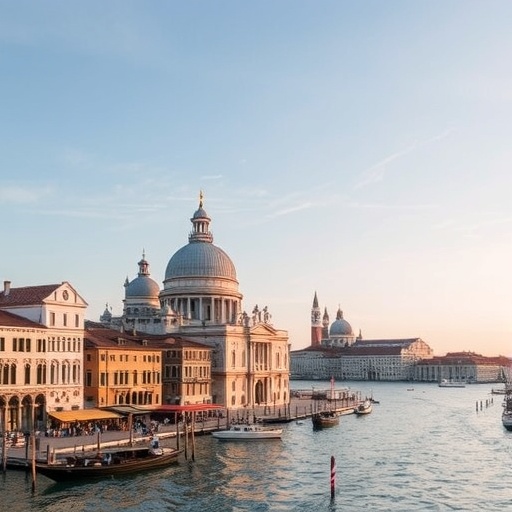
“Impluvium Redux,” a transformative architectural project designed by Juan José Castellón from Rice University’s School of Architecture, stands at the intersection of innovation, sustainability, and aesthetics. Recently shortlisted for the prestigious 2025 European Cultural Centre (ECC) Awards in the University Project category, this groundbreaking initiative not only showcases architectural prowess but also emphasizes the pressing need for sustainable water management solutions in urban environments. Currently on display in Venice as part of the Time Space Existence exhibition, “Impluvium Redux” represents a compelling collaboration between architecture and engineering, highlighting the broader implications of interdisciplinary work.
At the heart of “Impluvium Redux” is a comprehensive reimagining of traditional water infrastructure tailored to address contemporary environmental challenges. The project leverages a modular system designed for installation on rooftops or in public spaces, thereby facilitating the collection and purification of rainwater. The design employs hollow ceramic structural columns, paired with a lightweight, retractable canopy membrane, which works together to efficiently gather rainwater while simultaneously creating usable public spaces. This dual functionality serves not only the immediate need for sustainable water harvesting but also enhances community engagement and interaction with the environment.
Castellón’s vision encompasses more than mere functionality; he aims to revive the sensory experiences often dulled by modernity within the realm of architecture. He asserts the importance of incorporating tactile elements, spatial feelings, and sensory stimulation into architectural designs. By bringing attention to the materials and environmental context, Castellón seeks to foster a deeper connection between individuals and their surroundings, encouraging an appreciation for both natural and constructed elements.
The inspiration for “Impluvium Redux” draws heavily from Castellón’s cultural roots in Spain, where strong traditions of textile and ceramic craftsmanship exist. This artistic heritage has informed his approach to rethinking conventional water storage solutions, leading him to explore the potential of ceramics as a viable alternative to traditional materials like timber and steel. By conceptualizing a hollow ceramic structure that aligns with vernacular Spanish architecture, Castellón prompts a re-evaluation of how we think about infrastructure and its aesthetic implications.
The prototype on display in Venice stands approximately 5 meters tall, constructed from modular ceramic fragments that serve dual purposes—acting as both structural elements and water collectors. This innovative use of materials culminates in a design that is not only visually distinctive but also functional. The folding canopy is engineered to open and close, efficiently capturing rainfall and channeling water into the hollow columns for storage. Furthermore, a carefully designed filtering mechanism within the canopy ensures that collected rainwater undergoes a purification process, making it suitable for reuse.
Castellón emphasizes the modularity of the design, likening it to a set of LEGO blocks that can be combined to form taller structures if desired. This inherent flexibility allows for customization based on its deployment location. By taking inspiration from the work of Spanish architect Miguel Fisac, who was known for his organic and skeletal concrete forms, Castellón integrates functionality with a playful approach to architectural design.
From its inception, “Impluvium Redux” has thrived on collaboration across multiple disciplines. Since joining Rice University in 2018, Castellón has actively engaged with Qilin Li, a professor of civil and environmental engineering whose research focuses on innovative water collection and treatment technologies. Their collaborative efforts underscore the importance of blending architectural design with engineering technicalities, resulting in solutions that are both effective and socially relevant.
The partnership with Li and other collaborators from the Rice WaTER Institute, Carbon Hub, and Rice Global exemplifies the holistic approach taken in realizing “Impluvium Redux.” By enlisting the expertise of professionals from varying disciplines, Castellón and his team have created a project that not only addresses immediate infrastructural needs but also has broader implications for urban design and environmental stewardship. The integration of scientific research with architectural creativity fosters a multi-dimensional understanding of how urban spaces can evolve through innovative design.
The selection of “Impluvium Redux” by a jury comprising leaders from notable organizations—including ArchDaily and STIRworld—highlights its significance in the global architectural discourse. Out of more than 200 submissions representing 52 countries, the project stood out, indicating a shift towards more sustainable and socially responsible architectural practices. The announcement of the winners at the Time Space Existence event on November 23 will undoubtedly spotlight projects that are making strides in redefining architecture’s role within the context of environmental sustainability.
Looking beyond the Venice exhibition, Castellón and his collaborators are keen on bringing prototypes of “Impluvium Redux” to Rice University’s campus. They envision potential installations on the rooftops of academic buildings, further integrating sustainable practices into the educational environment. This forward-thinking approach is indicative of a larger trend in which academic institutions are becoming incubators for sustainable innovation in architecture and engineering.
Endeavors like “Impluvium Redux” compellingly illustrate how cross-disciplinary collaboration can yield innovative solutions to contemporary challenges. Castellón has expressed gratitude for the engagement and support from his colleagues, recognizing that such achievements are made possible through collective effort. He views being shortlisted for the ECC Awards not solely as a personal accolade but as a triumph for his dedicated team and the shared vision of sustainable design.
In conclusion, “Impluvium Redux” exemplifies a new paradigm in architectural practice—one that marries sustainability with aesthetic appeal while addressing the urgent demands of urban infrastructure. Its innovative design challenges conventional notions of water management, encouraging a rethinking of how we interact with our environment. In an era where environmental concerns dominate, projects like Castellón’s serve as both a blueprint for future endeavors and a call to action for architects and engineers alike.
Keywords
Sustainability, Architecture, Water Infrastructure, Collaboration, Rice University, Interdisciplinary Design, Ceramic Structures, Modular Design, Environmental Innovation.
Cite Scienmag News
Denise Maddox. (September 23, 2025). Engineering and Architecture Collaboration Nominated for Prestigious Award in Venice. Scienmag. https://scienmag.com/engineering-and-architecture-collaboration-nominated-for-prestigious-award-in-venice/
Denise Maddox. "Engineering and Architecture Collaboration Nominated for Prestigious Award in Venice." Scienmag, 23 September 2025, https://scienmag.com/engineering-and-architecture-collaboration-nominated-for-prestigious-award-in-venice/. Accessed 4 September 2026.
Denise Maddox. "Engineering and Architecture Collaboration Nominated for Prestigious Award in Venice." Scienmag. September 23, 2025. https://scienmag.com/engineering-and-architecture-collaboration-nominated-for-prestigious-award-in-venice/


