

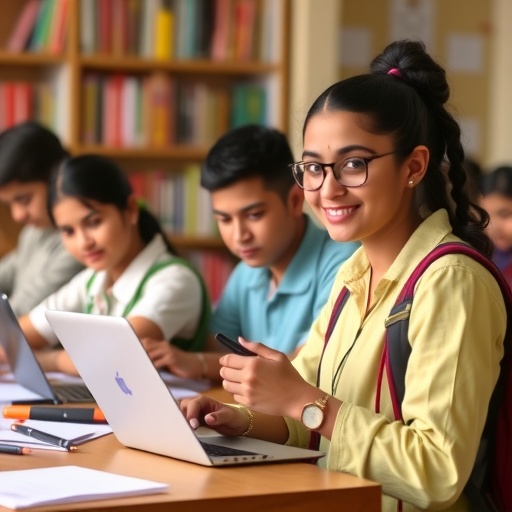
In a world increasingly interconnected by technology and globalization, the question of educational mobility takes on critical importance. A recent study sheds light on the role of English Medium Instruction (EMI) courses in enhancing international mobility, particularly for disadvantaged students. This research illuminates not just the barriers faced by these students, but also the transformative possibilities presented through strategic educational policies. By addressing systemic inequities within higher education, stakeholders can align resources to foster a more equitable global learning environment, enabling students from various backgrounds to pursue opportunities that were historically out of reach.
The integration of EMI in higher education represents a significant shift towards inclusivity. Traditional language barriers often hinder students with fewer resources from accessing international experiences, which are often pivotal for personal and professional growth. EMI courses, which prioritize English as the primary language of instruction, can serve as a powerful vehicle for underrepresented students, allowing them to compete more effectively on the global stage. This shift comes with an understanding that proficiency in English is not just a skill, but a passport to international opportunities.
Moreover, the study highlights a crucial aspect: the aspiration gap. Many disadvantaged students possess a desire for international study experiences, yet systematic barriers keep them from realizing these ambitions. EMI courses are positioned not just as a means of instruction, but also as a catalyst for ambition, encouraging students to envision themselves in global contexts. This proactive approach within educational frameworks could help to dismantle preconceived notions about who can achieve international success, thus serving as an equalizer in a landscape where socioeconomic factors disproportionately influence educational outcomes.
Beyond mere access, the study suggests that EMI courses can fundamentally alter the experiences of students who typically find themselves on the periphery of international education. Participation in these courses contributes significantly to the development of critical soft skills, such as intercultural communication, adaptability, and global awareness. These competencies are invaluable in an increasingly multicultural workforce. Hence, by facilitating the acquisition of both language skills and cultural dexterity, EMI programs are not merely instructional offerings; they represent a holistic approach to student development.
The implications of this research are far-reaching, extending beyond the classroom and affecting institutional policies and practices. Universities and colleges must adapt their recruitment strategies to attract a diverse student body, ensuring that disadvantaged individuals are not only accepted but also supported throughout their academic journeys. This entails providing financial resources, mentorship opportunities, and community engagement that can enhance students’ overall experience. Universities that prioritize such initiatives stand to benefit not only from a diverse student population but also from a richer educational environment that encourages collaboration among students from varied backgrounds.
Nonetheless, the implementation of EMI programs must be conducted with sensitivity to the cultural contexts of the students being served. Not all students will thrive equally in a system that primarily emphasizes English. There is a substantial need for pedagogical strategies that acknowledge and incorporate students’ linguistic backgrounds. Educational institutions must ensure that they are not only teaching English but also validating and embracing the linguistic diversity present within their student populations.
Another critical factor discussed in the study is governmental and institutional support. Policymakers must recognize the value of EMI programs and invest in their expansion. The role of government cannot be overlooked when considering how best to scale the impact of these educational initiatives. By developing policies that foster international collaborations and funding opportunities for disadvantaged students, governments can help create a supportive ecosystem that encourages mobility. Such investments not only benefit individual students but also strengthen the educational fabric of society as a whole.
Furthermore, the study emphasizes the necessity of partnerships between local institutions and international universities. Such alliances can create pipelines for student exchange and scholarship opportunities, which can supplement formal education and extend learning opportunities beyond the traditional classroom. By establishing connections with educational institutions abroad, local universities can facilitate satellite programs that maintain rigorous academic standards while promoting cultural exchanges that elevate student experiences.
The potential for EMI courses to promote international mobility also underscores the importance of adaptability in higher education. Education systems, historically resistant to change, must become more flexible and responsive to the evolving demands of our global society. This shift includes understanding the diverse needs of students and the importance of lifelong learner models, where education is no longer seen as confined to the classroom or a specific period of life, but rather as a continuous journey.
Additionally, as we reflect on the obstacles that disadvantaged students face, it’s crucial to consider not just access to education but also the quality of that education. EMI programs must be designed to engage students actively and to foster an environment where students can express themselves and develop critical thinking skills. This varied approach helps to structure a more engaging curriculum that resonates with students on a personal and professional level, ultimately leading to a richer learning experience.
Equally significant is the recognition of student voice in the evolution of EMI programs. Engaging with students to gather feedback and insights can foster a sense of community and belonging. Programs should actively solicit input from students, allowing them to shape the educational policies and practices that affect them directly. This participatory approach empowers students and encourages ownership over their educational paths, contributing to their overall success.
The transformative power of EMI courses goes beyond individual student experiences; it speaks to the potential for societal change. When universities embrace EMI as a tool for promoting equity, they are actively participating in the dismantling of systemic barriers. By championing initiatives that foster international mobility for disadvantaged students, educational institutions position themselves as catalysts for social change, capable of shifting the narrative around access and opportunity in higher education.
In conclusion, research into the role of EMI courses illuminates a pathway toward not only understanding the intricacies of international mobility for disadvantaged students but also toward redefining the educational landscape as a whole. We live in a time where preparation for a globalized workforce is imperative; therefore, it is essential to support initiatives that promote educational accessibility. By collectively acknowledging the importance of EMI courses in higher education, we can foster an environment where all students have the opportunity to thrive, learn, and contribute to the global community.
Subject of Research: The role of EMI courses in promoting international mobility for disadvantaged students.
Article Title: Breaking the cycle: the role of EMI courses in promoting international mobility for disadvantaged students.
Article References:
Yang, JY., Lin, E.S. Breaking the cycle: the role of EMI courses in promoting international mobility for disadvantaged students.
High Educ (2026). https://doi.org/10.1007/s10734-025-01613-x
Image Credits: AI Generated
DOI: https://doi.org/10.1007/s10734-025-01613-x
Keywords: English Medium Instruction, EMI, international mobility, disadvantaged students, education policy, language barriers, global citizenship, higher education, inclusivity, systemic barriers, student voice, cultural diversity, lifelong learning, educational equity.


