


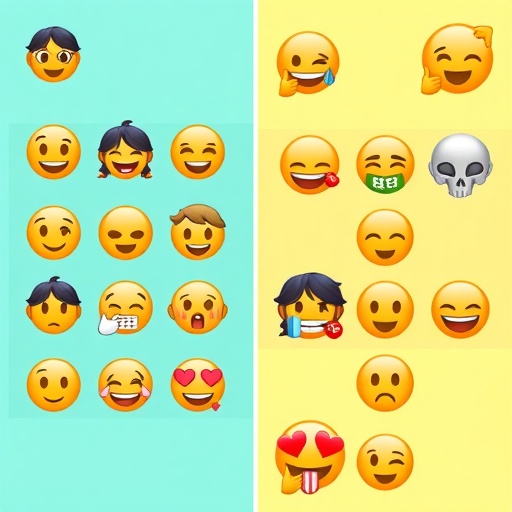
In the rapidly evolving landscape of digital communication, emojis have cemented their role as pivotal elements in conveying emotion, nuance, and interpersonal context. Recent research conducted by Tian and Liu provides a comprehensive examination of how different age groups in China—specifically younger and older adults—employ emojis within WeChat conversations, revealing not only generational distinctions but also shared strategies rooted in cognitive efficiency and cultural influence. This investigation dives into the pragmatic functions of emojis under the lens of Relevance Theory, offering fresh insights into how users optimize the balance between communicative effort and contextual impact in virtual exchanges.
Emojis, broadly classified into expressive, interactive, and symbolic categories, function in diverse capacities to enrich textual communication. Expressive emojis, such as smiling faces or crying expressions, directly convey emotional states with minimal ambiguity. Interactive emojis serve as conversation facilitators, signaling approval, disapproval, or encouragement—typified by gestures like the thumbs-up. Symbolic emojis represent tangible objects or abstract ideas, ranging from a simple flower to a brain, standing in for broader concepts or items. Crucially, these classifications are fluid, as emotive communication permeates all types, blurring conventional boundaries. In Tian and Liu’s database, expressive emojis dominate, underscoring their primary role in emotional exchange.
When analyzing generational variations, both younger and older users heavily rely on the “substituting” function of emojis, wherein an emoji replaces a chunk of textual information for communication efficiency. This function hinges on maximal relevance achieved through high contextual effect paired with minimal cognitive effort. Its prevalence across age cohorts highlights a shared strategy: utilizing the communicative economy of emojis to maintain emotional expressiveness while minimizing interpretive effort. Contrastingly, functions categorized as “challenging” or “weakening”—which demand substantial inference and cognitive processing—are notably underrepresented in both groups. The rarity of these complex functions suggests that interlocutor intimacy and cultural norms discourage ambiguous or indirect emotional cues in favor of clarity.
The study delves deeper into the psychology of emoji use, revealing age-specific nuances shaped largely by cognitive capacities and sociocultural contexts. Younger adults tend to employ “filling” emojis, which supplement or complete textual emotional expressions, enhancing the vibrancy and dynamism of their messages. Older adults, however, favor “enhancing” emojis that reiterate emotions already explicit in text, requiring less cognitive effort for decoding. This distinction reflects differing comfort levels with ambiguous or layered digital symbols: younger individuals display greater confidence and fluency in interpreting nuanced visual cues, while older adults prefer straightforward, reinforcing emotive signals.
Cognitive aging factors further illuminate these usage disparities. Declining working memory and processing speed among older adults can hinder their ability to effectively utilize a broad spectrum of emojis or decipher complex embedded meanings. Despite intact semantic knowledge, the additional cognitive load associated with mastering diverse symbolic forms and employing intricate communicative strategies motivates older users to restrict their emoji repertoire. This pragmatic economizing aligns with Relevance Theory’s principle that communication is optimized when the effort-to-effect ratio is minimized, preserving conversational coherence without taxing mental resources.
A fascinating cultural overlay contextualizes these findings. Chinese cultural norms, deeply influenced by Confucian values, prioritize social harmony, respect, and group cohesion, unlike Western individualistic orientations. Older users exemplify this through a selective, restrained emoji usage pattern that aligns with authoritative and stable self-presentation ideals expected of their age group. Meanwhile, younger users embrace more entrepreneurial and playful emoji forms, leveraging the multimodal potential of digital communication to express adaptability and liveliness. Such cultural dimensions crucially affect the social image management strategies embodied in emoji selection and usage contexts.
Quantitatively, the study reveals that while younger adults generate roughly twice as many emoji-inclusive conversations as older adults on WeChat, their relative frequency of emoji use compared to text remains similarly proportional across age groups. This counters earlier research suggesting a wider gap in emoji adoption between ages. Instead, it indicates a generational convergence fueled by increasing digital literacy among older demographics, suggesting that emoji use has matured into a standardized emotional expression tool transcending purely age-related digital divides.
The “substituting” function manifests differently between age cohorts in terms of preferred emoji types and conversational roles. Younger adults often employ more abstract, cartoonish emojis serving as polite conversational closers, infusing interactions with playfulness and subtle social cues. Conversely, older adults gravitate toward direct, textually explicit emojis that straightforwardly extend greetings or confirm understanding. These divergent practices exemplify subgroup communication norms: younger users amplify contextual richness at the cost of higher interpretive demands, whereas older users prioritize clarity and minimal processing overhead.
The underutilization of “challenging” emojis—those relying on irony, sarcasm, or banter—is particularly striking for the older group, with zero recorded occurrences. This functional absence likely reflects a preference for unambiguous, efficient communication modes rooted in cultural expectations and age-related cognitive pragmatics. Moreover, older adults’ inclination toward formal language styles reinforces the avoidance of nuanced or indirect emoji functions that might introduce ambiguity or misinterpretation, especially in emotionally salient exchanges.
Digital literacy emerges as a pivotal factor underpinning younger users’ broader and more versatile emoji repertoire. Having grown up immersed in digital environments, younger adults display enhanced technical competence, enabling fluid multimodal communication and experimentation with diverse emoji categories. Meanwhile, older adults, often adopting digital tools later in life, face steeper learning curves exacerbated by cognitive aging. These barriers contribute to more conservative emoji use patterns, aimed at reducing cognitive strain and ensuring communicative efficiency within familiar interpretive frameworks.
Interviews supplementing the quantitative analyses affirm these patterns, with older participants reporting less confidence navigating WeChat’s emoji interfaces and operating principles. Insights from these qualitative data underscore the entrenchment of age-specific digital habits shaped by exposure timing, technological familiarity, and cognitive resource availability. Consequently, emoji use is not solely a function of personal preference but intricately entwined with broader developmental, cognitive, and sociocultural contingencies.
The study also highlights the psychological dimension of age-based image expectations in China. Middle age begins at 35, and societal narratives often frame those over 50 as “old,” fostering perceptions of inferiority or obsolescence in technology use. Older adults’ restrained emoji practices can be seen as an adaptive measure to preserve status and circumvent potential embarrassment or cognitive overload. Moreover, cultural reverence for elder stability manifests through selective emoji usage that conveys authority and decorum, distancing from the youthful expressiveness and experimental styles emblematic of younger cohorts.
From a Relevance Theory standpoint, the negotiation between cognitive effort and contextual effect is paramount. Older adults opt for straightforward emojis yielding substantial relevance with minimal decoding effort, enabling effective emotional expression that respects cognitive limits. In contrast, younger adults are willing to invest greater mental resources to unlock richer semantic layers and social functions embedded within more playful or abstract emojis. This dynamic encapsulates a generational trade-off between communicative economy and expressivity that shapes digital social interactions.
The functional deployment of “filling” and “enhancing” emojis further encapsulates this generational divergence. “Filling” emojis actively complete the emotional subtext, requiring interlocutors to integrate visual and textual cues fluidly—a process younger adults are more adept at navigating. “Enhancing” emojis, by reiterating explicit feelings already conveyed in text, lower interpretive complexity, appealing more to older adults’ preferences for cognitive simplicity. These usage patterns reveal how age influences the multimodal integration strategies individuals employ to maintain emotional clarity in digital dialogues.
Finally, the research foregrounds the profound influence of cultural frameworks, particularly Confucianism, on emoji communication norms. The emphasis on group harmony, face-saving, and respect within Chinese society moderates expressions of emotion, favoring politeness and directness over sarcasm or irony. This cultural substrate, coupled with age-related cognitive and social factors, informs the distinct emoji usage strategies observed, underscoring the inseparability of digital linguistics and sociocultural context.
This extensive exploration of emoji use among Chinese younger and older adults affords critical insights for the design of age-inclusive digital communication platforms, the understanding of cross-generational interaction dynamics, and the theoretical modeling of multimodal language in the digital age. As emojis continue to evolve as emotional conduits, their nuanced functional deployment will illuminate underlying cognitive, social, and cultural processes shaping human interaction in increasingly virtual spaces.
Cite Scienmag News
Courtney Benton. (July 10, 2025). Emojis in WeChat: Age Differences Explained by Relevance Theory. Scienmag. https://scienmag.com/emojis-in-wechat-age-differences-explained-by-relevance-theory/
Courtney Benton. "Emojis in WeChat: Age Differences Explained by Relevance Theory." Scienmag, 10 July 2025, https://scienmag.com/emojis-in-wechat-age-differences-explained-by-relevance-theory/. Accessed 3 September 2026.
Courtney Benton. "Emojis in WeChat: Age Differences Explained by Relevance Theory." Scienmag. July 10, 2025. https://scienmag.com/emojis-in-wechat-age-differences-explained-by-relevance-theory/


