


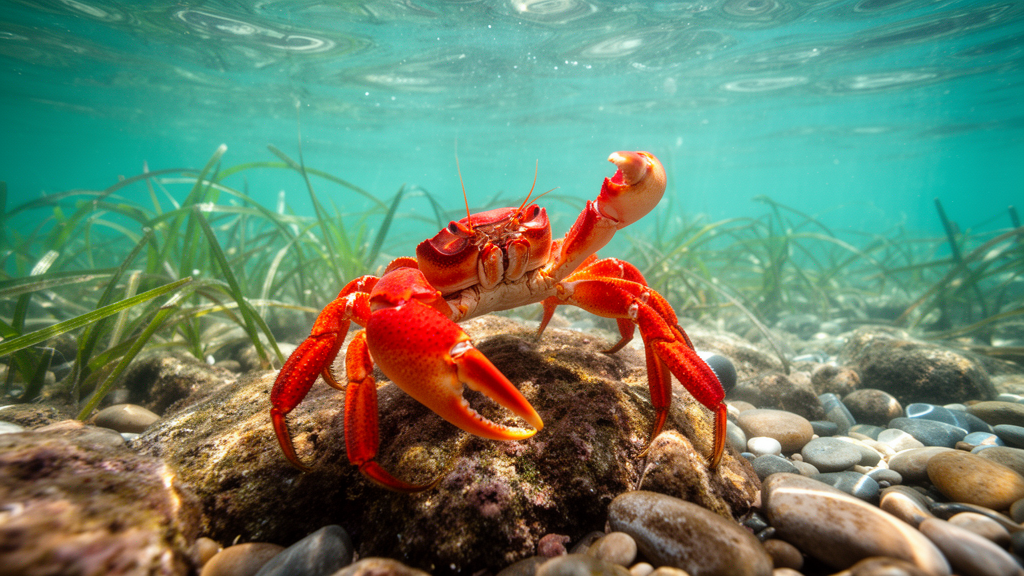
Eleven additional captures of the Lessepsian migrant crab Gonioinfradens giardi along the Ionian coast of Sicily between November 2025 and January 2026 provide early evidence that the species is establishing in the central Mediterranean. The observations were reported alongside the first published Italian record, bringing the documented total in the study area to 12 individuals over about two months.
This was an observational field report based on opportunistic captures obtained through collaboration with local fishers. It focused on the eastern Sicilian coast between Catania, at 37.54639°N, 15.17410°E, and Portopalo di Capo Passero, at 36.69326°N, 15.14161°E. The specimens came from artisanal trammel nets used to target the common cuttlefish, Sepia officinalis, rather than from a standardized survey designed to estimate population density or distribution.
Eleven specimens were obtained at Portopalo, Marzamemi, Siracusa, Avola and Catania. Recorded capture depths ranged from 8 to 18 metres, and captures occurred in rocky, sandy and mixed habitats. When the animals were not heavily damaged, the researchers documented the capture date, geographical coordinates, depth, fishing gear, sex and carapace width and length. Carapace dimensions were measured with a caliper accurate to within one millimetre.
The researchers identified the crabs using diagnostic characters described in earlier taxonomic work, including four prominent anterolateral teeth, cheliped morphology and colour pattern. Preserved voucher specimens were deposited in the zoological collection of the Ente Fauna Marina Mediterranea under the codes EFMM181225, EFMM231225 and EFMM090126. Among specimens whose dimensions were recorded, carapace width ranged from 36 millimetres in a female collected at Portopalo on 13 November 2025 to 59 millimetres in a male captured at Avola on 23 December.
Both sexes were represented in the captures, but no ovigerous females were found. The observations therefore document the presence of multiple individuals, including males and females, but do not establish that the species is reproducing locally. The repeated captures across nearby locations and within a short interval support the hypothesis of a local population at an early stage of establishment rather than a single isolated introduction, although establishment was not directly measured through systematic abundance or reproductive surveys.
The first confirmed record of G. giardi in Italian waters was documented in November 2025 at Portopalo di Capo Passero in southeastern Sicily. At the time, it was also the westernmost reported Mediterranean occurrence. The species is native to the Red Sea and Arabian Sea and reaches the Mediterranean through the Suez Canal. It was historically confused with Gonioinfradens paucidentatus before its taxonomic revalidation by Galil and colleagues in 2018. Since that revalidation, it has been reported from the Aegean, Ionian and Levantine basins.
The Sicilian records extend the documented range of G. giardi westward and strengthen the biogeographic significance of the first Italian report. The report places these observations within a broader pattern of non-indigenous species entering the Mediterranean amid climate warming, intensified maritime traffic and continued ingress through the Suez Canal. It also notes that portunid crabs have expanded rapidly within the sea, with several species becoming established, although the new observations do not demonstrate how G. giardi compares with those species in abundance or ecological impact.
The ecological consequences of this expansion remain uncertain. The report states that G. giardi may interact with native benthic communities, but it provides no specific data on the crab’s feeding ecology, trophic role or competitive behaviour toward native portunids. Any effects on benthic invertebrate populations or local food webs therefore remain hypothetical. The species is also smaller than portunids such as Callinectes sapidus and Portunus segnis, which are known to interfere with trammel-net fisheries; its direct or indirect effects on small-scale coastal fisheries are presently unknown and unquantified.
Collaboration with fishers allowed the researchers to detect the species at multiple sites, habitats and depths over a short period, while retained vouchers and recorded measurements documented the captures. The authors identify long-term monitoring, early impact assessment and the integration of fishers’ observations through citizen-science networks as priorities for the Ionian coast. Based on the repeated and geographically coherent captures, they consider further geographic spread and increasing local abundance probable in the near future, but these outcomes are predictions rather than measured results of the field report.
Subject of Research: Early evidence of establishment of the Lessepsian crab Gonioinfradens giardi along Sicily’s Ionian coast
Article Title: Rapid expansion of a Lessepsian migrant crab, Gonioinfradens giardi ( Crustacea , Brachyura , Portunidae ), in the Ionian Sea: New records and early evidence of establishment
Article References: Tiralongo, F., Leotta, P., Accolla, H., Tibullo, D., & Felici, A. (2026). Rapid expansion of a Lessepsian migrant crab, Gonioinfradens giardi (Crustacea, Brachyura, Portunidae), in the Ionian Sea: New records and early evidence of establishment. Acta Ichthyologica et Piscatoria, 56, 145-149. https://doi.org/10.3897/aiep.56.185183
Image Credits: AI Generated
Keywords: Gonioinfradens giardi, Lessepsian migrants, Sicily, Ionian Sea, Mediterranean Sea, non-indigenous species, crab establishment, citizen science, Suez Canal, marine biodiversity, Rapid, expansion
Cite Scienmag News
Patricia Pace. (October 20, 2026). Eleven G. giardi captures provide early evidence of establishment off Sicily. Scienmag. https://scienmag.com/eleven-g-giardi-captures-provide-early-evidence-of-establishment-off-sicily/
Patricia Pace. "Eleven G. giardi captures provide early evidence of establishment off Sicily." Scienmag, 20 October 2026, https://scienmag.com/eleven-g-giardi-captures-provide-early-evidence-of-establishment-off-sicily/. Accessed 20 October 2026.
Patricia Pace. "Eleven G. giardi captures provide early evidence of establishment off Sicily." Scienmag. October 20, 2026. https://scienmag.com/eleven-g-giardi-captures-provide-early-evidence-of-establishment-off-sicily/


