


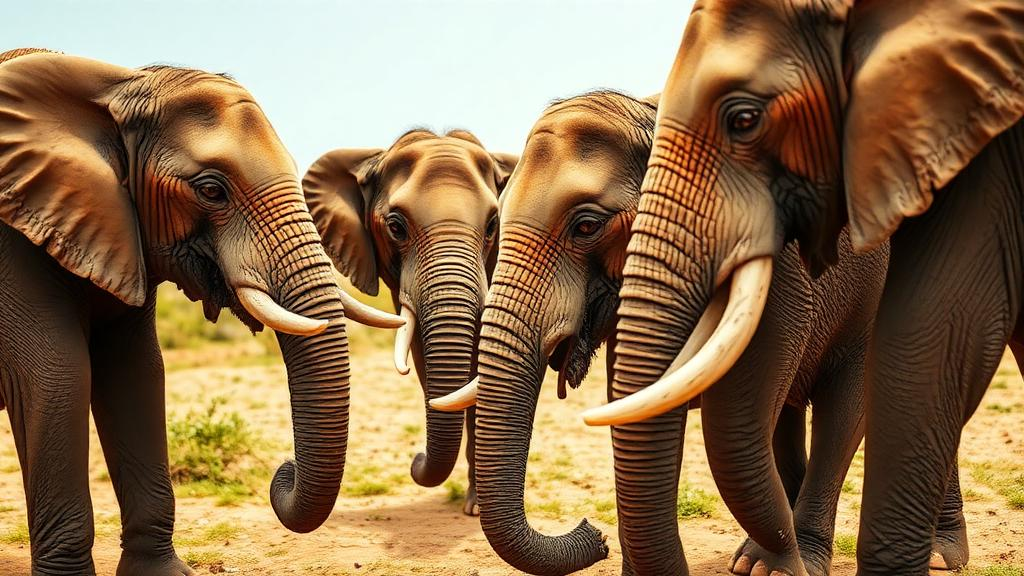
African elephants are among the most influential foragers on Earth. A single adult can consume well over a hundred kilograms of vegetation in a day, toppling trees, stripping bark, and reshaping entire landscapes in the process. Because of this outsized ecological footprint, scientists have long wanted to understand how these massive herbivores decide what to eat and where to go. A new study published in the journal Animal Cognition by Claire L. Peinke and Adrian M. Shrader of the University of Pretoria offers a surprisingly precise answer to one part of that question: elephants can use their eyes to judge how much food is available, but only within a remarkably short range.
The research team set out to fill a gap in what is known about elephant sensory ecology. Earlier work had shown that African elephants can use olfactory cues to assess food, and that they may also respond to leaf colour as an indicator of food quality when choosing between individual plants and patches. What remained unclear was whether elephants rely on visual information about food quantity, such as the size of a tree canopy or the density of its leaves, when making foraging decisions. Answering this required a carefully controlled experimental setup in which every cue except the one being tested could be eliminated.
Peinke and Shrader worked with four semi-tame adult African elephants at a South African facility, conducting a series of visual choice experiments designed to test foraging decisions at two very different spatial scales. Rather than presenting the animals with real vegetation, which would have introduced odours, textures, and nutritional signals that could confound the results, the researchers used abstract visual stimuli. Solid black circles were printed on canvases in two sizes, one metre and 0.7 metres in diameter, to represent differences in the apparent size of a food source, analogous to a larger or smaller tree canopy.
To simulate differences in leaf density, the team created a second set of stimuli: black and white circles printed on canvases that differed in the proportion of black shading, at 25 percent, 50 percent, and 100 percent. A canvas that was fully black would appear denser, much like a tree with thick foliage, while a sparsely shaded canvas would resemble a tree with thinner leaf cover. Before the actual experiments began, the elephants were trained to associate the larger circle and the greater densities with a reward, ensuring that each animal understood the task before any formal testing took place.
Once training was complete, the elephants faced paired choices between canvases that differed in size or in density. The critical variable was distance. The researchers tested the animals at a series of increasing distances: 5 metres, 10 metres, 20 metres, 40 metres, and finally 80 metres from the paired stimuli. This gradient allowed the team to pinpoint exactly how far away an elephant can still extract meaningful visual information about the quantity of food in front of it, a question that had never been experimentally resolved for this species.
The results were striking in their clarity. The elephants successfully discriminated between circles of different sizes and between canvases of different densities, but only up to a distance of 5 metres. Beyond that threshold, at 10, 20, 40, and 80 metres, their performance no longer indicated that they could reliably tell the more abundant option from the less abundant one. In other words, the visual world of a foraging elephant, at least with respect to judging food quantity, effectively ends at about five metres, roughly the length of two adult elephants standing nose to tail.
This five-metre boundary has important implications for how scientists interpret elephant foraging behaviour at different scales. Within a patch of vegetation, where individual trees and shrubs sit close together, an elephant moving through the area can visually assess the size of a canopy and the density of its leaves before committing to feed. At this fine scale, the study suggests, foraging decisions are likely shaped by a combination of visual and olfactory cues working together. An elephant might see that one bush is larger and denser while simultaneously smelling whether its leaves are palatable, integrating both channels of information to choose the best meal.
Between patches, however, the picture changes dramatically. When an elephant stands at one feeding site and contemplates travelling to another tens or hundreds of metres away, visual information about food quantity is simply unavailable. A distant tree canopy cannot be reliably judged by eye at those ranges, according to the experimental results. This means that long-distance foraging decisions, the choices that determine where elephants travel across a landscape and which areas they impact most heavily, must depend primarily on other senses, with smell being the leading candidate given previous findings on elephant olfactory abilities.
The ecological consequences of this sensory split could be substantial. African elephants are widely described as ecosystem engineers because their feeding behaviour transforms habitats, opening woodlands, dispersing seeds, and creating pathways used by other species. If visual assessment of food quantity operates only within patches, then the fine-grained pattern of which individual trees an elephant strips or pushes over may reflect a blend of sight and smell, while the broader pattern of landscape use reflects olfactory navigation over much longer distances. Understanding this division of sensory labour helps explain both the spatial and temporal dimensions of elephant impact on savanna ecosystems.
The study also demonstrates the value of abstract experimental stimuli in animal cognition research. By replacing real food with printed canvases, Peinke and Shrader isolated the visual variable with a precision that would be impossible in a natural setting, where smell, taste, and prior experience all compete for the animal’s attention. The work, which was funded by the National Research Foundation of South Africa and the Rory Hensman Conservation Research Unit and approved by the University of Pretoria’s Animal Ethics committee, adds a quantitative edge to a growing body of research on how large herbivores perceive their world. For an animal whose decisions can redraw the map of an entire ecosystem, knowing that its visual assessment of food quantity reaches only five metres is a small detail with large consequences.
Subject of Research: Visual assessment of food quantity in African elephant foraging decisions
Article Title: Do African elephants use visual cues of food quantity when making foraging decisions?
Article References: Peinke, C. L., & Shrader, A. M. (2026). Do African elephants use visual cues of food quantity when making foraging decisions?. Animal Cognition. https://doi.org/10.1007/s10071-026-02111-y
Image Credits: AI Generated
DOI: 10.1007/s10071-026-02111-y
Keywords: African elephants, Loxodonta africana, foraging decisions, animal cognition, visual cues, olfactory cues, leaf density, canopy size, choice experiments, herbivory, ecosystem engineers, sensory ecology
Cite Scienmag News
Gavin Prescott. (October 1, 2026). Elephants Judge Food by Sight Only Up Close, Study Finds. Scienmag. https://scienmag.com/elephants-judge-food-by-sight-only-up-close-study-finds/
Gavin Prescott. "Elephants Judge Food by Sight Only Up Close, Study Finds." Scienmag, 1 October 2026, https://scienmag.com/elephants-judge-food-by-sight-only-up-close-study-finds/. Accessed 4 October 2026.
Gavin Prescott. "Elephants Judge Food by Sight Only Up Close, Study Finds." Scienmag. October 1, 2026. https://scienmag.com/elephants-judge-food-by-sight-only-up-close-study-finds/


