


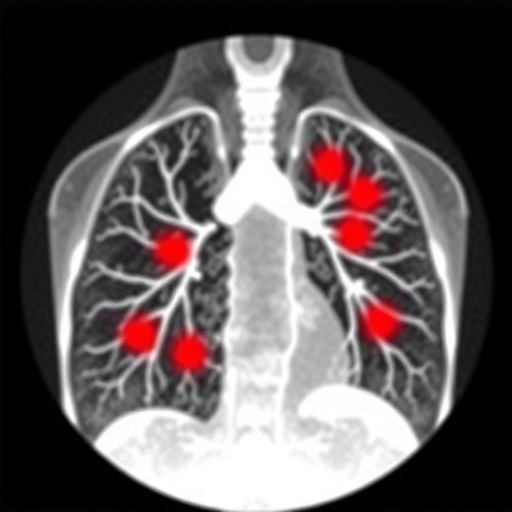
Lung cancer continues to hold its grim position as the foremost cause of cancer-related deaths worldwide, prompting relentless research into early detection and effective treatment strategies. One critical element in the management of lung cancer is the timely and accurate identification of pulmonary nodules, which often serve as the earliest indicators of malignancy. Advances in imaging technology, most notably the widespread adoption of low-dose spiral computed tomography (LDCT), have resulted in a marked increase in the detection rate of pulmonary nodules. Remarkably, these screenings frequently reveal small, multiple nodules within the same lung, creating complex challenges for clinicians tasked with localization prior to surgical intervention.
Traditionally, preoperative localization of pulmonary nodules has relied heavily on computed tomography-guided percutaneous lung puncture (CTPLP) methods, which include dye marking, radiotracer labeling, and implantation of hook wires or micro-coils, among other techniques. While these methods have been instrumental in improving surgical outcomes by enabling precise nodule targeting, they are not without significant drawbacks. Especially for patients harboring multiple nodules within a single lung, these approaches tend to markedly increase radiation exposure and elevate the risk of procedure-related complications such as pneumothorax, hemothorax, and pleural reactions. Consequently, the thoracic surgery community has been in pursuit of safer, more efficient alternatives that maintain diagnostic precision while minimizing patient risk.
In this context, electromagnetic navigation bronchoscopy-guided dye marking (ENBDM) has emerged as a promising minimally invasive technology that combines high localization accuracy with a superior safety profile. Unlike CTPLP, which involves percutaneous puncture, ENBDM utilizes a bronchoscopic approach navigated electromagnetically to guide dye marking within the bronchial tree directly adjacent to the nodules. This method reduces both radiation exposure and mechanical injury associated with needle puncture. Despite its appeal and growing use for singular nodules, until recently, there had been no comprehensive evaluations focusing on ENBDM’s efficacy in the localization of multiple ipsilateral pulmonary nodules.
A recent retrospective observational study sought to address this gap by comparing the performance of ENBDM against the traditional CTPLP approach among 203 patients undergoing preoperative localization before video-assisted thoracoscopic surgery (VATS). Of these patients, 99 underwent ENBDM, while 104 received CTPLP. Importantly, baseline characteristics were well matched, ensuring a fair comparison of procedural outcomes. The analysis revealed a striking difference in localization time: the ENBDM group required significantly less time—averaging just 8 minutes—compared to 22 minutes with CTPLP. This nearly threefold reduction in procedure duration was particularly notable as the number of nodules increased, underscoring ENBDM’s scalability and efficiency in the multi-nodule context.
Crucially, the localization accuracy of ENBDM closely paralleled that of the CTPLP method, with success rates of 94.9% and 97.4%, respectively. This finding refutes any notion that the less invasive ENBDM technique compromises the surgeon’s ability to accurately identify and resect malignant nodules. From a clinical safety perspective, the benefits of ENBDM were even more pronounced. None of the patients in the ENBDM group experienced complications, whereas the CTPLP group recorded significant incidences of pleural reactions (7.7%), pneumothorax (34.6%), and hemothorax (14.4%). These figures highlight the invasive nature of CTPLP and the tangible risk for patients, especially those requiring localization of multiple nodules.
The procedural context further amplifies the advantages of ENBDM. Unlike CTPLP, which necessitates patient transfer from the CT suite to the operating room post-localization, ENBDM can be fully conducted within an integrated operating suite equipped with electromagnetic navigation bronchoscopy. This integration obviates patient transport delays and the logistical complexities of coordinating interdepartmental scheduling, streamlining the preoperative timeline substantially. By consolidating localization and resection into a single procedural setting, ENBDM significantly improves patient throughput and overall hospital efficiency.
In practical terms, ENBDM’s less invasive nature stems from the electromagnetic navigation system, which leverages real-time three-dimensional mapping of the bronchial anatomy to guide the dye marker accurately to multiple nodule sites. This bronchoscopic route reduces trauma to lung parenchyma and pleura and diminishes inflammation and hemorrhagic risks. Its reliance on electromagnetic guidance also decreases the need for repeated imaging checks, thus minimizing cumulative radiation doses—a critical consideration in patient safety and long-term oncologic management.
The implications for the management of patients with multiple ipsilateral pulmonary nodules are particularly impactful. Such cases have historically presented a diagnostic and therapeutic challenge given the compounded risks using conventional percutaneous methods. ENBDM offers a revolutionary alternative that not only maintains precision but does so with improved procedural speed and nearly eliminated complication rates. This paradigm shift can enhance patient quality of life by reducing hospitalization time, mitigating procedural anxiety, and potentially lowering overall healthcare costs associated with managing complications.
Moreover, the technique aligns with the broader clinical movement toward minimally invasive diagnostic and therapeutic procedures. Advances in technology and imaging integration have set the stage for ENBDM to become a cornerstone in thoracic surgical practice. Its adaptability could extend to a range of pulmonary pathologies beyond cancer, including inflammatory and infectious nodules that require precise preoperative localization for diagnostic biopsy or targeted therapy.
Looking ahead, the findings underscore the need for prospective multicenter studies to validate these promising results further and to refine protocols for optimal ENBDM application. The integration of artificial intelligence and enhanced imaging modalities with electromagnetic navigation bronchoscopy also presents an exciting frontier, potentially augmenting localization precision and automated workflow management in the operating room. As these technologies evolve, patient-centered care models will continue to benefit from safer, faster, and more effective surgical interventions.
In summary, electromagnetic navigation bronchoscopy-guided dye marking represents a significant advancement in the preoperative localization of multiple pulmonary nodules in the ipsilateral lung. Its confluence of rapidity, safety, and accuracy addresses the critical limitations of traditional CT-guided puncture methods. For thoracic surgeons and oncologists seeking to optimize surgical outcomes while minimizing patient morbidity, ENBDM emerges as a compelling technique poised to reshape the standards of care in pulmonary nodule management.
News Publication Date: 27-Mar-2025
Web References: http://dx.doi.org/10.21037/tlcr-24-901
Cite Scienmag News
Nathaniel Bowman. (June 20, 2025). Electromagnetic Navigation Bronchoscopy: A Superior Method for Localizing Multiple Pulmonary Nodules. Scienmag. https://scienmag.com/electromagnetic-navigation-bronchoscopy-a-superior-method-for-localizing-multiple-pulmonary-nodules/
Nathaniel Bowman. "Electromagnetic Navigation Bronchoscopy: A Superior Method for Localizing Multiple Pulmonary Nodules." Scienmag, 20 June 2025, https://scienmag.com/electromagnetic-navigation-bronchoscopy-a-superior-method-for-localizing-multiple-pulmonary-nodules/. Accessed 7 September 2026.
Nathaniel Bowman. "Electromagnetic Navigation Bronchoscopy: A Superior Method for Localizing Multiple Pulmonary Nodules." Scienmag. June 20, 2025. https://scienmag.com/electromagnetic-navigation-bronchoscopy-a-superior-method-for-localizing-multiple-pulmonary-nodules/


