

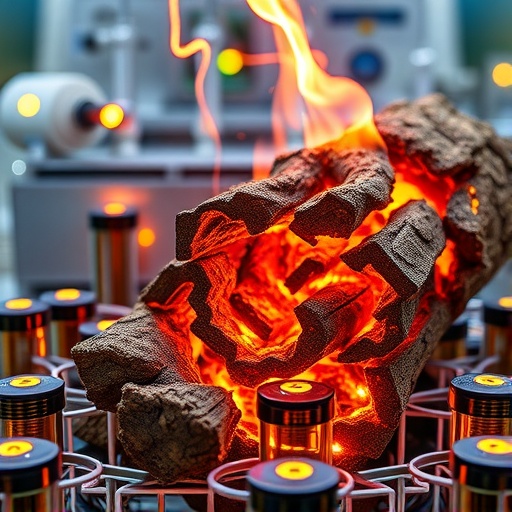
In a significant leap toward sustainable chemical production and carbon neutrality, researchers at Sungkyunkwan University and the Korea Institute of Science and Technology (KIST) have unveiled a highly efficient electrochemical process that converts lignin, a notoriously stubborn component of woody biomass, into valuable aromatic and cyclohexene-based compounds. This pioneering work addresses one of the bioindustry’s most challenging hurdles: breaking down lignin’s resilient ether bonds under mild conditions without relying on external hydrogen gas. The breakthrough, recently detailed in the prestigious journal Applied Catalysis B: Environment and Energy, points to a transformative biorefinery platform that harnesses renewable electricity for green chemical synthesis.
Lignin, as the most carbon-dense polymer in lignocellulosic biomass, holds immense promise for substituting fossil-based aromatic chemicals. Yet, its conversion into useful monomers and intermediates has long been stymied by its intricate three-dimensional polymer structure and robust carbon-oxygen (C–O) and carbon-carbon (C–C) bonding networks. Conventional approaches to cleaving dominant ether linkages such as the 4–O–5 and α–O–4 diaryl ethers typically demand harsh reaction environments involving elevated temperatures and high-pressure hydrogen atmospheres. These conditions not only elevate energy consumption drastically but also suffer from poor selectivity and limited monomer yields, undermining process efficiency and economic feasibility.
The novel methodology designed by the research team circumvents these limitations by leveraging an electroreductive conversion system founded on a 5 weight percent palladium on carbon (Pd/C) catalyst. This system ingeniously generates reactive atomic hydrogen species on the catalyst surface during water electrolysis, which then attack and cleave the challenging ether bonds within lignin fragments. The approach operates at relatively low temperatures—30 to 70 degrees Celsius—and importantly, it obviates the need for an external hydrogen source, relying entirely on electricity as the energy input. This capability affords precision control of surface-adsorbed hydrogen species through adjustments in applied current density, which directly dictates reaction rates and selectivity.
Extensive validation studies involved both carefully selected model compounds and authentic biomass-derived lignin solvolysates. Model substrates representing the 4–O–5 linkage, such as diphenyl ether (DPE) and phenyl tolyl ether (PTE), achieved complete conversion within 90 minutes at 70°C and 50 milliamps per square centimeter current density. Meanwhile, the α–O–4 model compound, benzyl phenyl ether (BPE), was fully converted at a considerably lower temperature of 30°C. The products formed displayed remarkable selectivity: DPE hydrogenation predominantly yielded cyclohexanol and cyclohexane with yields surpassing 85%, PTE afforded 4-methyl cyclohexanol and methyl cyclohexane at nearly quantitative conversion, and BPE furnished cyclohexanol, toluene, and methyl cyclohexane selectively. These results underscore the dual-functionality of the process: efficient ether bond scission followed by controlled hydrogenation of aromatic intermediates to upgraded cyclic molecules.
Optimization experiments further highlighted the critical role of solvent composition and electrochemical parameters. The introduction of isopropanol (IPA) as a co-solvent at a 30 wt% concentration enhanced the solubility of lignin derivatives and improved hydrogen atom transfer efficiency, culminating in a 100% conversion of DPE and a Faradaic efficiency peaking at 70.2%. However, increasing the current density beyond 50 mA cm⁻² triggered competitive hydrogen evolution reactions that detracted from target product yields, demonstrating that fine-tuned electrolysis conditions are vital for maximizing process efficiency.
Mechanistic insights into the catalyst’s performance revealed a fascinating bifunctional interplay intrinsic to the Pd/C system. Palladium oxide (PdO) species facilitate the crucial cleavage of C–O bonds, while metallic palladium (Pd⁰) sites mediate the subsequent hydrogenation of aromatic intermediates like phenol and benzene into cyclohexanol and cyclohexane derivatives. Empirical comparisons showed that catalysts consisting solely of Pd foil or PdO crystals resulted in significantly lower conversion efficiencies—19.3% and 57.4%, respectively—whereas the Pd/C composite exhibited outstanding catalytic activity with turnover frequencies (TOF) as high as 468.0 h⁻¹. Notably, Pd/C outperformed other noble and transition metal catalysts such as Pt/C, Ru/C, Ag/C, and Ni/C, affirming its superior selectivity and stability over multiple reaction cycles.
To verify practical applicability, the team extended their electrochemical depolymerization strategy to real-world woody biomass sourced from birch trees. Initial methanol-based solvolysis enabled delignification with a high yield of 81 wt%, but the monomer fraction extracted at this stage was modest, roughly 5.0 carbon percent, due to extensive lignin polymer integrity. Applying the Pd/C-catalyzed electroreduction in acidic media proved challenging owing to rapid repolymerization, which diminished monomer recovery. However, adjusting the electrolyte to a mild acetate buffer at pH approximately 5 dramatically increased phenolic monomer yields to 13.6 carbon percent after the first hour and ultimately 19.6 carbon percent by the fourth hour. Advanced two-dimensional gas chromatography coupled with time-of-flight mass spectrometry (GC×GC–TOF/MS) validated the presence of a suite of aromatic products, including 4-n-propanol syringol, 4-n-propyl syringol, and related guaiacol derivatives, underscoring the technology’s robustness in real biomass conversion contexts.
This groundbreaking research establishes a new green biorefinery paradigm that leverages electrically driven catalytic pathways to dismantle lignin’s resilient chemical architecture and craft high-value chemicals under ambient pressure and moderate temperatures. The elimination of external hydrogen sources, coupled with the remarkable catalytic efficiency and selectivity of Pd/C, positions this strategy as a compelling platform for sustainable chemical manufacturing, aligning with global imperatives to decarbonize industrial feedstocks. Beyond its environmental benefits, the approach’s scalability and integration with existing biomass processing routes could significantly advance the bioeconomy by supplying renewable aromatic building blocks and biofuel precursors.
The implications of this study resonate strongly in light of rising demands for eco-friendly alternatives to petrochemical-derived aromatics. By enabling precise electroreductive cleavage of lignin bonds and harnessing catalytic bifunctionality, the researchers have successfully navigated complexities that have long restricted lignin valorization. Their work opens pathways not only for producing chemicals traditionally sourced from crude oil but also for integrating large-scale lignin electroconversion within circular bio-refineries, thereby fostering a low-carbon sustainable chemical sector.
In summary, this cutting-edge electrochemical lignin upgrading process demonstrates that catalytic innovation paired with renewable energy inputs can revolutionize biomass utilization. As the scientific community intensifies exploration of electrification in chemical manufacturing, this study exemplifies how fundamental understanding of catalyst surface chemistry and reaction environment control can yield practical, scalable solutions. The future of lignin valorization hinges on such transformative technologies that reconcile efficiency, selectivity, and environmental sustainability—a vision this research team has realized with tremendous promise.
Subject of Research: Electrochemical conversion of lignin to aromatic and cyclohexene compounds using renewable electricity and Pd/C catalyst.
Article Title: Highly efficient electro-reductive conversion of lignin into aromatics and cyclohexenes
News Publication Date: February 2026
Web References: https://doi.org/10.1016/j.apcatb.2025.125851
References: Kim, J., Lee, D. K., Karanwal, N., Kim, S., Liyanage, Y., & Kim, J. (2026). Highly efficient electro-reductive conversion of lignin into aromatics and cyclohexenes. Applied Catalysis B: Environment and Energy, 381.
Image Credits: Neha Karanwal, Seoyeon Kim, Yasora Liyanage, Dong Ki Lee, Jaehoon Kim


