


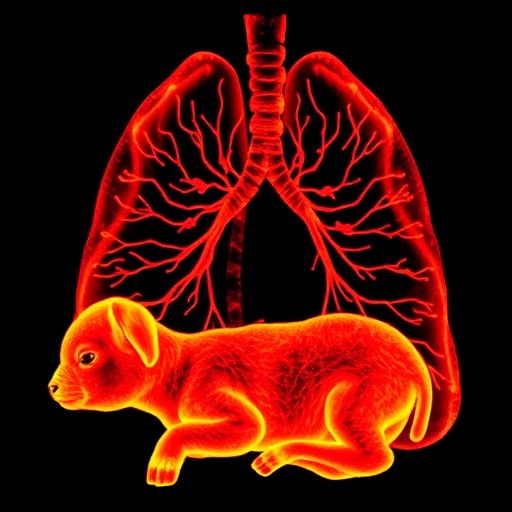
In a groundbreaking advancement poised to transform neonatal care, researchers have unveiled the potential of electrical impedance tomography (EIT) as a powerful tool for monitoring pulmonary circulation changes in newborns. The innovative study, conducted on lamb models, shines new light on how the delicate and complex pulmonary vascular system adapts immediately after birth, providing clinicians with a non-invasive window into neonatal respiratory physiology like never before.
Pulmonary circulation in neonates undergoes rapid and profound changes following delivery. The lungs transition from fluid-filled, non-functioning organs to air-filled structures capable of efficient gas exchange. This transition is orchestrated by a dramatic reduction in pulmonary vascular resistance and a concomitant increase in blood flow. Historically, assessing these changes has relied on invasive and often cumbersome methods, which are impractical for fragile infants. The advent of EIT technology in this domain suggests a leap forward in both safety and diagnostic precision.
Electrical impedance tomography operates by measuring variations in the electrical conductivity within the thorax as blood and air volumes change, generating real-time images of lung ventilation and perfusion. Unlike traditional imaging modalities that expose subjects to radiation or require sedation, EIT is portable, radiation-free, and allows continuous bedside monitoring. This feature is particularly vital for neonates, whose instability can preclude lengthy or repetitive testing.
The team, led by Koeppenkastrop and colleagues, embarked on a detailed experimental design involving lambs—organisms whose cardiopulmonary physiology closely resembles that of human infants. By inducing controlled changes in pulmonary circulation and simultaneously capturing EIT data, they were able to validate the technology’s sensitivity and reliability in detecting dynamic circulatory shifts. Their data not only correlate robustly with established hemodynamic parameters but also reveal nuanced spatial and temporal variations previously undetectable.
Crucially, EIT facilitated visualization of regional lung perfusion heterogeneity, an insight that has significant implications for understanding pathologies like persistent pulmonary hypertension of the newborn (PPHN). In such conditions, impaired vascular adaptation leads to inadequate oxygenation and can quickly escalate to life-threatening scenarios. Real-time EIT monitoring could, therefore, enable earlier diagnosis and tailored interventions, potentially reducing morbidity and mortality.
Furthermore, the study’s findings underscore EIT’s utility beyond mere diagnostic imaging. By capturing continuous physiological data, it can serve as a feedback mechanism during therapeutic procedures, including surfactant administration or mechanical ventilation adjustments. This approach aligns with the broader shift towards personalized neonatal care, where therapies are dynamically adapted based on ongoing monitoring rather than fixed protocols.
Technically, the researchers tackled the inherent challenges of EIT in neonatal models, such as optimizing electrode placement to ensure signal fidelity while minimizing discomfort and movement artifacts. The custom-designed electrode arrays conform to the contours of the lamb’s thorax, ensuring uniform current distribution and consistent impedance measurement. These technical refinements pave the way for translating this technology into clinical neonatal practice.
Another compelling advantage of EIT is its potential to unravel the mechanistic underpinnings of neonatal respiratory transition. Pulmonary circulation changes in neonates are influenced by complex interactions between vascular tone, ventilation, and cardiac output. By providing real-time, region-specific data, EIT offers researchers an unprecedented tool to dissect these relationships with temporal precision, which could catalyze new therapeutic targets or protocols.
The integration of this technology into neonatal intensive care units (NICUs) would represent a paradigm shift. Traditional monitoring methods, such as pulse oximetry and blood gas analysis, provide systemic but indirect snapshots of oxygenation and perfusion. EIT complements these by offering spatial resolution, highlighting discrepancies such as localized hypoperfusion or atelectasis that may necessitate focused interventions.
The implications of EIT also extend into training and clinical decision-making. The visual feedback provided can enhance clinicians’ understanding of complex lung dynamics and foster more informed choices in ventilator management, fluid therapy, and pharmacologic support. Such dynamic assessment tools are critical as neonates’ respiratory conditions often evolve rapidly, requiring continuous reassessment.
Importantly, the use of a lamb model reflects an astute choice grounded in translational relevance. The structural and functional properties of lamb cardiopulmonary systems closely mirror those of humans at birth, ensuring that the findings and technological optimizations gleaned here are readily adaptable to human neonates. This translational approach accelerates the pathway from bench to bedside.
While the current study concentrates on healthy pulmonary transitions, the technology opens exciting prospects for research into neonates with congenital anomalies, bronchopulmonary dysplasia, or cardiac defects. In these contexts, EIT’s ability to monitor therapeutic responses and disease progression non-invasively could be game-changing, enabling aggressive yet precise management paradigms.
Moreover, the portability and non-invasive nature of the device makes it ideal for use in diverse settings—from cutting-edge NICUs in urban centers to resource-limited clinics where radiologic facilities are scarce. This democratization of advanced pulmonary monitoring could extend benefits to underserved populations globally, addressing disparities in neonatal mortality and morbidity.
The research also underscores the broader trend of harnessing bioelectrical signals for diagnostic imaging, a field that is rapidly evolving thanks to advances in sensor technologies, signal processing algorithms, and computational modeling. As EIT devices become more sophisticated, integrating artificial intelligence to enhance image reconstruction and clinical interpretation seems an inevitable next step.
Ethical considerations centered on minimizing harm to neonates are paramount in neonatal research. The non-ionizing, gentle nature of EIT fulfills the imperative to “do no harm,” aligning with stringent standards for pediatric instrumentation. This ethical advantage complements the scientific promise, facilitating smoother regulatory approvals and clinical acceptance.
It is worth noting that despite the promise, clinical integration will demand rigorous multi-center trials to confirm reproducibility, safety, and clinical efficacy in human neonates across heterogeneous populations. The technology’s cost-effectiveness and learning curve will also influence its adoption trajectory. Nonetheless, the potential to improve outcomes through enhanced monitoring creates a compelling impetus.
In summary, Koeppenkastrop and colleagues have achieved a landmark demonstration of electrical impedance tomography as a versatile, real-time modality for measuring pulmonary circulation changes in neonatal models. Their pioneering work not only advances scientific understanding of neonatal respiratory physiology but also sets the stage for a new era in neonatal monitoring—one defined by real-time, bedside insights that could transform care for the most vulnerable patients in our healthcare systems.
The cascading effects of such innovations are profound: earlier detection of pulmonary dysfunction, refined therapeutic strategies, decreased reliance on invasive diagnostics, and ultimately, healthier beginnings for newborns worldwide. As the research community and clinicians embrace this powerful technology, the future of neonatal care promises to be monitored by the silent yet illuminating currents of electrical impedance, bringing clarity to the shadows of neonatal respiratory physiology.
Cite Scienmag News
Harold Sullivan. (April 23, 2026). Electrical Impedance Tomography Tracks Newborn Lamb Lung Circulation. Scienmag. https://scienmag.com/electrical-impedance-tomography-tracks-newborn-lamb-lung-circulation/
Harold Sullivan. "Electrical Impedance Tomography Tracks Newborn Lamb Lung Circulation." Scienmag, 23 April 2026, https://scienmag.com/electrical-impedance-tomography-tracks-newborn-lamb-lung-circulation/. Accessed 7 September 2026.
Harold Sullivan. "Electrical Impedance Tomography Tracks Newborn Lamb Lung Circulation." Scienmag. April 23, 2026. https://scienmag.com/electrical-impedance-tomography-tracks-newborn-lamb-lung-circulation/


