


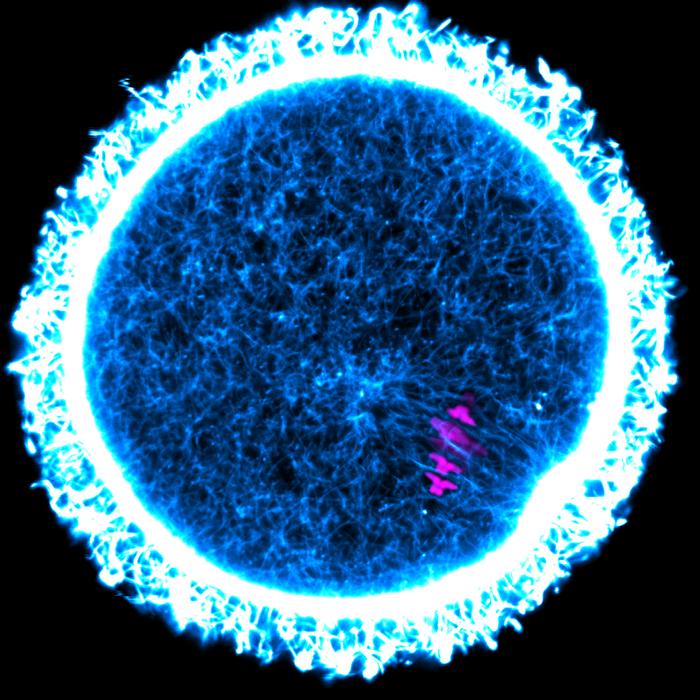
Female mammals – including humans – are born with all of their egg cells. Of a woman’s one to two million egg cells, about 400 mature before menopause and can be fertilized. Some egg cells therefore survive for several decades – and need to remain functional over this long time. Extremely long-lived proteins in the ovary seem to play an important role in this, as teams of researchers from Göttingen (Germany) have now discovered in experiments with mice. These long-lived proteins appear to help maintain fertility for as long as possible.

Credit: Melina Schuh / Max Planck Institute for Multidisciplinary Sciences
Female mammals – including humans – are born with all of their egg cells. Of a woman’s one to two million egg cells, about 400 mature before menopause and can be fertilized. Some egg cells therefore survive for several decades – and need to remain functional over this long time. Extremely long-lived proteins in the ovary seem to play an important role in this, as teams of researchers from Göttingen (Germany) have now discovered in experiments with mice. These long-lived proteins appear to help maintain fertility for as long as possible.
“Egg cells need to be preserved throughout a woman’s reproductive life so they can develop into healthy embryos,” explains Melina Schuh, Director at the Max Planck Institute (MPI) for Multidisciplinary Sciences. Even in mice, which can only reproduce for just over a year, the lifespan of egg cells is much longer than the average lifespan of proteins. Living cells recycle most of their proteins within just a few days. However, depending on the cell type and function, not all of the proteins are degraded at the same rate.
Many extremely long-lived proteins in ovaries
Together with teams led by group leaders Juliane Liepe and Henning Urlaub, Schuh’s team has now quantitatively investigated how frequently long-lived proteins occur in the ovaries. For their experiments, the researchers combined various biochemical and molecular methods with mathematical modeling. “This multidisciplinary approach allowed us to observe proteins in the ovaries and oocytes of mice at different stages in life to determine the age of the proteins,” says Max Planck research group leader Liepe. The scientists also analyzed how the proteins’ abundance changed over time by recording an ovary protein inventory of nearly 8,900 proteins.
The result: Ovaries contain an extremely high number of long-lived proteins – more than other tissues, and even more than the brain. These stable proteins are found not only in the eggs themselves but also in other somatic cells in the ovary.
“Many of the long-lived proteins have protective functions, such as repairing DNA or protecting cells from damage,” explains Urlaub, who is a group leader at the MPI and the University Medical Center Göttingen (UMG). These molecular folding helpers, known as chaperones, prevent misfolded proteins from aggregating and disrupting cellular processes. The experiments of the Göttingen scientists showed that the chaperones are extremely stable in the ovary and prevent aggregation for a longer time than in the brain, for example. Similarly, the egg cell’s powerhouses – the mitochondria – contained particularly stable proteins. Since mitochondria are passed on from mother to offspring, it is essential that these organelles stay healthy.
Fewer long-lived proteins with age
“However, the concentration of many long-lived proteins in the ovary and egg cells decreases with age. In contrast, proteins associated with acute inflammation or immune response increase over time,” Schuh reports. This is in line with previous findings that inflammatory reactions are more frequent in the ovaries of older women. “The complex ovarian protein network changes. The gradual disappearance of long-lived proteins from the ovaries and egg cells may explain why fertility declines in female mammals after a certain age.”
The study was funded by the Cluster of Excellence “Multiscale Bioimaging: From Molecular Machines to Networks of Excitable Cells” (MBExC), of which Melina Schuh and Henning Urlaub are members.
Journal
Nature Cell Biology
Method of Research
Experimental study
Article Title
The maintenance of oocytes in the mammalian ovary involves extreme protein longevity
Article Publication Date
20-Jun-2024
Cite Scienmag News
Drew Townsend. (July 9, 2024). Egg cell maintenance: Long-lived proteins may be essential. Scienmag. https://scienmag.com/egg-cell-maintenance-long-lived-proteins-may-be-essential/
Drew Townsend. "Egg cell maintenance: Long-lived proteins may be essential." Scienmag, 9 July 2024, https://scienmag.com/egg-cell-maintenance-long-lived-proteins-may-be-essential/. Accessed 4 September 2026.
Drew Townsend. "Egg cell maintenance: Long-lived proteins may be essential." Scienmag. July 9, 2024. https://scienmag.com/egg-cell-maintenance-long-lived-proteins-may-be-essential/

