


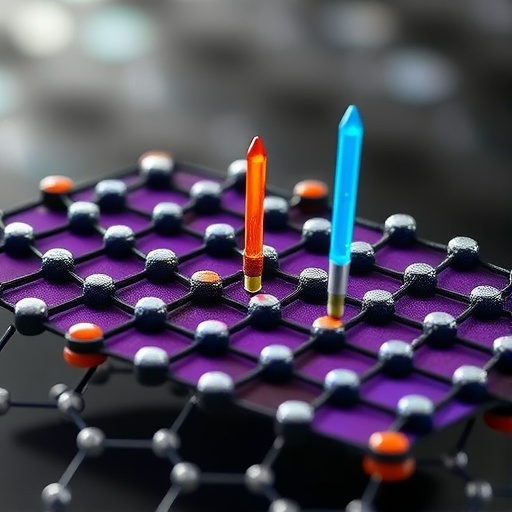
Researchers have recently embarked on a groundbreaking journey toward developing a highly efficient photocatalyst for hydrogen peroxide (H₂O₂) production. This quest is fueled by the pressing need for greener alternatives to traditional chemical manufacturing processes, especially given H₂O₂’s significance in various industries. The study harnesses the innovative capabilities of cobalt single-atom catalysts (Co SACs) combined with nanosheet materials, offering a fresh perspective on photocatalytic reactions.
The traditional methods of producing hydrogen peroxide, such as the anthraquinone oxidation process, have long dominated the industrial landscape. However, this approach is increasingly deemed unsustainable due to its complexity and energy-intensive nature. In anticipation of a move toward more environmentally-friendly alternatives, researchers now focus on utilizing artificial photosynthesis to synthesize H₂O₂ directly from water and oxygen, guided by renewable solar energy. This revolution could significantly reduce the ecological footprint of H₂O₂ production.
Central to this new approach is the two-electron oxygen reduction reaction (2e⁻ ORR), essential for generating H₂O₂. While considerable research has been dedicated to refining photocatalytic materials, many photocatalysts face inherent challenges such as rapid charge carrier recombination and limited active sites, leading to suboptimal yields. Thus, the urgent task at hand is to innovate materials that enhance photocatalytic efficiency to overcome these hurdles.
One of the promising candidates highlighted in recent research is the perylenetetracarboxylic acid (PTA) nanosheet. Despite its potential, PTA exhibits limitations due to poor charge separation and insufficient catalytic sites, thus hampering its effectiveness in large-scale H₂O₂ production. Researchers have turned to graphene-based materials, particularly reduced graphene oxide (rGO), to bridge the gap and enhance charge separation in photocatalytic systems. This two-dimensional material, known for its excellent electron transport properties, serves as an effective support and electron mediator, setting the stage for remarkable photocatalytic advancements.
To maximize photocatalytic performance, the introduction of single-atom catalysts (SACs) has emerged as a game-changing strategy. SACs provide highly dispersed active centers that optimize atomic utilization, fostering improved catalytic performance and reaction specificity. Metal phthalocyanine (MPc) has emerged as a particularly promising precursor for SACs, enabling the synthesis of materials exhibiting well-defined M-N₄ coordination structures that prevent metal aggregation during high-temperature processing—a vital factor in preserving catalytic activity.
In the recent study, researchers successfully synthesized a cobalt single-atom catalyst embedded on a phosphate-functionalized rGO support, designated as Co@rGO-P. This innovative structure was further integrated with PTA nanosheets through an in-situ growth method to create a highly efficient photocatalyst, Co@rGO-P/PTA. This heterojunction system represents a pivotal step in combining the superior electronic properties of rGO with the inherent capabilities of PTA, facilitating the target reaction under solar illumination.
Notably, the results exhibited exceptional photocatalytic activity for non-sacrificial H₂O₂ production in pure water conditions, showcasing the potential of this novel photocatalyst and its applicability in sustainable H₂O₂ production. The precision in the materials’ fabrication and their unique structural characteristics played a significant role in achieving these promising outcomes. The research holds the potential to pave the way for large-scale applications that could redefine industry standards regarding hydrogen peroxide synthesis.
As global concerns over environmental sustainability continue to mount, advancements in heterogeneous photocatalysis, as demonstrated in this investigation, offer a pathway to more sustainable practices in chemical synthesis. The promising results of Co@rGO-P/PTA could instigate further research into optimizing photocatalytic systems, leading to breakthroughs in efficient green chemistry methodologies.
In conclusion, the integration of cobalt single-atom catalysts with advanced nanosheet materials marks a significant milestone in photocatalytic research. As the scientific community continues to explore and refine these materials, we may soon witness a transformation in the landscape of H₂O₂ production, contributing to more sustainable and scalable chemical processes. The findings from this research will undoubtedly inspire further exploration into alternative photocatalytic approaches that can help meet the world’s growing demand for hydrogen peroxide in an eco-conscious manner.
The study’s publication in the prestigious Chinese Journal of Catalysis highlights its relevance and potential impact on addressing current challenges in the field of catalysis and sustainable chemistry. As the search for innovative solutions continues, the implications of this work resonate well beyond the laboratory, with the potential to influence real-world applications in a wide array of sectors from environmental remediation to pharmaceuticals.
Keywords
Applied sciences and engineering
Cite Scienmag News
Denise Maddox. (October 31, 2025). Efficient H2O2 Production Boosted by Cobalt-Enhanced Phosphate-Functionalized Reduced Graphene Oxide/Perylenetetracarboxylic Acid Nanosheet Heterojunctions. Scienmag. https://scienmag.com/efficient-h2o2-production-boosted-by-cobalt-enhanced-phosphate-functionalized-reduced-graphene-oxide-perylenetetracarboxylic-acid-nanosheet-heterojunctions/
Denise Maddox. "Efficient H2O2 Production Boosted by Cobalt-Enhanced Phosphate-Functionalized Reduced Graphene Oxide/Perylenetetracarboxylic Acid Nanosheet Heterojunctions." Scienmag, 31 October 2025, https://scienmag.com/efficient-h2o2-production-boosted-by-cobalt-enhanced-phosphate-functionalized-reduced-graphene-oxide-perylenetetracarboxylic-acid-nanosheet-heterojunctions/. Accessed 4 September 2026.
Denise Maddox. "Efficient H2O2 Production Boosted by Cobalt-Enhanced Phosphate-Functionalized Reduced Graphene Oxide/Perylenetetracarboxylic Acid Nanosheet Heterojunctions." Scienmag. October 31, 2025. https://scienmag.com/efficient-h2o2-production-boosted-by-cobalt-enhanced-phosphate-functionalized-reduced-graphene-oxide-perylenetetracarboxylic-acid-nanosheet-heterojunctions/


