


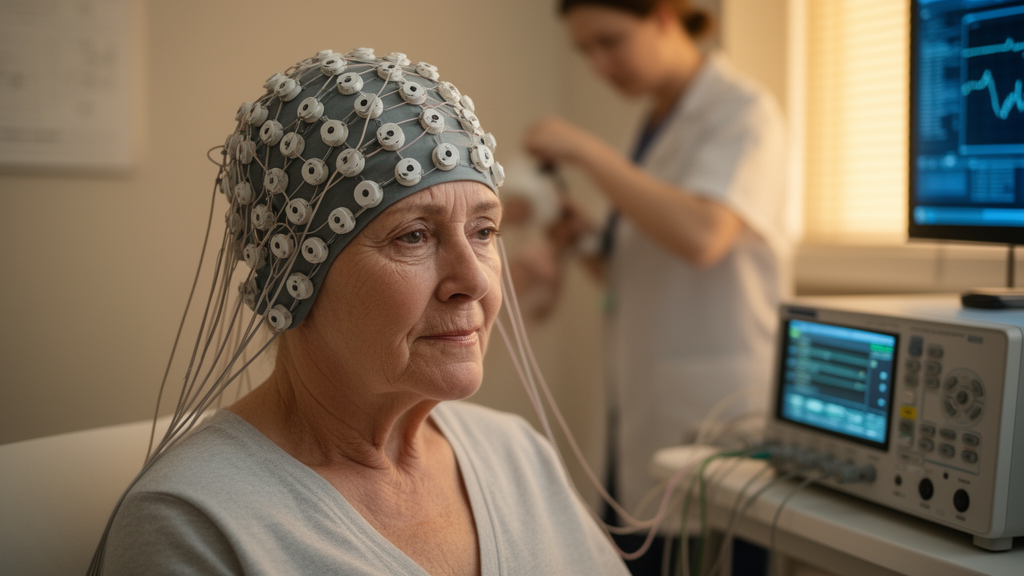
For decades, patients with cancer have described a frustrating fog of forgetfulness, slowed thinking, and trouble concentrating — a phenomenon popularly known as chemobrain. Scientists now have a clearer picture of how this fog has been measured, and the answer is messier than anyone hoped. A new scoping review published in Frontiers in Human Neuroscience has systematically mapped every study that used electroencephalography, or EEG, to investigate cognitive functioning in people with cancer, and the findings reveal a field that is growing rapidly but remains scattered, small, and surprisingly disconnected from the cognitive outcomes it claims to explain.
The review, led by Barbara Johanne Thomas Nordhjem and colleagues at Copenhagen University Hospital Rigshospitalet, followed PRISMA-ScR guidance and searched MEDLINE, PsycINFO, and Web of Science from database inception to February 2025. After screening 3,577 records, the team included 60 articles published between 1981 and 2025. Most were small and cross-sectional, with publication output increasing markedly after 2015. The registered protocol is available on PROSPERO under identifier CRD420251084951.
EEG records cortical electrophysiological activity with millisecond temporal resolution, offering a complementary approach to MRI-based neuroimaging. Although scalp EEG has less anatomical specificity than MRI, it can characterize the timing and coordination of neural activity at rest and during cognitive processing. The information obtained depends strongly on the recording condition, paradigm, and analytic approach. Task-based EEG typically yields event-related potentials, or ERPs — time-locked voltage responses to discrete stimuli — while resting-state recordings are analyzed using quantitative EEG, or qEEG, methods applied to spectral power, functional connectivity, and network organization.
Among the 60 included articles, 35 reported ERP measures only, 19 reported qEEG measures only, and 6 included both. Task-based paradigms were used in 47 articles, resting-state in 18, and sleep EEG in just one. Oddball and deviance paradigms, which present rare stimuli among frequent ones to elicit the P300 component, and attention or executive control tasks were the most frequently used. The P300 component is commonly interpreted in relation to attentional-resource allocation and context updating, whereas P300 latency provides an index of stimulus-evaluation speed.
In populations with cancers outside the central nervous system, longer P300 latency and lower amplitude were the most recurrent findings, reported across childhood cancer, breast cancer, radiotherapy, and acute treatment studies. However, opposite and null findings also occurred. Some studies reported stable P300 measures, shorter latencies, or no group differences at all. Differences in stimulus modality, target probability, electrode selection, peak definition, age, and treatment timing further limit cross-study comparison, making it difficult to interpret longer P300 latency as a reliable cognitive marker of cancer-related cognitive impairment.
The evidence from primary CNS and other intracranial tumor populations was sparse, with only 9 articles addressing these groups. All 9 included fewer than 50 cancer participants. In these studies, EEG findings were more often examined in relation to tumor-related neurological factors, including focal or diffuse slowing, altered phase synchrony, and differences in network organization. Two reports from one glioma cohort found that greater theta activity and theta-band network organization were related to poorer language performance, offering the clearest preliminary candidate for a reproducible EEG-cognition relationship in this population.
Quantitative EEG findings showed limited convergence across articles. Spectral power was the most frequently reported analysis family in 19 articles, connectivity or phase-based measures in 5, and aperiodic 1/f measures in just 1. In one longitudinal breast cancer cohort, aperiodic slopes became flatter from before to after treatment in patients relative to controls, which the authors interpreted as increased neural noise. Flatter slopes were also associated with poorer executive control and alerting performance. This aperiodic finding is a specific candidate, but it has not been independently replicated.
A central finding of the review is the gap between detecting an EEG abnormality and validating an EEG marker of cognition. Overall, only 21 of 60 articles reported at least one direct EEG-outcome association that met the statistical significance threshold used in the original article. Many articles instead reported task-related EEG modulation, group differences, or parallel longitudinal changes without testing whether individual differences in EEG measures were associated with cognitive outcomes. Associations involving standardized cognitive tests administered independently of the EEG task were less common.
Cancer populations were also unevenly represented. Breast cancer was the most frequently studied diagnosis, accounting for 21 of the 60 articles. Hematologic malignancies and primary CNS tumors followed with 8 articles each. Only 9 articles included children or adolescents, and 5 of these included mixed pediatric and adult samples. Geographically, 29 articles were conducted in Europe, 22 in North America, and 9 in Asia, with no eligible articles exclusively from other world regions.
The authors conclude that EEG provides a complementary approach to investigating cognition in people with cancer, but the evidence remains methodologically heterogeneous. Larger longitudinal studies, more consistent cognitive outcome selection, and closer integration of neural and cognitive measures are needed to establish reproducible findings. The potential of EEG for risk stratification and prediction remains largely unexplored, and the current evidence is insufficient to support biomarker or clinical applications. The findings should be viewed as hypothesis-generating rather than as evidence for established EEG markers of cancer-related cognitive impairment.
Subject of Research: Functional brain activity in cancer-related cognitive impairment: a scoping review of EEG studies
Article Title: Functional brain activity in cancer-related cognitive impairment: a scoping review of EEG studies
Article References: Nordhjem, B. J. T., Rothschild, L. M. T., Honoré, C. R., Larsen, A. T. S., Fridh, M. K., & Hjalgrim, L. L. (2026). Functional brain activity in cancer-related cognitive impairment: a scoping review of EEG studies. Frontiers in Human Neuroscience, 20, Article 1851560. https://doi.org/10.3389/fnhum.2026.1851560
Image Credits: AI Generated
DOI: 10.3389/fnhum.2026.1851560
Keywords: Functional, brain, activity, cancer-related, cognitive, impairment, scoping, review, studies, scientific research
Cite Scienmag News
Nathaniel Bowman. (October 15, 2026). EEG Reveals Scattered Brain Signals in Chemobrain, New Review Finds. Scienmag. https://scienmag.com/eeg-reveals-scattered-brain-signals-in-chemobrain-new-review-finds/
Nathaniel Bowman. "EEG Reveals Scattered Brain Signals in Chemobrain, New Review Finds." Scienmag, 15 October 2026, https://scienmag.com/eeg-reveals-scattered-brain-signals-in-chemobrain-new-review-finds/. Accessed 15 October 2026.
Nathaniel Bowman. "EEG Reveals Scattered Brain Signals in Chemobrain, New Review Finds." Scienmag. October 15, 2026. https://scienmag.com/eeg-reveals-scattered-brain-signals-in-chemobrain-new-review-finds/


